Chapter 22
Jesus Again Foretells His Death and Resurrection
Verse 1: Leaving that place, Jesus and his disciples went on their way through Galilee. He did not want anyone to know it, | Mark 9:30
2 for he was teaching his disciples, telling them all, “The Son of Man is to be betrayed into the religious leaders hands, and they will kill him for breaking their laws, and three days after being killed, you will see me again.” | Mark 9:31
3 But they did not understand his meaning and were afraid to question him further. | Mark 9:32
Jesus and the Temple Tax
4 When they had arrived in Capernaum, the collectors of the temple tax approached Peter and asked, “Does your teacher not pay the tax to the temple?” | Matthew 17:24
5 Peter said, “Yes, of course.” And when he came home, Jesus anticipated him, asking, “What do you think, Simon? From whom do earthly kings take tolls or taxes? From their owns sons or from foreigners?” | Matthew 17:25
6 Peter said to him, “From foreigners,” and Jesus replied, “Then the children are free. | Matthew 17:26
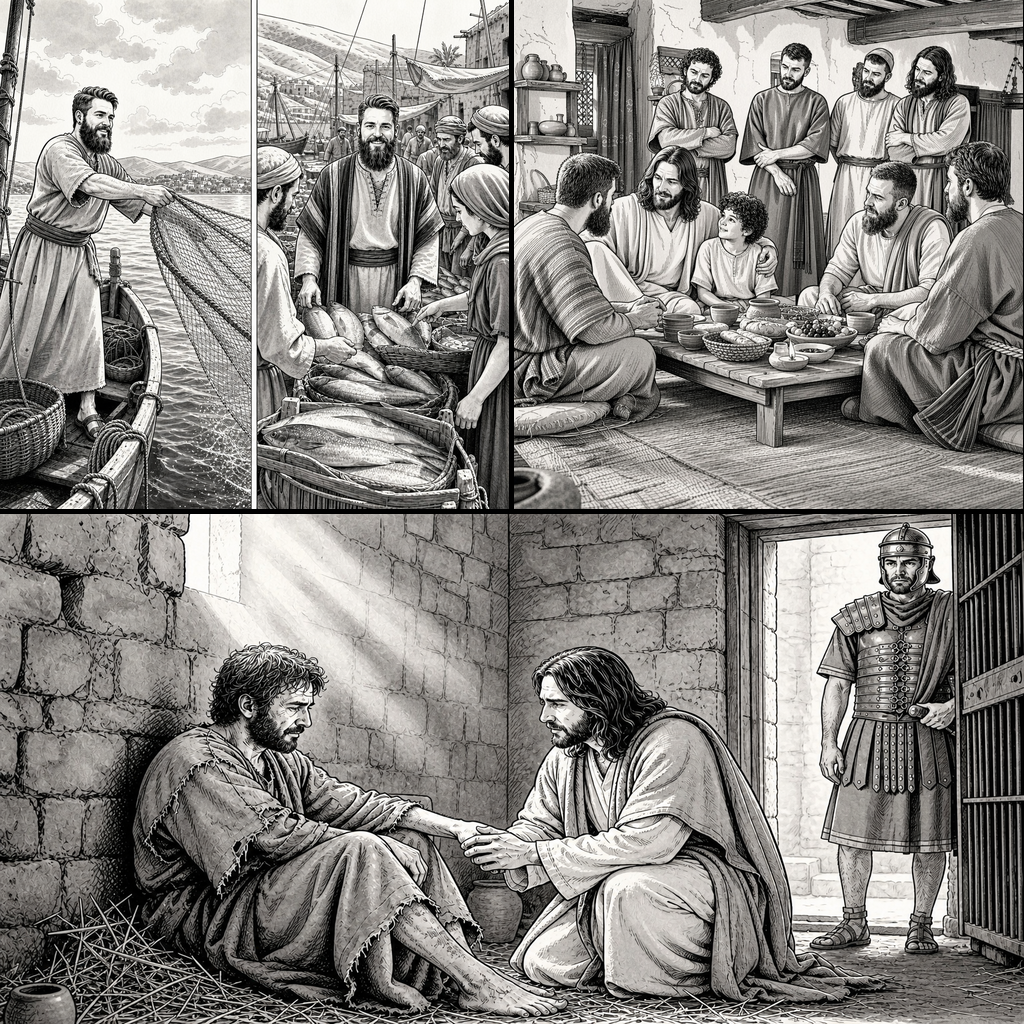
7 But in order that we do not give offense to them, go to the sea and cast a net; on your first cast you will catch exactly what's needed; sell them at the marketplace and give the proceeds to them for you and me.” | Matthew 17:27
True Greatness
8 Soon after they entered a house. As everyone settled, Jesus approached the table he asked them, “What were you all arguing about on the way?” | Mark 9:33
9 But they were silent and embarrassed, for on the way they had argued with each other on the way about who was the greatest. | Mark 9:34
10 One of the disciples questioned, “Who is the greatest in the kingdom of heaven?” | Matthew 18:1
11 Jesus sat down and said to them, “If anyone wants to be the first must be last of all and servant of all. | Mark 9:35
12 A man old in days will not hesitate to ask a small child seven days old about the place of life, and he will live. For many who are first will become last, and they will become one and the same.” | Gospel of Thomas 4
13 Then he took a young child and had them standing amongst them, and taking the child into his arms he said to them, | Mark 9:36
14 “Truly I tell you,” He said, “unless you change and become like little children, you will not enter the kingdom of heaven. | Matthew 18:3
15 Look at this child; no teacher has burdened them, no law has claimed them. That is who stands greatest in my Father's kingdom. Can any of you say the same? | Matthew 18:4
16 And anyone who, in my name welcomes such child is welcoming me and the one who sent me, | Mark 9:37
17 and if anyone gives even a cup of cold water to one of these little ones, becomes my disciple and in truth I say to you, they will not lose their reward.” | Matthew 10:42
The Prisoner of Capernaum
18 After Jesus had left the house, he walked instead toward the edge of town, where the road ran close to the wall of the garrison. In the distance two guards stood at their posts.
19 Jesus stopped at a squat stone building near the wall. A single guard stood there, his spear resting against the stone.
20 “Teacher,” Thomas whispered, “This is a place for the discarded. There is no glory here.” Jesus said quietly, “There is a man inside who believes the world has ended.”
21 Andrew shook his head. “The Romans keep only those with no names here. Debtors with no kin, thieves with no advocates. If he had anyone to speak for him, he would be out by now.” Jesus looked at Andrew intently, “Then we shall speak for him.”
22 The guard, recognizing Jesus from the stories whispered in the barracks, filled with awe, asked for no word or coin. He simply unbolted the door and stepped aside for Jesus.
23 The air inside was thick with the smell of old straw and unwashed skin. A single shaft of light, no wider than a finger, pierced the gloom from a slit high in the masonry.
24 In the corner sat a man. He was little more than a shadow wrapped in a tattered tunic. His hands were folded in his lap, broken and motionless. He did not look up when the light from the open door spilled across the floor. To him, a turning key only meant a handful gruel or a lashing.
25 Jesus entered and sat on the dirt floor directly across from him. He did not speak at first. He simply sat in the man’s space, breathing the same heavy air.
26 “What is your name?” Jesus asked softly. The man looked up and his voice was a dry rattle. “I have no name here. Now I'm simply a debt that cannot be paid.” and he looked away.
27 “No, you are a son of my Father.” Jesus said, “And you are starving.”
28 The man recalled painfully, “I took some grain from a merchant’s storehouse. A handful. Enough for one night.” He paused. “I had no land. No brothers. No wife. I'm not of any importance.” He looked at Jesus then, a flicker of confusion in his eyes. “Why are you here?”
29 “I am here because my Father sent me”, Jesus replied. The man let out a short, dry laugh that turned into a cough. “I have no money to give you for your prayers, Rabbi. There is no one to pay the merchant's price. I was even thrown out of the synagogue. When I die, they will cast me into a nameless grave, and the world will be better for it.”
30 Jesus was silent. He looked at the man for a long time, the way a person looks at someone they have known for years.
31 Jesus looked at the man's wrists, they were raw from the ropes that had long since been removed but had left their mark. He reached out and touched the man's hand. “Believe that you are not alone. The darkness is passing”, he continued, “The one who holds the ledger has seen a greater mercy than a measure of grain.”
32 The man’s hand trembled under Jesus's touch. For the first time in a year, he felt the warmth of another human being. He didn't speak, but nodded as some relief left his body, tears flowing down his face.
33 Jesus stood and looked at the guard, who had been watching from the threshold. “You have shared your meals with him,” Jesus said. It wasn't a question.
34 The soldier flushed, looking away. “It was only half of what I had.” Jesus said, “To the one who has nothing, half is a king's banquet.”
35 When Jesus turned and emerged back out into the sunlight, a small group of the Centurion’s guard was approaching. At their head was the same officer who had been sent to tell Jesus he need not trouble himself to come to his master's house.
36 He came to a halt before Jesus and bowed his head; not as a subject to a king, but as a man who recognized a superior commander.
37 “Teacher,” the officer said, his voice carrying across the yard. “My master, the Centurion, sends word. He has been told of your visit here.”
38 The disciples gathered close, anxious. The officer continued, “The Centurion says that since his own house was restored by a word he did not deserve, he cannot in good conscience hold the debts of his neighbor. He has paid the merchant’s price and has settled the prisoner’s account with the governor.”
39 The officer turned to the guard at the door. “Bring him out. He is a free man.”
40 A few minutes later, the prisoner emerged. He stood blinking in the light, shielding his eyes with a shaking hand as he stood straight and whole. He looked at the vast, open world. He remembered the market, the lake, the people and he looked terrified. He had no home to go to, no coins in his belt, and no one to welcome him.
41 He looked at Jesus, his voice a whisper. “Where do I go? I have no one.”, Jesus walked over and placed a hand on his shoulder, turning him toward the disciples and the small crowd of followers. “You have people now,” Jesus said, “Come and be filled.”
42 The man who had been forgotten followed. He wept openly as he followed them, but he did not walk alone, for one of the women who ministered Jesus was with him.
43 Jesus then turned to the disciples and said, “You have asked who is greatest. In truth I say to you, whoever sits in the dirt with the forgotten, sits with me. Whoever walks past the cell, walks past me.”