Unless You Become Like a Child: What the Sayings Say, What the Church Made of Them, and What Else Is on the Table
The passages in question
Three passages are usually read together as a single teaching:
- Matthew 18:2–4 — Jesus places a child in the middle of the disciples and says that unless they turn and become like children, they will not enter the kingdom of heaven, and that whoever humbles himself like this child is the greatest in the kingdom.
- Mark 10:13–16 / Matthew 19:13–14 — People bring children to Jesus to be blessed. The disciples turn them away. Jesus tells the disciples to let the children come, “for the kingdom of God belongs to such as these,” and adds that whoever does not receive the kingdom of God like a child will not enter it.
Two further passages are less commonly read alongside these, but are central to the argument below:
- Matthew 21:31 — Jesus tells the chief priests and elders that tax collectors and prostitutes are entering the kingdom of God ahead of them.
- Matthew 23:13 — Jesus tells the scribes and Pharisees that they shut the kingdom of heaven in people’s faces, neither entering themselves nor allowing others to enter.
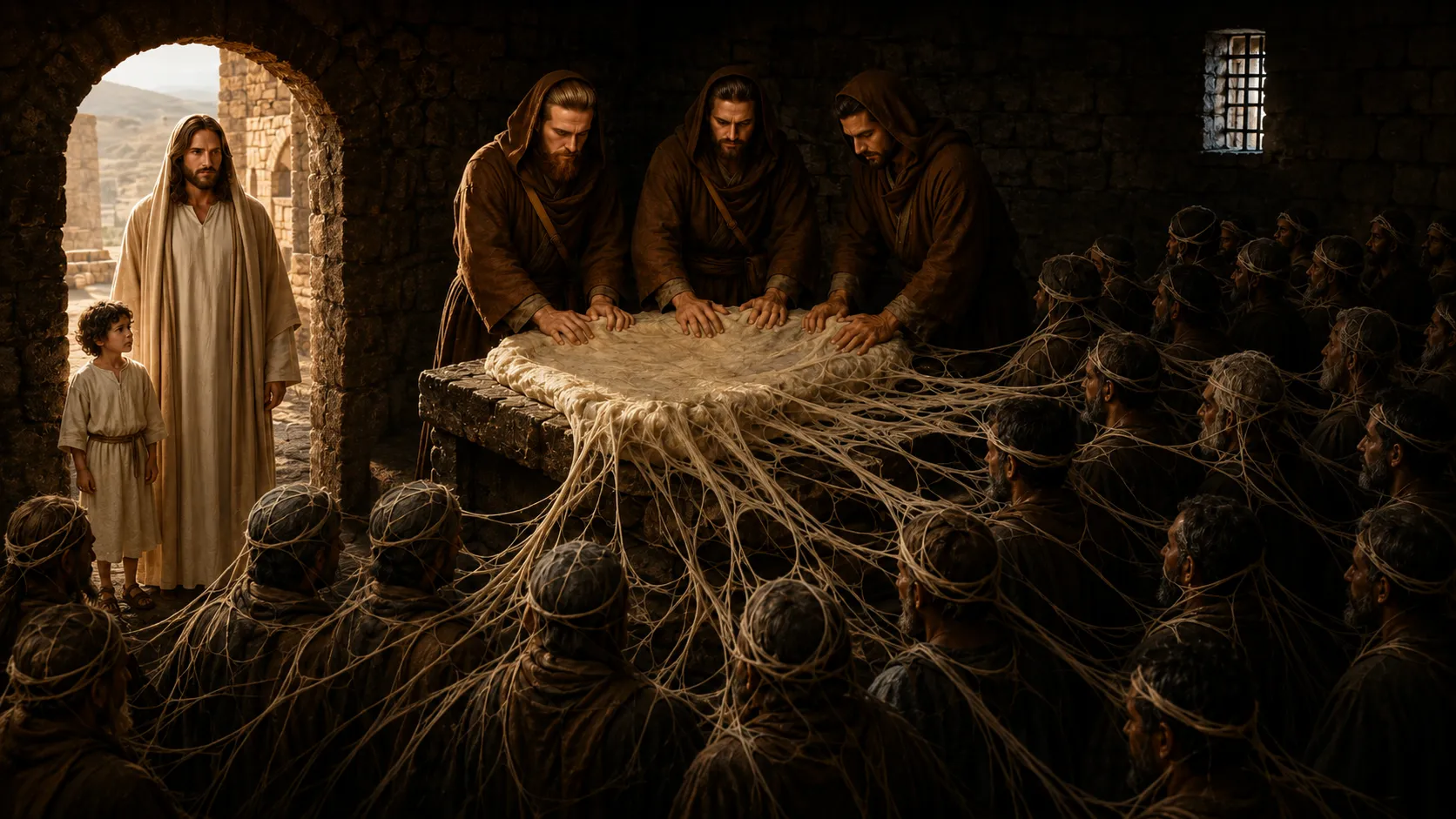
- Matthew 16:6 — Jesus warns the disciples, “Watch out and beware of the leaven of the Pharisees and Sadducees.”
The standard church reading treats the child sayings as being about personal disposition — humility, trust, innocence. The argument below asks whether that reading survives contact with (a) what a “child” actually was, socially and legally, in this setting, and (b) the rest of what Jesus says about who is and isn’t getting into the kingdom.
What the church has traditionally said
Across most of Christian history, these sayings have been read as being about the inner qualities of a child, applied metaphorically to adult disciples. The recurring themes are:
- Innocence. A child is read as morally uncomplicated, not yet capable of the calculated sin adults are capable of — so becoming “like a child” means recovering a lost innocence.
- Humility and lack of status. In the ancient household, a child had no social rank, no legal standing, no claim to honor. Jesus placing a child in the disciples’ midst — right after they had been arguing about who was greatest — is read as a rebuke of status-seeking: the child models having no status to seek.
- Trust and dependence. A child depends entirely on a parent for provision and protection. Read this way, “become like a child” means adopting total dependence on God, without the adult’s illusion of self-sufficiency.
This is the reading found in most catechesis, most Sunday sermons on these texts, and most popular devotional material: children are held up as instinctively trusting, humble, and unspoiled, and the disciple is told to become that way again.
Lifetime totals — baseline assumptions
Life expectancy (birth)
~35 yrsDragged down by ~50% infant mortality. Survive to age 10 → expect ~45 yrs total.
Adult religious life
~32 yrsBar mitzvah at 13 → avg death ~45. This is the active obligation window.
Sabbath visits (lifetime)
~1,66052 Sabbaths/yr × 32 yrs of adult life
Temple pilgrimages
~963 required per year × 32 yrs (for those close enough to make the trip)
Daily prayers
~35,0003 prayers/day × 365 × 32 yrs
Religious days per year
~80–9052 Sabbaths + major holidays + fast days + new moons
Lifecycle ritual timeline
Birth Home
Born into a covenant community. ~50% infant mortality rate. Mother considered ritually impure for 7–40 days (Lev. 12). Community prayers offered.
Brit Milah — Circumcision Home/community
The covenant of Abraham (Gen. 17:12). Performed publicly on the 8th day regardless of Sabbath. The boy receives his Hebrew name. Family celebration follows. This single event binds him into the Jewish covenant before he can speak or choose.
Pidyon HaBen — Redemption of the firstborn Temple/priest
If firstborn male, the father “redeems” him from the priest (kohein) with 5 silver shekels (Num. 18:16). Ceremony held on day 31. Connects the child to the Temple system from the first month of life.
Torah education begins Synagogue/home
The Mishnah (Avot 5:21) specifies age 5 for scripture study. In 1st century Judea this meant attending the bet sefer (house of the book), typically attached to the synagogue. He begins learning Hebrew, Torah portions, and oral law. This is the beginning of ~8 years of intensive religious schooling.
Bar Mitzvah — “Son of the commandment” Synagogue
At 13 he becomes legally responsible for all 613 commandments (mitzvot). He is called to read Torah publicly for the first time. He may now count toward a minyan (prayer quorum of 10). He is now obligated to fast on Yom Kippur, don tefillin, and attend all three annual Temple pilgrimages. The full weight of the covenant falls on him this day. This is also ~37% of the average life expectancy at birth — he becomes religiously adult before most of his life’s major chapters have begun.
Marriage Synagogue/community
The Mishnah (Avot 5:21) specifies age 18 as proper for marriage. The ketubah (marriage contract) is a legal document read under a chuppah (canopy). Seven blessings are recited over wine. Marriage creates new religious obligations: he must provide his wife with food, clothing, and conjugal rights — all defined by law. His household becomes a new liturgical unit (Shabbat table, Passover seder, mezuzah, etc.).
Annual Temple pilgrimages — Shalosh Regalim Jerusalem Temple
Torah commands ALL males to appear at the Temple 3 times per year: Passover (Pesach), Feast of Weeks (Shavuot), and Feast of Booths (Sukkot). This is a commandment, not optional. The journey from rural Galilee to Jerusalem was ~4–6 days on foot each way. Each pilgrimage = ~2 weeks of his year. Total across 32 adult years: ~96 pilgrimages, ~192 weeks (~3.7 years) of travel and Temple attendance.
Shabbat — The Sabbath Synagogue + Home
From Friday sundown to Saturday nightfall, all work ceases. Torah is read in synagogue. Prayers are said. The family gathers for festive meals. Shabbat is the single most recurring religious event in his life: 52 times per year, ~1,660 times across his adult life. It structures every single week. The synagogue Torah reading on Sabbath (plus Monday and Thursday) means he hears the entire Torah read aloud in a ~3-year cycle, repeatedly throughout his life.
Three daily prayers + Shema Home/synagogue
Shacharit (morning), Mincha (afternoon), Ma’ariv (evening) — timed to correspond with the two daily Temple sacrifices. The Shema (“Hear O Israel”) is recited morning and evening. These prayers were not yet fully standardized in the 1st century but were practiced widely. Total across adult life: ~35,040 prayer sessions. Additionally, blessings (brachot) are said over food, upon waking, after bodily functions, before studying — dozens per day.
Death and burial Home/tomb
Burial within 24 hours. Body washed and wrapped in linen, anointed with spices (myrrh and aloes). Buried in a rock-hewn tomb in 1st century Judea. Shiva (7 days of mourning) is observed by the family, during which prayers are held in the home. Kaddish (mourner’s prayer) is recited daily. The community gathers — the synagogue is once again central even in death.
How that reading took shape
The innocence-and-trust reading didn’t arrive all at once; it built up in layers, and each layer left the text a little further from its first-century setting.
Patristic and medieval use tended to fold the child sayings into broader arguments the church was already having — about human nature, about status among clergy, about the virtue of humility as a check on ambition. The child became a stand-in for a virtue the writer was already trying to teach, rather than a category the writer was trying to explain.
The Reformation and post-Reformation traditions carried this forward as moral instruction: the passages became proof texts for humility and childlike faith in catechisms and hymns, detached from any question of what a child’s actual social or legal position was in first-century Judea.
The nineteenth and twentieth centuries added something new: a culturally specific, sentimental idea of childhood as a state of purity, before “the world” corrupts a person. This is a modern Western idea about childhood, not an ancient Judean one — antiquity had no illusions that children were morally pure; infant and child mortality were extremely high, children worked, and childhood was not treated as a protected, innocent phase of life the way post-Romantic Western culture treats it. That modern sentiment about childhood got read back into the text, and the “innocent child” reading has been standard ever since — reinforced by Sunday-school art, greeting-card theology, and centuries of repetition, rather than by anything in the Greek text itself.
Annual religious calendar — major observances
Passover (Pesach)
Temple pilgrimage7 days. No leavened bread. Family seder retells Exodus. ALL males required at Temple. Spring.
Shavuot
Temple pilgrimage1 day. Giving of Torah at Sinai. First fruits brought to Temple. No work. 50 days after Passover.
Rosh Hashanah
Synagogue2 days. Jewish New Year. Shofar blown. Day of judgment. No work. Intense synagogue liturgy.
Yom Kippur
Synagogue + fast1 day. Holiest day. Total fast (25 hrs). Atonement. No work. Synagogue all day. Temple sacrifices of High Priest performed in this era.
Sukkot
Temple pilgrimage7–8 days. Harvest festival. Dwelling in booths (sukkah). Lulav + etrog waved. Temple pilgrimage. No work on first/last day.
Purim
Community1 day. Book of Esther read aloud. Gifts of food exchanged. Charity given. Festive. Minor holiday but publicly observed.
Hanukkah
Home/Temple8 days. Menorah lighting. Commemorates Temple rededication after Maccabean revolt. Work permitted. More celebrated in this era than later.
Tisha B’Av
Fast day1 day fast. Mourning destruction of First Temple. In this era the Second Temple still stands, but the day is still observed as a fast of mourning.
New Moons (Rosh Chodesh)
Synagogue12× per year. Beginning of each lunar month. Special prayers (Hallel). Additional Temple sacrifice. Semi-festive.
How much of his adult year was religiously structured?
Bars scaled relative to a 365-day year. Pilgrimage figure assumes ~6 days travel each way from rural Galilee.
The problem with the innocence reading
The reading depends on treating “child” as a synonym for “morally innocent.” That premise doesn’t hold up well even on its own terms.
Children are capable of serious, deliberate violence, including killing — well-documented cases exist across different countries and eras of children as young as ten carrying out killings, some of them premeditated and prolonged. Whatever else is true of childhood, “incapable of real wrongdoing” isn’t a safe descriptive claim about children as a class, in the first century or now. If Jesus’s point were simply “children are morally pure, be morally pure like them,” it rests on a claim about children that isn’t actually true and that nobody in the ancient world — where child mortality was brutal and children were not sentimentalized — would have needed to be told.
That doesn’t mean the passages are meaningless. It means the quality Jesus is pointing to probably isn’t innate moral purity. It’s something else about the social and legal position of a child specifically in that setting — something that has nothing to do with a child’s character and everything to do with what a child had, or hadn’t, yet been made into.
An alternative reading: the child as someone outside the system
In first-century Judea, a child was not yet a full participant in the religious-legal system that governed adult Jewish male life — the system of formal obligation, purity law, and instruction under the scribes and Pharisees that structured roughly a quarter to a third of every year and touched nearly every daily act. A young child had not yet been trained in that system’s categories, had not yet been placed under its full weight of obligation, and had no stake in its hierarchies of status. He hadn’t yet been made into a Pharisee, a scribe, or an observant adult male answerable to that system’s rules about purity, table-fellowship, and legal correctness.
Read this way, “become like a child” is not “become innocent.” It’s closer to: become someone who has not been formed by, and does not carry the assumptions of, the religious-legal system I am criticizing. The child is a live example, standing in the room, of someone who has not yet been shaped by the very structure the Pharisees represent — not because he’s morally pure, but because he simply hasn’t been through the formation process yet.
This reading gets support from three other things Jesus says, right around the same material.
How central was religion to his life? — the empirical verdict
~24–28% of every year was formally structured by religious obligation — Sabbaths, holidays, fasts, and pilgrimages alone account for 88–110 days annually where specific behaviours were commanded.
100% of every day touched religious practice: morning prayer upon waking, blessings before and after eating, tefillin worn during morning prayer, mezuzah touched at every doorway, dietary laws (kashrut) governing every meal, ritual hand-washing, Shema recited at bedtime.
Every major life event — birth, naming, puberty, marriage, death — was structured by and conducted within a religious framework, most involving the synagogue or Temple.
The Temple was the gravitational centre. In this era (before its destruction in 70 CE), it was not merely a place of prayer — it was where atonement happened (Yom Kippur High Priest ritual), where firstborn sons were redeemed, where firstfruits and tithes were delivered, and where three times a year every Jewish man was commanded to physically appear. Distance mattered enormously: a man living in Jerusalem or nearby Judea may have visited the Temple dozens of additional times per year voluntarily. A man in Galilee faced a 4–6 day journey each way.
The synagogue was the weekly anchor. Torah was read every Sabbath, Monday, and Thursday. Disputes were adjudicated there. Community was organized there. It was the school, the courthouse, and the prayer hall in one building.
Days/year formally obligated
~90–110Sabbaths + holidays + fast days + pilgrimage travel
% of year under direct religious law
~25–30%And the remaining 70% still governed by kashrut, prayer, and daily blessings
Lifetime Sabbath gatherings
1,660From bar mitzvah to avg death at ~45
Lifetime Temple visits (commanded)
~963/yr × 32 adult years. Voluntary visits additional.
Major lifecycle rituals
6–8Birth, circumcision, pidyon haben, bar mitzvah, marriage, death + mourning cycle
Daily blessings (brachot)
~100+Covering waking, meals, Torah study, bodily functions, seeing lightning, etc.
Sources and caveats: Life expectancy drawn from archaeological and demographic studies of Roman Palestine (est. 30–35 yrs at birth; ~45 yrs for those surviving to age 10). Pilgrimage obligations from Deuteronomy 16:16 and Mishnah, Synagogue attendance frequency from Acts 15:21 and Josephus. Rituals and structures from Talmudic sources and 1st-century Jewish practice. Pilgrimage travel times estimated from Galilee → Jerusalem (~130 km; 4–6 day walk). Not all Jews in 1st century Judea were equally observant — Pharisees, Sadducees, and common people differed in practice. Figures represent an observant, non-Diaspora Jewish male in the land of Israel before the Temple’s destruction in 70 CE.
Matthew 16:6
Ὁρᾶτε καὶ προσέχετε ἀπὸ τῆς ζύμης τῶν Φαρισαίων καὶ Σαδδουκαίων. “Watch out and beware of the leaven of the Pharisees and Sadducees.”
Explanation of the text:
Zymē (ζύμη) is leaven or yeast — not the bread itself, but the agent that works through dough and changes its whole character. Prosechete (“beware,” προσέχετε) literally means “hold your mind toward” or “pay close attention to” — it’s a warning to actively monitor an influence, not simply to avoid a single act. A few verses later in the same chapter, Jesus clarifies for the disciples that by “leaven” he means the Pharisees’ and Sadducees’ didachē (διδαχή) — their teaching. Put together: Jesus warns the disciples about “the leaven of the Pharisees and Sadducees.” Leaven works by spreading through and transforming what it’s added to. The warning isn’t about a specific sin; it’s about a formation process — the Pharisees’ teaching and system permeate and shape a person over time. Someone who hasn’t been leavened by it yet — a child — hasn’t been shaped by it at all.
Matthew 21:31
Ἀμὴν λέγω ὑμῖν ὅτι οἱ τελῶναι καὶ αἱ πόρναι προάγουσιν ὑμᾶς εἰς τὴν βασιλείαν τοῦ θεοῦ. “Truly I say to you, the tax collectors and the prostitutes are going into the kingdom of God ahead of you.”
Explanation of the text:
Jesus tells the chief priests and elders that tax collectors and prostitutes are entering the kingdom of God ahead of them. Proagousin means “go before” or “lead the way” — Jesus isn’t saying these people will eventually be let in; he’s saying they are already ahead, already moving into the kingdom, while the religious leadership he’s addressing is not. These are people the system had already formally excluded or marginalized — people the Pharisaic system had rejected, rather than people who had never been inside it. The common thread with the child saying isn’t virtue; it’s standing outside the system’s approval structure.
Matthew 23:13
Οὐαὶ δὲ ὑμῖν, γραμματεῖς καὶ Φαρισαῖοι ὑποκριταί, ὅτι κλείετε τὴν βασιλείαν τῶν οὐρανῶν ἔμπροσθεν τῶν ἀνθρώπων· ὑμεῖς γὰρ οὐκ εἰσέρχεσθε, οὐδὲ τοὺς εἰσερχομένους ἀφίετε εἰσελθεῖν. “Woe to you, scribes and Pharisees, hypocrites, because you shut the kingdom of heaven in people’s faces; you yourselves do not enter, nor do you allow those entering to go in.”
Explanation of the text:
Jesus tells the scribes and Pharisees directly that they “shut the kingdom of heaven” in people’s faces — neither entering themselves nor letting others in. Kleiete (“you shut”) is active and ongoing — this is something the scribes and Pharisees are doing continuously, not a one-time failure. This is Jesus naming the system itself, and the people running it, as the actual obstacle to entry. If the system is the obstacle, then the person least shaped by the system — the child — is, structurally, the person with the fewest obstacles in the way.
Matthew 18:3
Ἀμὴν λέγω ὑμῖν, ἐὰν μὴ στραφῆτε καὶ γένησθε ὡς τὰ παιδία, οὐ μὴ εἰσέλθητε εἰς τὴν βασιλείαν τῶν οὐρανῶν. “Truly I say to you, unless you turn and become as little children, you will not enter the kingdom of heaven.”
Explanation of the text:
Paidia (παιδία) here is the ordinary word for young children — a paidion is a small child, up to roughly the age at which formal instruction begins, well before any adult legal or religious status is in view. The verb strephō (“turn”) implies a reversal of direction, not a return to a lost purity — a turning away from the path the disciples are currently on, which the surrounding text identifies as arguing over who is greatest.
Matthew 18:4
ὅστις οὖν ταπεινώσει ἑαυτὸν ὡς τὸ παιδίον τοῦτο, οὗτός ἐστιν ὁ μείζων ἐν τῇ βασιλείᾳ τῶν οὐρανῶν. “Whoever humbles himself like this child is the greatest in the kingdom of heaven.”
Explanation of the text:
Tapeinoō (“humble”) is a status word, not a purity word — it’s about rank, not sin. The contrast Jesus draws is with people jockeying for rank, and the child is chosen precisely because a child had no rank to claim in that society.
Mark 10:14–15 (parallel: Matthew 19:14)
Ἄφετε τὰ παιδία ἔρχεσθαι πρός με, μὴ κωλύετε αὐτά, τῶν γὰρ τοιούτων ἐστὶν ἡ βασιλεία τοῦ θεοῦ. Ἀμὴν λέγω ὑμῖν, ὃς ἂν μὴ δέξηται τὴν βασιλείαν τοῦ θεοῦ ὡς παιδίον, οὐ μὴ εἰσέλθῃ εἰς αὐτήν. “Let the little children come to me; do not hinder them, for the kingdom of God belongs to such as these. Truly I say to you, whoever does not receive the kingdom of God like a child will not enter it.”
Explanation of the text:
The disciples are the ones hindering the children — enforcing, in miniature, exactly the kind of gatekeeping Jesus accuses the Pharisees of doing to grown adults in Matthew 23:13. “Such as these” (tōn toioutōn) points to a category — people like the children in front of them — not a comment on the children’s souls.
What this adds up to
Taken together, these passages are not obviously a lesson about the moral purity of children. They read more consistently as a claim about who the system serves and who it excludes: the scribes and Pharisees, custodians of the system, are locking people out of the kingdom (23:13) and infecting their own students with a formation process Jesus tells his disciples to actively resist (16:6). Meanwhile the people getting in ahead of the religious establishment are the ones outside its structures of approval — the socially and legally excluded (21:31) and, in the child sayings, the not-yet-formed (18:2–4, Mark 10:14–15). The common denominator across all four passages isn’t innocence. It’s distance from the system Jesus is criticizing.
This is one reading among several live options in the history of interpretation of these texts, not the settled consensus — the traditional humility/trust/innocence reading remains the majority position in the church, and a reasonable case for it can still be made on other grounds (the immediate narrative context of the disciples’ status argument, for instance, fits both readings). What can be said is that the innocence reading rests on an assumption about childhood — inherent moral purity — that is neither obviously true nor obviously what “child” meant to a first-century audience, and that reading these four passages side by side surfaces a coherent alternative that the innocence reading tends to leave unexamined.