"Fulfilled" Does Not Mean "Finished": Why the Covenant and the Law Still Stand
I. Introduction
Christian theology has, for two thousand years, rested a great deal of weight on a single English word: fulfilled. Jesus, it is said, “fulfilled” the Law and the Prophets. Therefore — the argument goes — the sacrificial system is closed, the covenant of Sinai is superseded, and a “new covenant” belongs now to the Church rather than to Israel. This article takes the Jewish position against that claim. It argues, from the Hebrew text on its own terms, that fulfillment was never framed as termination, that the doctrine of “fulfillment-as-abrogation” is a later theological construction rather than something the Tanakh itself anticipates, and that the very job description of the Messiah — reuniting Israel and restoring the Temple — is undermined, not accomplished, by setting the covenant and the Law aside.
II. How Christians Arrive at “Fulfilled = Obsolete”
The Starting Text: Matthew 5:17
Greek: Μὴ νομίσητε ὅτι ἦλθον καταλῦσαι τὸν νόμον ἢ τοὺς προφήτας· οὐκ ἦλθον καταλῦσαι ἀλλὰ πληρῶσαι. English: “Do not think that I have come to abolish the Law or the Prophets; I have not come to abolish them but to fulfill them.” (Matthew 5:17)
The key verb is plēroō (πληρόω) — “to fill up, to bring to full measure.” On its face, this verse is actually a denial that Jesus ends the Law (“I have not come to abolish”). The abrogation doctrine is not a plain reading of this verse in isolation; it is built by combining it with other texts and with later theological argument.
Paul’s Contribution
Paul supplies the theological engine, primarily in two places:
- Romans 10:4 — Greek: “τέλος γὰρ νόμου Χριστὸς εἰς δικαιοσύνην παντὶ τῷ πιστεύοντι.” English: “For Christ is the telos (end/goal) of the law for righteousness to everyone who believes.” Telos is deliberately ambiguous between “termination” and “destination” — Christian readings lean on “termination.”
- Galatians 3:24-25 — the law as a paidagōgos (a slave who escorted children to school), no longer needed “now that faith has come.”
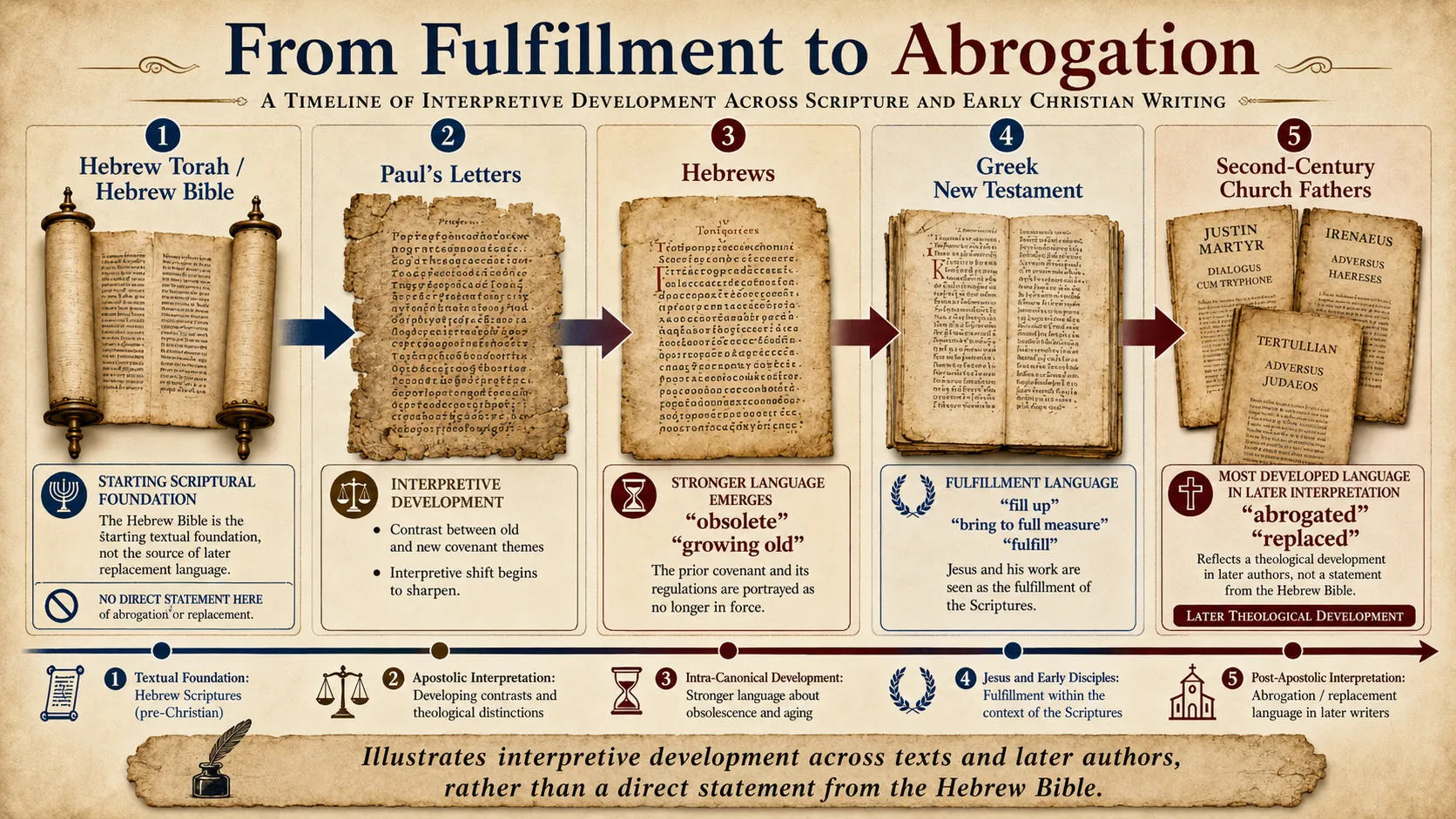
- Hebrews 8:13 — quoting Jeremiah 31 and adding an editorial gloss: “In speaking of a new covenant, he makes the first one obsolete (πεπαλαίωκεν). And what is becoming obsolete and growing old is ready to vanish away.”
Note: this last verse is the closest anything in the New Testament comes to actually stating “the covenant is ending” — and it is a Christian commentary layered onto Jeremiah, not Jeremiah’s own words.
The Church Fathers Formalize It
Paul’s ambiguity hardens into explicit doctrine within the next century:
- Justin Martyr, Dialogue with Trypho, Chapter 11 (c. 155–160 CE), titled outright “The Law Abrogated”: “For the law promulgated on Horeb is now old, and belongs to yourselves alone; but this [new covenant] is for all universally. Now, law placed against law has abrogated that which is before it, and a covenant which comes after in like manner has put an end to the previous one.” This is the first fully explicit statement of supersession: not “fulfilled in the sense of filled up,” but abrogated — actively cancelled and replaced.
- Irenaeus of Lyons, Against Heresies IV.16 (c. 180 CE), argues the “old” covenant (circumcision, Sabbath, sacrifice) was a temporary pedagogical measure, given “on account of their hardness of heart,” and rendered unnecessary once the “new covenant” arrived.
- Origen and later Augustine extend the same logic through allegorical exegesis: the sacrificial law is read as a type whose antitype is Christ, meaning the type (the actual command) is discarded once the antitype appears.
Key points — the Christian buttressing logic
- Plēroō (“fulfill”) in Matthew 5:17 is read alongside Paul’s telos (Romans 10:4) to shift “fill up” toward “bring to an end.”
- Hebrews 8:13 is the load-bearing verse for outright obsolescence — but it is a Christian interpretive gloss on Jeremiah, not Jeremiah’s own language.
- Justin Martyr (c. 155–160 CE) is the first to state supersession as explicit doctrine, using the word “abrogated,” not merely “fulfilled.”
- The sacrificial/ritual law is reclassified as a “type” or “pointer” pointing to Christ, a category applied after the conclusion (Jesus is the referent) is already assumed — which is the circularity a Jewish reader is entitled to name.
- The moral law (do not murder, do not steal) is, notably, not claimed to be abrogated even by these same Fathers — showing that even the Christian tradition itself does not treat “fulfilled” as a uniform synonym for “cancelled.”
III. How the Tanakh Rejects This
The Hebrew Vocabulary for “Fulfilled” Never Touches Covenant or Law
The Hebrew word that becomes “fulfilled” in English translation is a form of מָלֵא (male’ — “to fill”). Where it is used for something reaching completion, it is applied only to bounded, finite spans of time — never to covenant (brit) or law (torah):
- Genesis 25:24 — וַיִּמְלְאוּ יָמֶיהָ לָלֶדֶת (vayimle’u yameha laledet) — “her days to give birth were fulfilled.” A pregnancy ends.
- Genesis 29:27-28 — Jacob’s seven years of labor are “fulfilled” (male’). A term of service, not a covenant.
- Leviticus 12:4, 12:6 — וּבִמְלֹאת יְמֵי טָהֳרָהּ — “when the days of her purification are fulfilled.” A finite ritual period.
There is no verse anywhere in the Tanakh that says the covenant will be fulfilled or the law will be fulfilled using this vocabulary. The word is reserved, without exception, for things that were always understood to have a terminus — a pregnancy, a period of years, a purification cycle. Covenant and law are never framed this way.
What the Tanakh Actually Says About Covenant and Law: Enduring, Not Expiring
- Exodus 31:16 — בְּרִית עוֹלָם (brit olam) — “an everlasting covenant.” Applied to Sabbath.
- Leviticus 16:34 — חֻקַּת עוֹלָם (chukat olam) — “a statute forever.” Applied to Yom Kippur — the sacrificial, ritual law itself, self-described in its own text as eternal.
- Psalm 119:89 — לְעוֹלָם ה’ דְּבָרְךָ נִצָּב בַּשָּׁמָיִם — “Forever, O LORD, Your word stands firm in the heavens.”
- Isaiah 40:8 — וּדְבַר־אֱלֹקֵינוּ יָקוּם לְעוֹלָם — “The grass withers, the flower fades, but the word of our God stands forever.”
- Malachi 3:6 — כִּי אֲנִי ה’ לֹא שָׁנִיתִי — “For I, the LORD, do not change” — given as the very reason Israel still exists.
- Deuteronomy 29:28 — the revealed things belong “to us and to our children forever, that we may do all the words of this Torah.”
Key points — why the Tanakh’s own language forecloses obsolescence
- Olam (“forever/everlasting”) is the term the Torah applies to itself — repeatedly, deliberately, and specifically to ritual/sacrificial law, not only moral law (Leviticus 16:34 on Yom Kippur is the clearest case).
- The Hebrew word that later gets translated “fulfilled” (male’) is never used of covenant or law in the entire Tanakh — its only domain is bounded time periods.
- Malachi 3:6 makes God’s unchanging nature the explicit basis for Israel’s continued existence — a covenant contingent on that unchanging nature cannot logically be framed as temporary.
- Jeremiah 31:31-34, the one text that anticipates something “new,” names the parties explicitly — בֵּית יִשְׂרָאֵל וְאֶת־בֵּית יְהוּדָה (“the house of Israel and the house of Judah”) — the same parties as Sinai, and describes a change in internalization (“I will put My Torah in their inward parts, and write it in their hearts” — 31:33), not a change in content. The Torah itself remains; only where it’s inscribed changes.
- Nowhere does the Tanakh describe the Law or Covenant as provisional, as a “type,” as a placeholder, or as something awaiting a terminus.
IV. Why Jesus Does Not Fit the Messianic Role
Sidestepping the larger debate about resurrection, divinity, or messianic prophecy generally, the sharpest and simplest failure is structural: the Messiah’s job, per Jewish expectation, is to restore Israel to Torah and the Temple — not to retire either.
The Classical Job Description
Maimonides’ formulation (Mishneh Torah, Hilchot Melachim 11:4) is the clearest statement of the standard view: the Messiah will restore the kingdom of David, rebuild the Temple, gather the exiles of Israel, and — critically — all the laws will be reinstated in his days as they were before: sacrifices offered, sabbatical and jubilee years observed, the whole Torah fulfilled. Malachi 4:4 gives the same instruction as the final word of the prophetic corpus: זִכְרוּ תּוֹרַת מֹשֶׁה עַבְדִּי — “Remember the Torah of Moses My servant… the statutes and judgments.” That is the last thing the prophets say before the eschaton — not “the Torah of Moses will end,” but “remember it.”
The Structural Problem
If the Messiah’s defining task is to reunite the dispersed people around Torah observance and a functioning Temple, then a candidate whose arrival is claimed to end Temple sacrifice and relativize Torah observance is not fulfilling the messianic role — he is doing the opposite of it. This is not a minor exegetical quibble; it is a category failure. The claim “Jesus fulfilled the Law by ending its sacrificial function” is, on Jewish terms, structurally identical to saying a claimed king united the kingdom by dissolving it. The predicate and the conclusion contradict each other.
What the True Messiah Does Instead
On the Jewish reading, the Messiah’s devotion to Yahweh is expressed precisely through fidelity to covenant and Torah, not around them or past them. His authority is downstream of the Law, never superior to it — he is a king who is himself commanded to write his own Torah scroll and keep it “all the days of his life” (Deuteronomy 17:18-19), and his historic mission is inseparable from the Temple: gathering Israel to it, not away from it. A figure whose legacy is a movement that no longer keeps Sabbath, no longer keeps kashrut, and treats the Temple’s sacrificial system as closed is not buttressing the covenant and the Law — he is dismantling the very things the Messiah exists to restore.
V. Fulfilled Does Not Mean Obsolete
Strip away the theology and the argument collapses to a plain English (and Hebrew) fact: fulfillment is not obsolescence.
Picture a fairground ride with a rule: children must be 5’7“ to ride. A child who is 5’4“ is turned away. Then a child arrives who is exactly 5’7“ — the rule’s condition is met, satisfied, fulfilled. Does the rule now vanish for the next child in line? Of course not. A 5’0“ child who walks up next is still turned away. The rule was never a countdown to its own cancellation — it’s a standing condition, and meeting it once does nothing to it for the next person who approaches. Fulfillment of a rule, by any plain sense of the word, leaves the rule standing.
That is exactly the relationship the Tanakh describes between Israel and its covenant and Law: brit olam, chukat olam, “forever,” “throughout your generations.” The Hebrew word that does get translated “fulfilled” (male’) is reserved for pregnancies and terms of years — never for covenant or Torah — because covenant and Torah were never framed as things with a countdown clock attached.
The Christian claim that Jesus “fulfilled” the Law and covenant in a sense that retires them requires importing a meaning of “fulfilled” that the Hebrew text itself never uses that way, built by Paul’s ambiguous telos, hardened into explicit “abrogation” by Justin Martyr in the second century, and applied backward onto a Hebrew Bible that consistently says the opposite about itself in its own words. And structurally, a Messiah is supposed to restore Israel to the Temple and the Torah — not to preside over their closure. On both the philological evidence and the messianic job description, the Christian conclusion does not follow. Fulfilled does not mean finished. The rule stays.