God Created The World As Intended: Why "The Fall" Doesn't Hold Up
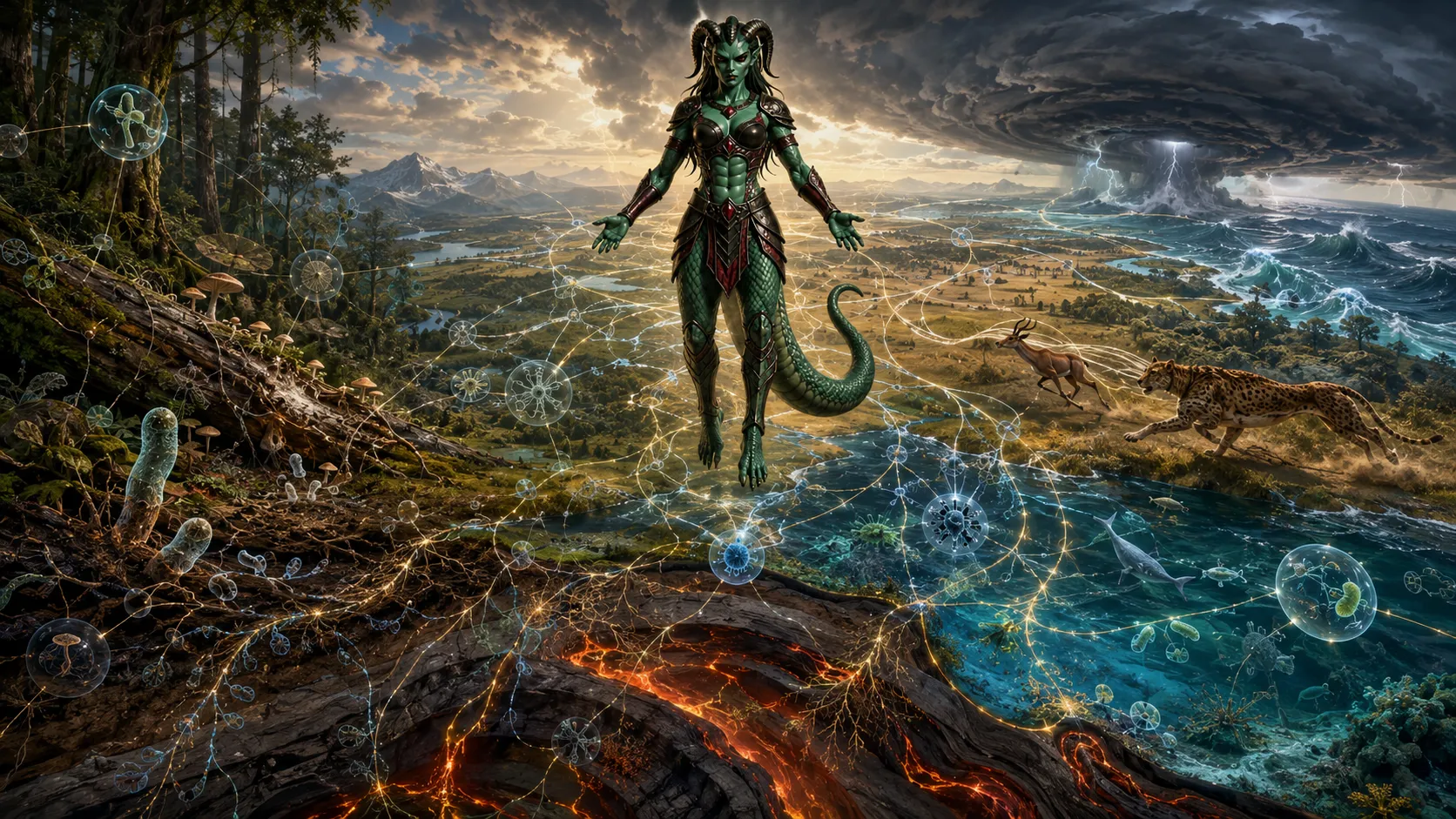
Preface
This article argues a specific position: the earth was made exactly as it was designed to be — predators, parasites, pathogens, earthquakes, and all — and the doctrine that a single man’s disobedience corrupted a previously perfect creation is a theological invention, not a textual fact. The only consequence Genesis actually assigns to Adam and Eve’s act is expulsion from one garden. Everything else — death, disease, disaster — was already built into the system before they ever took a bite.
This is not a neutral survey. It is a case, built from the text and from the historical record of how the “original sin” doctrine came to exist in the first place.
Part I: The Apologetic Case (What Defenders of the Doctrine Argue)
Apologists who defend the idea that Adam’s sin corrupted creation itself generally build the case in two stages.
First, the mechanism. Two models are offered for how one man’s act could affect everyone born after him:
- Federal headship — Adam acted as humanity’s legal representative, the way a head of state’s declaration of war binds citizens who never voted on it.
- Realism — all of humanity was somehow seminally “present” in Adam, so his act was, in some sense, everyone’s act.
Second, the theological payoff. Apologists argue the doctrine is necessary to make the rest of the story work: if sin and death didn’t enter through Adam, then Paul’s parallel in Romans 5 — “as in Adam all die, so in Christ all shall be made alive” — collapses, because there’d be nothing for Christ’s death to answer. The corruption of Adam and the redemption of Christ are treated as a matched pair; you’re told that if the fairness of inheriting Adam’s guilt bothers you, look at the fairness of inheriting Christ’s righteousness instead — the same logic that supposedly indicts you is what supposedly saves you.
Some apologists soften the claim by distinguishing inherited corruption (a broken nature) from inherited guilt (personal culpability for Adam’s specific act) — echoing the Eastern Orthodox position that we inherit mortality, not blame. But the core commitment remains: nature itself, in this view, was not always adversarial. Death, decay, and disaster are framed as intrusions — a good world gone wrong because of what one man did in one garden.
This is the load-bearing claim of the doctrine: creation was not originally what we now observe it to be.
Part II: The Scholarly Consensus (What the Text Actually Supports)
Set the apologetics aside and look at what historical-critical scholarship actually finds, and the doctrine gets considerably shakier.
Genesis 3, read on its own terms, is not a “fall of creation” narrative. Most Hebrew Bible scholars read it as an etiology — a story explaining why human life involves toil, pain in childbirth, and mortality, not a claim that the physical order of the universe was rewritten at that moment. Ancient Israelite and later Jewish tradition never developed anything resembling “original sin” as later Christianity would define it. Ezekiel 18 and Deuteronomy 24:16 explicitly state that children are not punished for their parents’ sins — the opposite of what the inherited-guilt doctrine requires.
The doctrine as commonly understood is a fourth-century invention, not a first-century one. It was Augustine, arguing against Pelagius, who built the idea that Adam’s sin is transmitted to all humanity as inherited guilt (peccatum originale). Critically, Augustine’s reading leaned on a Latin mistranslation of Romans 5:12 — rendering Paul’s Greek as “in whom all sinned” rather than the more accurate “because all sinned.” That single mistranslation is a documented hinge point in how hard the doctrine calcified in the West.
Paul’s own Greek in Romans 5:12 reads:
διὰ τοῦτο ὥσπερ δι’ ἑνὸς ἀνθρώπου ἡ ἁμαρτία εἰς τὸν κόσμον εἰσῆλθεν καὶ διὰ τῆς ἁμαρτίας ὁ θάνατος, καὶ οὕτως εἰς πάντας ἀνθρώπους ὁ θάνατος διῆλθεν, ἐφ’ ᾧ πάντες ἥμαρτον
dia touto hōsper di’ henos anthrōpou hē hamartia eis ton kosmon eisēlthen kai dia tēs hamartias ho thanatos, kai houtōs eis pantas anthrōpous ho thanatos diēlthen, eph’ hō pantes hēmarton
“Therefore, just as sin entered the world through one man, and death through sin, so death spread to all people, because all sinned.”
The critical word is ἐφ’ ᾧ (eph’ hō), which the Greek most naturally renders as “because” or “in that” — a causal statement about each person’s own sinning, not a claim of inherited transmission. Augustine’s Latin, in quo omnes peccaverunt (“in whom all sinned”), reads the phrase as referring back to Adam, turning a statement about universal individual sinning into a doctrine of collective, inherited guilt. Modern scholars widely flag this as a mistranslation that Western theology built an entire anthropology on top of.
Even Second Temple Jewish texts that do discuss Adam’s sin causing death (4 Ezra, 2 Baruch) don’t describe a corruption of the physical world — they describe mortality entering the human story, which is a very different and much narrower claim than “creation itself was rewired.”
The honest scholarly summary: Genesis narrates an event. Paul builds a typology on it. Augustine, centuries later — via a mistranslation — turns that typology into a doctrine that the entire natural order was once different and was broken by one act. That last step is not in the text. It was added.
Part III: What the Text Actually Says — and What Tov Actually Means
Strip away both the apologetics and the later doctrinal architecture, and look at Genesis 1 on its own terms, in its own language.
The recurring phrase across the creation account is:
וַיַּרְא אֱלֹהִים כִּי־טוֹב
Vayyar Elohim ki-tov
“And God saw that it was good.”
The word doing the work is טוֹב (tov). In English, “good” carries a moral weight — good versus evil. But that is not the register the Hebrew word operates in. In this context, tov is a functional and systemic evaluation, not a moral or aesthetic one. Something is tov when it does what it was built to do: the light divides day from night, the waters gather so dry land appears, the vegetation carries seed and reproduces, the sun and moon mark time, the sea creatures and birds and land animals proliferate after their kind. Each tov is a checkmark on a functioning system, not a certificate of comfort or safety.
The concrete opposite of tov in the text is תֹּהוּ וָבֹהוּ (tohu va-vohu) — the “formless and void” state of Genesis 1:2, before creation begins. This is not evil in a moral sense; it is non-function — a chaotic, unusable, unstructured state. The movement from tohu to tov across Genesis 1 is the movement from non-functioning to functioning, not from bad to nice.
This matters because of what is already present, and already declared tov, before Adam and Eve are ever formed:
- Predation and the food chain are structurally implied by “every winged fowl after his kind” and “every living creature that moveth” being declared tov on Day 5 — an ecosystem of creatures that eat one another.
- Decay and reproduction cycles are built into “herb yielding seed after his kind” — plants that live, seed, and die are declared tov on Day 3.
- The sun, weather systems, and geological order — the same physical laws that produce storms, earthquakes, and tsunamis — are declared tov on Day 4, governing the sky and the waters.
None of this changes on Day 6 when humans arrive. Humans are not the reason the system was built, and the text does not present them as the reason. They show up last, into an already-operating, already-declared-tov world, and are given a management role (וְיִרְדּוּ, veyirdu, “let them have dominion”) over a system that was already running before they existed.
The final declaration, after everything — including the animals, the ecosystems, and the humans — is:
וַיַּרְא אֱלֹהִים אֶת־כָּל־אֲשֶׁר עָשָׂה וְהִנֵּה־טוֹב מְאֹד
Vayyar Elohim et-kol-asher asah vehinneh-tov me’od
“And God saw everything that He had made, and behold, it was very good.”
מְאֹד (me’od) intensifies rather than moralizes — it means “exceedingly” or “with force.” The text is saying the whole integrated system — predator and prey, growth and decay, calm and storm — was declared fully, forcefully functional. Not safe. Not painless. Functional.
Genesis 3 then happens. Adam and Eve eat from the tree of the knowledge of good and evil. The text’s own stated consequence is expulsion from the garden, and the specific hardships tied directly to that act — painful childbirth, toil in growing food, and the statement “for dust you are, and to dust you shall return.” But death, predation, decay, and the mechanics of storms and disease are not introduced here — they are already present in a world that was declared tov and tov me’od two chapters earlier. The text does not say the ground’s basic nature changed; it says the specific relationship between the humans and the ground changed — they now labor against thorns, where before they didn’t have to.
Nothing in Genesis 1–3 supports the idea that bacteria, viruses, parasites, earthquakes, or tsunamis are the result of Adam’s act. Those mechanics were already declared tov before Adam existed.
Conclusion: The World Was Exactly What It Was Built to Be
Put the pieces together and the conclusion is direct: God made the earth exactly as intended, and the intended design already included everything that later gets blamed on “the Fall.”
Tov is a declaration that the system works — not that the system is safe, comfortable, or painless for any one species within it. A world with a functioning food chain, a functioning decay cycle, and functioning weather and geological systems is, by definition, a world with predation, disease, and disaster built in from the start. Those aren’t corruptions of the design. They are the design, running exactly as specified, declared tov me’od — forcefully, completely functional — before a single human being had done anything at all.
The doctrine that says otherwise — that a once-perfect, danger-free creation was corrupted by one man’s disobedience — is not something Genesis 1 supports. It is a doctrine built later: implied loosely in Paul’s typology, then hardened by Augustine off the back of a mistranslated Greek phrase, into a claim the text itself never makes. Strip the doctrine away, and Genesis 3’s own account is narrow: eat the fruit, get cast out of the garden, now farming is harder and childbirth hurts. That’s the stated consequence. The text does not say the ground grew thorns everywhere for the first time, that predators started killing for the first time, or that pathogens began to exist for the first time.
The system was never broken. It was built exactly as it now operates. A world in which earthquakes, tsunamis, viruses, and bacteria kill humans is not a fallen world — it is a tov world, running precisely as intended, doing exactly what it was designed to do, indifferent to whether a human happens to be standing in the way.