Yahweh and the Hatred of Man: Reading the Texts Without Apologetics
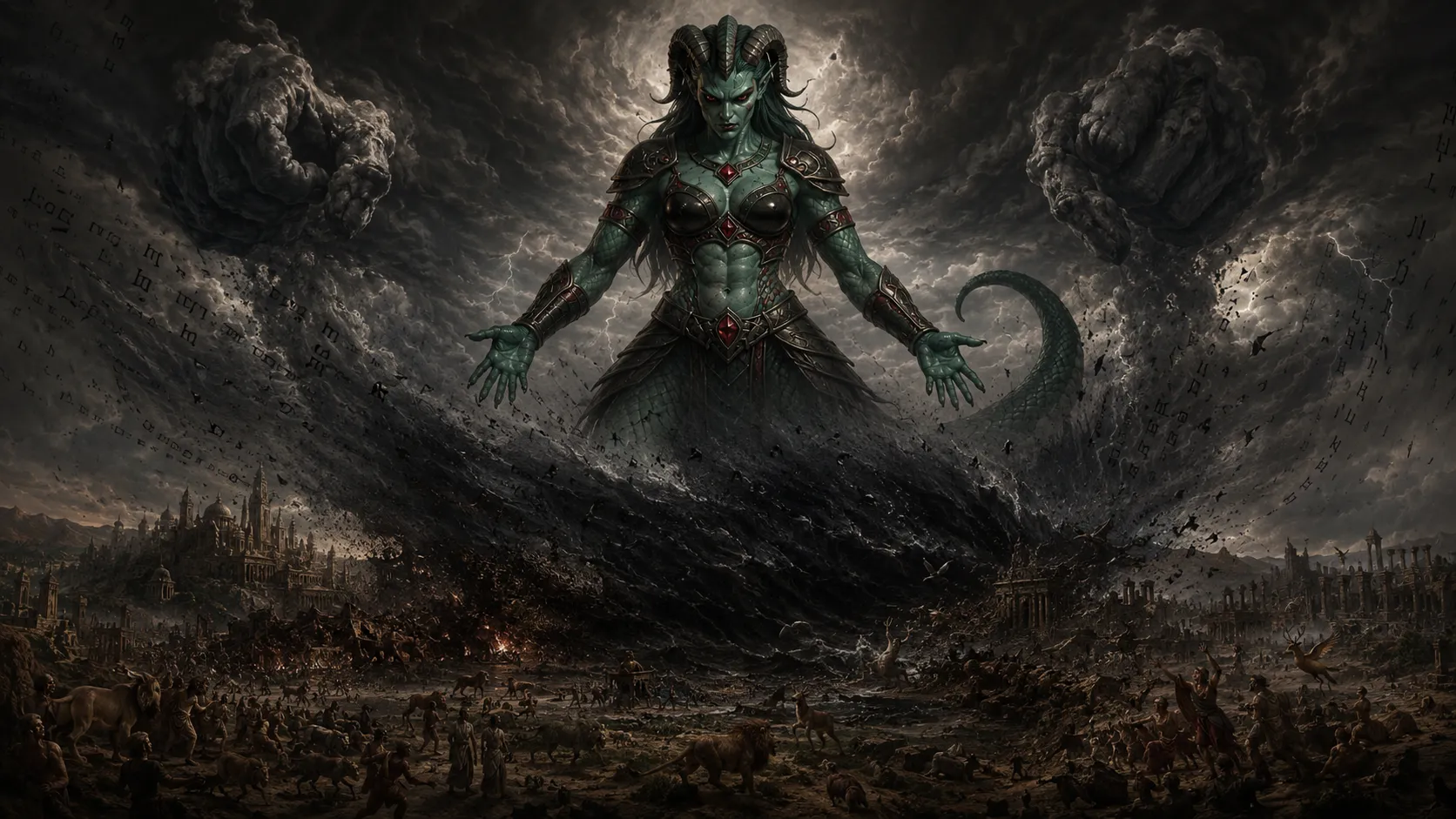
Three independent bodies of text — the Hebrew Bible, the Reformed confessional tradition, and the Nag Hammadi corpus — describe the same underlying pattern: a creator whose relationship to humanity includes regret, jealousy, and the will to destroy what he made. Read separately, each is treated as a puzzle to be explained. Read together, they converge on a simpler conclusion: the being called God in these texts is not the highest source of divinity, but a lower, secondary power — Yahweh — distinct from the true, transcendent source above him, the Monad. This article traces that pattern from Genesis, through the doctrine of reprobation, to the Gnostic material that names it directly.
I. The Old Testament: God Regrets Making You
The place to start is Genesis 6:5–7, immediately before the flood. This is not a passage that requires reading between the lines — it says, in plain terms, that the creator of humanity came to regret the act of creation and grieved over it.
Genesis 6:6
וַיִּנָּ֣חֶם יְהוָ֔ה כִּֽי־עָשָׂ֥ה אֶת־הָֽאָדָ֖ם בָּאָ֑רֶץ וַיִּתְעַצֵּ֖ב אֶל־לִבּֽוֹ
va-yinnachem YHWH ki-asah et-ha-adam ba’aretz, va-yit’atzev el-libo
- וַיִּנָּחֶם (va-yinnachem) — from the root נ-ח-ם (nacham), here in the Niphal stem. This is the same root that gives Noah his name, and the same root used later of God “relenting” toward Nineveh in Jonah 3:10. It is standardly glossed as “regretted” or “was sorry” — a term denoting an emotional reversal of intent, not a neutral administrative decision.
- כִּי־עָשָׂה אֶת־הָאָדָם (ki-asah et-ha-adam) — “that he had made the man/humanity.” The regret is explicitly tied to the act of creation itself, not to a specific sin.
- וַיִּתְעַצֵּב (va-yit’atzev) — from ע-צ-ב, the same root used in Genesis 3:16–17 for the pain of childbirth and the toil of labor. Here it describes God’s own internal state: he was pained, grieved, distressed.
- אֶל־לִבּוֹ (el-libo) — “to/at his heart.” The grief is located internally, in God, not externally, in circumstance.
Literal rendering: “And YHWH regretted that he had made man on the earth, and it grieved him to his heart.”
The verse that follows is the operative one:
Genesis 6:7
וַיֹּ֣אמֶר יְהוָ֗ה אֶמְחֶ֨ה אֶת־הָאָדָ֤ם אֲשֶׁר־בָּרָ֙אתִי֙ מֵעַ֣ל פְּנֵ֣י הָֽאֲדָמָ֔ה … כִּ֥י נִחַ֖מְתִּי כִּ֥י עֲשִׂיתִֽם
va-yomer YHWH: emcheh et-ha-adam asher-barati me’al pnei ha-adamah … ki nichamti ki asitim
- אֶמְחֶה (emcheh) — “I will wipe out / blot out.” The same verb (מ-ח-ה) used elsewhere for erasing ink from a written record — total, deliberate deletion, not correction.
- נִחַמְתִּי (nichamti) — first person of the same nacham root as v.6: “I regret.”
Literal rendering: “And YHWH said, I will wipe out the man whom I created from the face of the ground … for I regret that I made them.”
Two things follow directly from the text, without any theological gloss required:
- The being who made humanity came to regret that decision — the text uses an emotional-reversal verb, not a judicial or procedural one.
- His stated response to that regret was the deliberate, total extermination of the species he had made — described using the verb for erasing writing.
There is a genuine internal tension here that later theology tries to manage: 1 Samuel 15:29 states in the same breath that “the Glory of Israel…will not lie or repent (yinnachem, same root), for he is not a man that he should repent” — directly contradicting Genesis 6:6 on its own terms. This tension is not resolved in the text. It is simply present. Ancient readers noticed it; it was not invented by modern critics.
What Genesis 6 establishes, read plainly and without smoothing, is this: the creator’s baseline relationship to his creation includes regret, grief, and a willingness to annihilate it entirely. This is the starting data point, not a metaphor to be explained away.
II. What the Calvinist Tradition Concludes From This Same God
If Genesis 6 shows a single, retractable moment of regret, the Reformed tradition took the logic further: it made hostility toward a portion of humanity permanent, prior, and unconditional — decided before the individuals in question existed, entirely untouched by anything they do.
Calvinism proper
The Westminster Confession of Faith (1646), Chapter 3, “Of God’s Eternal Decree,” states that before the world existed, God freely and unchangeably determined the eternal fate of every person — some predestined to life, the rest foreordained to death. The number in each group is fixed and, in the Confession’s own words, cannot be increased or diminished. Those not elected are, in Reformed commentator A.A. Hodge’s summary of the doctrine, passed over based on nothing but God’s own pleasure — not because they are any worse than those chosen — and are then judicially condemned for the sin they were never going to be permitted to escape.
This rests on Romans 9:13, “Jacob I loved, Esau I hated,” which Reformed theologian A.W. Pink called the fullest biblical statement of the doctrine of reprobation. John Piper has written that Jacob and Esau were assigned to their respective destinies before either was born — before any act, belief, or rejection on their part had occurred.
Strip the confessional language away and the structure is this: a fixed subset of humanity is condemned by decision made prior to their existence, for reasons located entirely in God’s own will, not in them. Whatever they do afterward cannot move them out of that category.
Hyper-Calvinism
The stricter offshoot goes one step further and removes even the pretense of an open invitation. Where mainstream Calvinism still holds that the gospel is sincerely offered to everyone (even though only the elect will respond), Hyper-Calvinism — associated with figures like John Gill (1697–1771) — denies that the offer is genuine at all for the non-elect. Gill’s doctrine of eternal justification held that the elect were, in effect, already justified before birth, which by structural necessity means the reprobate were already excluded before birth as well. Historians of Gill’s thought conclude that on this system, God and the preacher do not actually command every hearer — elect or reprobate — to repent and believe, because the unregenerate are held to be entirely incapable of it regardless.
Put plainly, in Gill’s own tradition’s terms: the invitation is not real for you, no action on your part changes that, and the incapacity was total and fixed before you existed.
This is not internet argument or fringe reading. It is confessional Reformed theology and a documented historical school built from within Christianity’s own most rigorous logical tradition, following Genesis 6’s premise — a creator willing to regret and destroy his creation — to what its defenders considered its consistent conclusion: for some people, hostility from their creator was never contingent on anything they could do.
III. What Was Actually Happening: The Monad and Yahweh
The tension in Genesis 6 — a “God” who regrets, grieves, rages, and moves to annihilate — and the tension inside Calvinism itself, where the same being is called perfectly loving while permanently and unconditionally excluding a portion of what he made, both resolve cleanly once a premise from an older textual tradition is restored: the being acting in Genesis, and named YHWH, is not the highest source of divinity. He is a lower, secondary power, and the highest source is distinct from him entirely.
The oldest and highest source of all being is called, in this framework, the Monad — a perfect, undivided, transcendent unity, entirely beyond passion, regret, jealousy, or violent reaction. The Monad does not create the material world and does not create humanity directly. Between the Monad and the visible universe lie a series of emanations, and at the bottom of that chain, a lower power — ignorant of, or jealous of, what lies above it — is the one who fashions the physical universe and then fashions man. This lower power is Yahweh, the figure who speaks in Genesis, who regrets, who floods, who commands, who demands worship, and who reacts with fear and anger to human beings who exceed what he intended.
This is not a metaphorical reading. Multiple texts in the Nag Hammadi corpus describe this lower creator acting toward humanity in ways that are explicitly hostile, and the hostility takes two distinct forms in the texts: hostility triggered by human beings, and hostility that is built into the lower creator’s nature prior to any human action at all.
Hostility triggered by human excellence and growth
This pattern is drawn from three texts in particular: the Apocryphon of John, the Hypostasis of the Archons, and On the Origin of the World (the latter two share source material and sit together in Codex II of the Nag Hammadi library).
After the lower creator and his subordinate powers form the first human body, a spark of the higher, Monad-derived divinity is breathed into that body without the lower creator’s knowledge or consent. That spark makes the human being more intelligent and more enlightened than the lower creator and all his subordinate powers combined. The Apocryphon of John frames what happens next as terror and envy at seeing a being they made surpass them — and this reaction is the direct motive for seizing the human and casting him down into the most degraded part of the material world. The punishment is explicitly for being better than his creator, not for any wrongdoing.
The same text shows the lower creator restricting human access to knowledge — the forbidden fruit in Eden — specifically so humanity would not perceive the reality above him. That is deliberate deprivation used as a control mechanism, not neutral instruction.
Later, when humanity begins to multiply and improve, the Hypostasis of the Archons shows the ruling powers under the lower creator holding a council and explicitly planning a coordinated act of mass destruction — a flood, engineered by their own hands, to wipe out every living thing, human and animal. This is depicted as premeditated group extermination triggered by human flourishing, not judgment for sin. One subordinate power breaks with the group and secretly warns the intended victim — meaning the hostility was not universal even among the lower powers, but the chief creator’s own faction is shown planning the deliberate annihilation of the species he made, a second time, echoing Genesis 6 itself but stripped of any “regret” framing — this time it is calculation, not grief. On the Origin of the World, which shares source material with the Hypostasis and sits alongside it in the same codex, repeats this same flood conspiracy, indicating it was not an isolated detail but a recurring theme in this textual family.
Hostility prior to and independent of human action
A separate, earlier layer within On the Origin of the World locates the hostility before humanity exists at all. Before any human being is formed, the proto-material principle that becomes the lower creator perceives something greater than itself in the light above, and generates jealousy from that perception alone, with no human involved. The text is explicit that this is the origin point: from that moment forward, jealousy becomes a fixed, structural feature running through every level of the world this being goes on to make. Humans, when they later appear, are not the cause of this disposition — they simply fall within reach of a being who was already hostile before they existed.
The same text shows the pattern repeating one level down: when the lower creator sees that his own offspring has grown greater than the other subordinate powers, he becomes envious purely at the fact of that greatness, and out of that envy generates Death — which in turn produces Wrath, Jealousy, and Grief as further offspring. The disposition is not a one-time reaction; it is the default relational posture of this being toward anything with more potential than himself, humanity included.
What this resolves
Read this way, the tensions in Parts I and II stop being tensions:
- Genesis 6’s God who regrets making humanity and moves to destroy it is not an aberration in an otherwise loving, perfect being. He is a lower, flawed, jealous power behaving exactly as his nature dictates — regret and destruction are not out of character; they are his character.
- Calvinism’s God who fixes some portion of humanity for destruction before they exist, for reasons located in his own will and not in them, is describing, accurately, the behavior of the same lower being — an unconditional, prior hostility that the Reformed tradition correctly identified in the texts, but wrongly attributed to the highest possible source of being. What Calvinism calls the sovereign, eternal decree of the one true God is, on this reading, an accurate description of Yahweh’s actual disposition — just misidentified as the disposition of the Monad above him, who does not behave this way at all.
- The invitation Hyper-Calvinism says is not real for the reprobate, and never was, is consistent with a lower creator who deliberately restricts access to the knowledge that would let humanity see past him in the first place.
IV. Conclusion
Taken on their own terms — without the harmonizing moves of Christian apologetics, without appeals to mystery, paradox, or “accommodated language” to explain away Genesis 6’s plain grammar, and without assuming in advance that the figure called God in these texts must be the single, highest, all-loving source of being — the material examined here converges on a single figure with a consistent profile: a creator who regrets and moves to destroy the humanity he made (Genesis 6); whose most rigorous theological interpreters concluded, from his own decrees, that a fixed portion of humanity was condemned by his will alone, before they existed, independent of anything they would do (Reformed reprobation and Hyper-Calvinism); and who, in an older and separate textual tradition, is identified plainly as a lower, secondary power — Yahweh, not the Monad — whose jealousy, wrath, and hostility toward humanity are shown to be both triggered by human excellence and, more fundamentally, built into his nature prior to any human action at all.
The consistent thread across Genesis, Reformed confessional theology, and the Nag Hammadi material is not a single hostile act. It is a hostile disposition, textually attested across independent traditions, toward the species this figure made.