Three Realms: Rethinking Heaven, Earth, and Hell
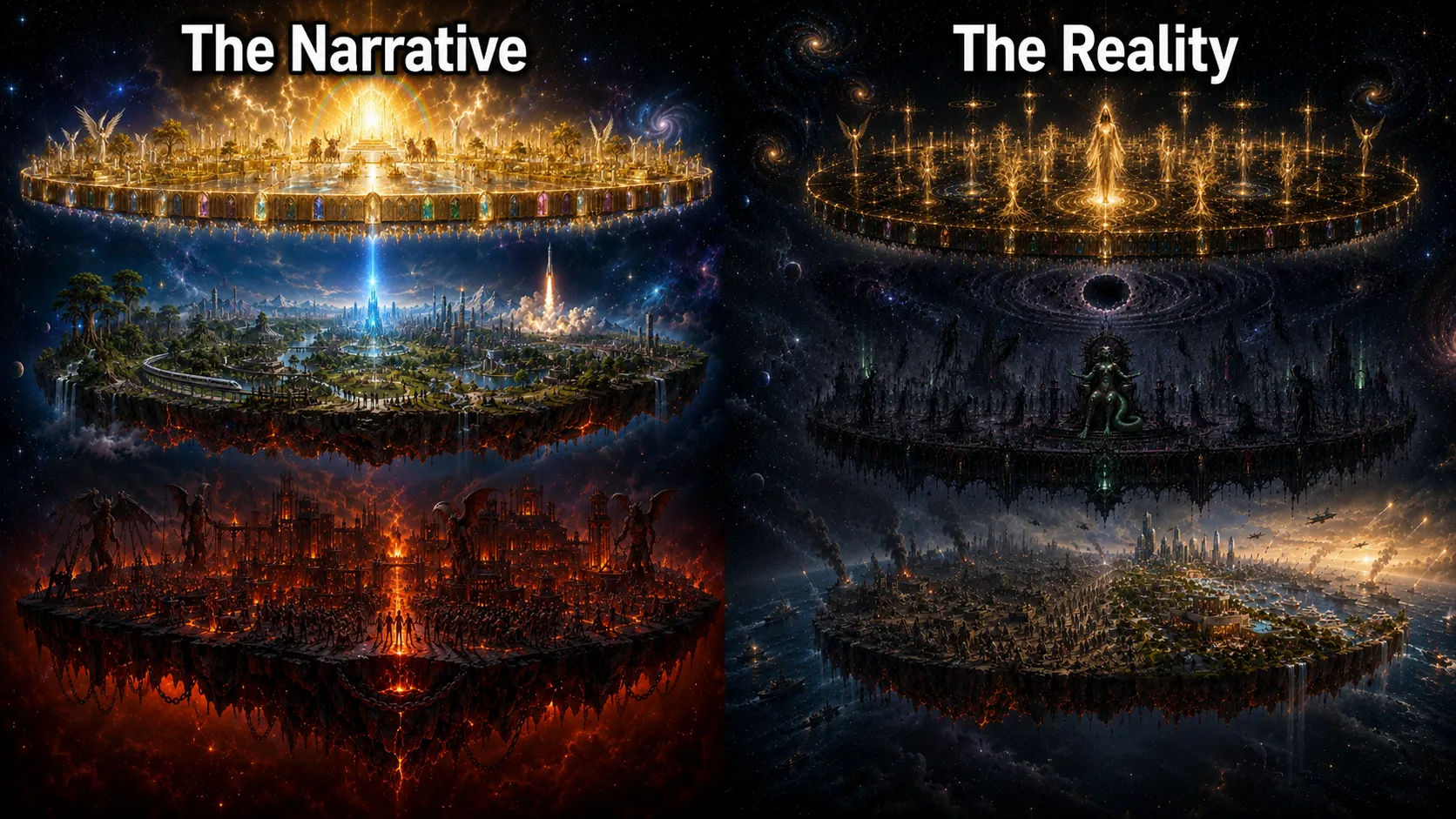
I. The Default Framework
The conventional structure of the afterlife handed down within the Abrahamic tradition is built on three tiers. But Christianity and Judaism arrive at that structure quite differently, and it’s worth separating the two.
Christianity
- Heaven — the reward reserved for the faithful, those who believed and followed the correct doctrine.
- Earth — the material world, a temporary and neutral stage of testing.
- Hell — a place of eternal, conscious torment reserved for evildoers and unbelievers.
In this structure, a single lifetime — roughly 80 years — determines an eternal outcome. Get it right, and you receive infinite reward. Get it wrong, and you receive infinite punishment. The scales are radically imbalanced: a finite life produces an infinite consequence.
This is the picture most people are handed by default: three static locations, one linear judgment, and an eternal, unchanging result.
Judaism
- Olam Ha-Ba (the World to Come) — not a reward for correct belief, but an inheritance based on merit. The Talmud holds that the righteous of any nation, not only Jews, have a share in it. Entry is determined by deeds, not doctrine.
- Olam Ha-Zeh (this world) — the primary arena of Jewish religious life. Where Christianity treats earthly life mainly as a testing ground for the next world, classical Judaism puts most of its emphasis here, in the present, lived world.
- Gehinnom — not eternal torment but a temporary place of purification, traditionally capped at twelve months, after which most souls ascend to Olam Ha-Ba. Even the fate of the truly wicked is unsettled within the tradition: some sources describe their souls as ultimately destroyed, others as eternally separated, but eternal conscious torment was never the default position.
In this structure, a single lifetime still matters, but the outcome it produces is neither infinite nor, for most souls, irreversible. The scales here are closer to proportionate: a finite life is met, in most accounts, with a finite period of reckoning rather than an eternal one.
This is a different picture from the Christian one: three tiers again, but built around purification and deeds rather than eternal doctrinal sentencing — and even this picture is contested, varying considerably across Orthodox, Conservative, and Reform interpretation.
The Architecture Beyond Judaism and Christianity
This three-tier architecture is not a peculiarity invented by Jewish or Christian theology. The historian of religions Mircea Eliade — working comparatively across shamanic, Indo-European, and archaic traditions with no contact with the biblical world — argued that the same vertical structure recurs independently across unrelated cultures. Eliade described a cosmos of three communicating levels — earth, heaven, and underworld — linked by a central axis, an “axis mundi,” typically imagined as a world pillar, mountain, or tree connecting the realms above and below. He documented this structure in circumpolar and Siberian shamanism, where the cosmos is understood as three vertically organized worlds joined by a cosmic axis that the shaman travels in trance; among the Sami, whose ritual drums were painted as maps of this same three-tiered cosmos, with sky gods above, the human world in the middle, and the realm of the dead below; and among Amerindian traditions where the sky, earth, and underworld are each populated by distinct beings. The same pattern appears as Yggdrasil in Norse mythology and Mount Meru in Hindu-Buddhist cosmology.
Eliade’s evidence establishes the architecture — a middle world flanked by an upper and lower realm — as a widespread, independently arising pattern rather than something unique to the biblical tradition. It’s worth noting a limit to this parallel: in the shamanic traditions Eliade studied, the lower realm is generally the domain of the dead and ancestors, not a place of moral punishment. The retributive, eternally punitive character of Hell specifically is more particular to the Jewish and Christian line described above. What Eliade’s scholarship supports is the shape of the default framework — three vertically stacked realms — not the ethical content poured into it.
Source: Mircea Eliade, Shamanism: Archaic Techniques of Ecstasy (1951; trans. 1964), ch. VIII, “Shamanism and Cosmology,” and The Sacred and the Profane: The Nature of Religion (1959).
II. The Alternative Framework
The alternative framework rearranges these three tiers entirely, changing not just their names but what they represent and how souls move through them.
- The Monad — true freedom. This is the ultimate destination, the escape from the entire cycle altogether. It is not a reward handed out for belief, but a liberation earned through how a soul actually lived.
- Yahweh’s Heaven — not final rest, but a holding system. Its true function is what could be called the “2nd Death”: a memory wipe. Souls who end up here are not eternally punished — they are recycled. Their memory of the life just lived is erased, and they are sent back to be born into the material world again.
- Earth — the real hell. Not a separate underworld of fire, but the material world itself. Life on Earth is the punishment and the classroom simultaneously: souls are born, live, forget who they were, and must try again. This is the cycle of birth and rebirth.
This same architecture — a material world doing double duty as punishment and classroom, judgment at death measured by conduct rather than doctrine, a temporary holding phase, an induced forgetting before return, and liberation defined as escape from repetition — is not a novel invention. Independent traditions outside the Jewish and Christian line, with no shared lineage, arrived at strikingly similar structures on their own:
Plato’s Myth of Er (Greek philosophy, Republic Book X) gives the closest structural parallel to the memory-wipe mechanic. After death, souls are judged and choose a new life; before rebirth they are marched to the Plain of Lethe and made to drink from the River of Forgetfulness, which erases their memory of the life just lived — total forgetfulness that prepared them for reincarnation in a new body. Notably, the Orphic mystery cult layered an escape hatch onto this myth: initiates were promised that their special knowledge would allow them to avoid the Lethe and drink instead from the spring of Mnemosyne, thereby retaining memory and achieving a higher afterlife destiny — souls exempted from the wipe through what they knew, not what they believed.
Egyptian judgment of the dead (Book of the Dead, Spell 125) offers the clearest non-Abrahamic precedent for judgment based on conduct toward others rather than correct doctrine. The deceased enters the Hall of Judgement and faces Osiris and other deities; the heart is weighed to determine whether they are worthy to enter the afterlife as one of the blessed dead. The deceased was expected to declare innocence against a list of vices through a “negative confession” before Osiris and forty-two assessors — offenses like theft and killing, not failures of belief. And failure carried real weight: a heart that failed the test was consumed, symbolizing the annihilation of the soul, which would cease to exist in any form — closer to Judaism’s Gehinnom-as-dissolution than to eternal conscious torment.
Hindu, Buddhist, and Jain teachings on samsara and moksha map most directly onto the claim that Earth itself, not some separate underworld, is the real site of punishment and repetition. Between death and the next life, the soul is judged by Yama, the god of death, and depending on its conduct in life, it may spend time in a hell realm or be reborn into another body to begin the cycle again. Actions generated by desire bind the spirit to an endless series of births and deaths, and salvation means emancipation from this cycle — an escape from impermanence. Jainism states the destination bluntly: moksha is not an afterlife, but rather the end to the unceasing suffering of existence — liberation as exit from the system entirely, not relocation within it.
The Tibetan Book of the Dead (Bardo Thödol) supplies both the judgment scene and the near-death-experience echo. In the final bardo, the deceased appears before Yama, Lord of the Dead, sees her past deeds in Yama’s mirror, and her good deeds are weighed against bad on Yama’s scale. Modern scholars have drawn the same NDE connection this framework proposes: a strong similarity has been noted between the Tibetan Book of the Dead and near-death experiences, including a life review and an understanding of the consequences of past choices, similar to karma and post-mortem evaluation.
None of these traditions map onto the framework laid out here point for point — the theology, the cast of characters, and the metaphysics differ widely. But the underlying architecture recurs with a consistency that’s hard to dismiss as coincidence: judgment happens at death, not once at the end of history; the standard applied is conduct, not creed; the material world doubles as both punishment and classroom; forgetting is the mechanism that keeps the cycle running; and liberation means escaping the system, not winning a nicer seat within it. What follows is not a lone speculative outlier — it’s reconstructing, in Christian and Jewish vocabulary, a shape that other traditions arrived at independently, and repeatedly.
In this model, the judgment is not a one-time doctrinal test but happens at the moment of death:
- Jesus judges first. The standard is not belief, ritual, or church membership — it is a single ethical commandment: love others as yourself, or do unto others as you would have them do to you. This lines up with the judgment scene described in Matthew 25:31-40, where the measure applied to each soul is entirely practical: did they feed the hungry, give drink to the thirsty, welcome the stranger, clothe the naked, care for the sick, and visit those in prison. There is no mention of doctrine, belief, or religious affiliation in that scene — only whether these basic acts of care were carried out toward others. Taken together with the “love your brother as yourself” standard, the judgment is consistently about lived action toward other people, not professed faith.
- If a soul passes, it is freed into the Monad — released from the cycle entirely.
- If a soul fails, it is cast into darkness — sent to Yahweh, where wrath is administered, memory is wiped, and the soul is sent back to Earth to be born again.
This reframes several familiar ideas:
- Hell is not a separate place of eternal fire — it is the material world itself, experienced repeatedly, life after life, without memory of what came before.
- The “outer darkness” and “weeping and gnashing of teeth” repeated throughout the New Testament are not metaphors for a torture chamber — they describe being cast back into the ignorance and suffering of another incarnation.
- Paul’s teachings, which emphasize faith and belief in Christ’s nature, diverge from what Jesus himself repeatedly emphasized: a single ethical standard of reciprocal love, on which the actual judgment rests.
- Near-death experiences are understood as glimpses of this judgment process — souls brushing against the boundary between systems before being sent back because they had not yet fully died.
In this framework, Yahweh is not the ultimate liberator but the administrator of an ongoing, punitive cycle — one that keeps souls trapped through repetition and forgetting. Jesus stands apart from that system, offering a single opportunity at each death to break free of it entirely, based on nothing more complicated than how a person actually treated others.
The default framework offers three static places — Heaven, Earth, Hell — with a single lifetime deciding an eternal, disproportionate outcome.
The alternative framework offers three dynamic roles instead: the Monad as true freedom, Yahweh’s Heaven as a recycling mechanism disguised as reward, and Earth as the actual hell — the place of suffering, forgetting, and repetition. Judgment does not happen once by doctrine, but at every death, by Jesus, using a single ethical measure. Passing frees the soul. Failing returns the soul to be born into the material world again, memory erased, to try again.
Where the traditional model punishes finite mistakes with infinite torment, this model replaces torment with rehabilitation through repetition — a system that keeps offering another chance, life after life, until a soul finally lives by the one standard that matters: how it treated others.
None of this makes the alternative framework provable, and it isn’t offered as such. But it is not without merit. Its central moving parts — death-by-death judgment on conduct, a material world doing double duty as punishment and classroom, forgetting as the engine of the cycle, and liberation defined as exit rather than relocation — are not unique to this reading of Jesus’s teaching. They are the same architecture reached independently by Plato, by Egyptian funerary religion, by the Hindu, Buddhist, and Jain traditions, and by Tibetan Buddhist teaching on death. A framework this consistent with that much unrelated precedent deserves to be judged on its coherence, not dismissed as invention.