Jesus and Abba: The Challenge to Temple Authority
Preface
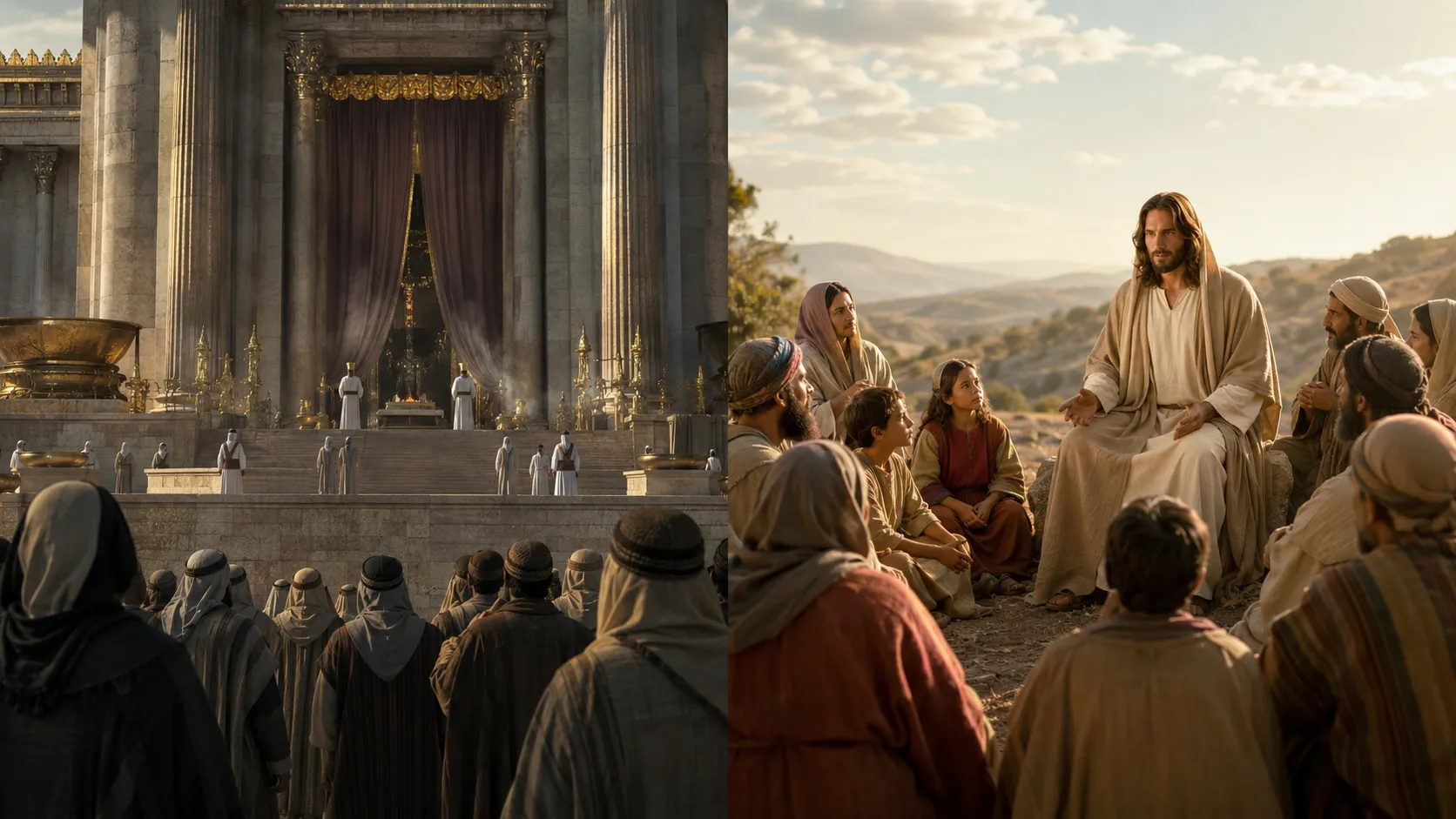
Most Christians read the word “Abba” as a warm footnote — proof that Jesus wants us to feel close to God. Few realize what that single word actually detonated in its own time. Behind it sits an entire legal and cultural architecture: a name so holy it could only be spoken once a year, by one man, in one room; a prayer culture built on formality and distance; a priesthood whose authority rested on controlling access to God. To call God “Abba” — and to teach ordinary people to do the same — wasn’t a gentle innovation in piety. It was a direct move against the Temple authorities, striking at the very structure they used to mediate between God and Israel. This article lays out that architecture in detail, so the size of what Jesus did — and why it provoked the response it did — becomes visible.
The architecture in one view
The prayer architecture
from guarded distance to direct address
Guarded distance
YHWH
Jesus' practice
Ἀββά
direct family address
- no substitute name
- no priestly relay
- no Temple barrier
the Father is already near
The Legal and Theological Framework
1. The Proper Names and Titles for God — and Why They Mattered
The Tanakh contains multiple names for God, and each one carried a specific, carefully guarded meaning. The Talmud in Shevuot 35a lists seven names considered fully holy — once written, these names may not be erased, and saying them in vain is a serious prohibition.
The Seven Sacred Names of God (Talmud, Shevuot 35a)
The Talmud in Shevuot 35a lists seven names of God considered fully holy. Once written on parchment or paper, these names may not be erased — and saying them in vain is a serious prohibition. And to be precise: whoever erases even one letter from any of these seven names is liable for lashes.
The seven are:
1. YHWH (יהוה) — The Tetragrammaton Called the Shem HaMeforash — the holiest of all names. It is built from the Hebrew root meaning “to be” — God as the One who exists, who has always existed, and who will always exist. This Name is so sacred it has not been pronounced for nearly two thousand years. In the Temple, only the High Priest pronounced it, and only on Yom Kippur, when he entered the Holy of Holies. Today, when it appears in the Torah or the prayer book, Jews read it as “Adonai” instead.
2. Adonai (אֲדֹנָי) — “My Lord” One of the names that, once written, cannot be erased because of its holiness. It was the standard spoken substitute for YHWH — the word Jews said instead of the Tetragrammaton. The irony is that even this substitute eventually became so sacred in its own right that it too required protection. In recordings of prayer services today, even Adonai is often replaced with “HaShem” to avoid casual use.
3. El (אֵל) — “God / Mighty One” The most ancient and elemental name. It denoted raw divine power and authority. It appears throughout the oldest layers of the Tanakh and was the Canaanite word for the king of the gods — which is why when God introduced himself to Abraham, he used El Shaddai, essentially saying “I am beyond even what you conceive when you hear this name.”
4. Elohim (אֱלֹהִים) — “God” (plural form) Elohim is the name of judgment and of justice. The Torah opens with this name — “In the beginning, God [Elohim] created.” When the Tanakh speaks of God as the lawgiver, the judge, the one who imposes order, the name is usually Elohim. Grammatically it is a plural noun used with singular verbs — a theological puzzle that has been debated for centuries.
5. El Shaddai (אֵל שַׁדַּי) — “God Almighty” Often translated as “Almighty.” Classical commentators read it as She-Dai — “the One who said enough” — meaning God set the boundaries of creation. This is the name God used when first introducing himself to Abraham, and it appears on the outside of every mezuzah scroll.
6. Tzeva’ot (צְבָאוֹת) — “Lord of Hosts” This name appears constantly in the books of the prophets and in the Kedushah of the Amidah: Kadosh, Kadosh, Kadosh, Hashem Tzeva’ot — “Holy, holy, holy is the Lord of Hosts.” It refers to God as commander of the armies of heaven — the angelic hosts. There was actually a rabbinic debate about whether this name qualified: Rabbi Yosei held that the word Tzeva’ot is allowed to be erased, arguing it names Israel’s hosts, not an independent name of God. He lost the debate.
7. Ehyeh-Asher-Ehyeh (אֶהְיֶה אֲשֶׁר אֶהְיֶה) — “I Am That I Am” This is the name God gave Moses at the burning bush — the one the blog post described. “I am the unchanging One, the one who has always been, the one who will always be.” Some authorities include this name among the seven; it is considered the source from which YHWH is derived. It is the most philosophically profound of all the names — a name that essentially resists being named.
A Note on the Complexity
Interestingly, the source for calling them “the seven ineffable names” actually comes not from the Talmud text itself, but from the Zohar (Vol. III, 272b). The Talmudic portion in Shevuot 35a does not specify exactly seven, and there are manuscript variations — Maimonides and other authorities debated which names to include in the list.
The rabbis’ original concern was taking God’s name in vain, determining which names were in danger of being misused. The discussion then expanded to erasing them. This is the reason why to this day, Jews store sacred texts containing the divine name in a genizah — a special repository — rather than simply discarding them. It is also why some people refrain from writing out “God” even in English, substituting a dash: G-d.
So when you put all of this back into the context of Jesus saying Abba — bypassing this entire elaborate, centuries-deep architecture of reverence and protection around God’s very name — you begin to understand just how seismic it was.
By the first century, the situation around God’s name had become extraordinarily rigid. It became common Jewish practice to restrict the use of the names of God entirely to a liturgical context. In casual conversation, some Jews would call God “HaShem” — Hebrew for simply “the Name” — to avoid using any sacred name at all.
The most guarded name was YHWH. The pronunciation of the tetragrammaton became increasingly rare, and according to later sources, by the Second Temple period it was articulated only once a year — on Yom Kippur, in the Temple’s Holy of Holies, by the High Priest alone. Someone who attempts to pronounce the tetragrammaton by its letters is said not to have a portion in the world to come (Mishnah Sanhedrin 10:1).
So by the time Jesus is teaching, the cultural situation around God’s name is one of maximum distance and formality. Adonai (“Lord”) was the standard substitute, which itself was already a step removed. HaShem (“The Name”) was used when even Adonai felt too direct.
2. The Pharisees’ View of God in Prayer — The Formal Distance Was Itself Theological
The grammar of Jewish prayer was a legal debate. Two sages of the third century, Rav and Shmuel, debated whether the word “You” should be included when addressing God in a blessing. Rav insisted on it, arguing we turn directly to God. But Shmuel maintained that including “You” places mere mortals in too intimate a relationship with the Creator of the universe.
That debate — over a single word — illustrates exactly what Jesus was stepping into. The entire framework of Pharisaic piety was built around the idea that God was transcendent — far above, holy, other. For the Pharisees, God was primarily one who makes demands, and the Scriptures were a set of rules that must be kept at all costs. The 613 commandments, and the oral law built on top of them, were tools to manage the gap between a holy God and sinful humans. You didn’t close that gap — you carefully navigated it.
The proper address for God in prayer was already highly structured. To this day, the most common form of address for God that Jews use in prayer is “Lord Our God, King of the Universe.” That formula — formal, hierarchical, acknowledging God’s sovereignty and power — was the exact opposite of Abba.
3. What the Blasphemy Laws Actually Said
The Torah’s blasphemy laws come primarily from Leviticus 24:10-23. In the two main passages in the Bible (Leviticus 24:10-23 and I Kings 21:8-13), the penalty for blasphemy is stoning to death. In the Mishnah (Sanhedrin 7:5), the technical definition of capital blasphemy requires that the offender used the Tetragrammaton — the four-letter name of God — to curse.
As long as Jewish courts exercised criminal jurisdiction, the death penalty was inflicted only upon the blasphemer who used the Ineffable Name. But the blasphemer of God’s attributes was subjected to corporal punishment.
Now here is where it gets legally complicated for Jesus’s case. On the strict technical definition, calling God “Abba” didn’t meet the narrow threshold for capital blasphemy — he wasn’t cursing YHWH by name. But scholars have demonstrated that blasphemy could be committed by “a combination of word and deed without formal utterance of the divine Name.”
The charge against Jesus evolved from how he addressed God to what that implied about himself. Jesus was not being accused of blasphemy merely for saying he was the “Son of God” as messiah — it was because he claimed to be God on the basis of his stated relationship with the Father.
4. The Real Legal Problem: The Implied Claim
When Jesus didn’t just use Abba himself but actively taught his disciples to do the same — essentially saying “you can all address God as your personal father” — he was making a staggering theological claim that went far beyond informal prayer language. To address Yahweh directly as Father in the intimate familial term Abba evoked an intimacy and access no one had ever employed before Jesus, and in both the ancient Near Eastern and Jewish contexts of the Old Testament and first-century Israel, it was unparalleled and unprecedented.
An Israelite would not have used it even in prayer. Only one who regarded himself as Son of God in the proper sense of the word could have spoken thus of him and to him as Father.
That is exactly what the Pharisees heard. They rejected his claims that God was his Father and that he had authority to forgive sins — they found these claims to be ridiculous and offensive.
And when Jesus declared “I and my Father are one” (John 10:30), Judaism teaches that it is heretical for any man to claim to be God, part of God, or the literal son of God. The Jerusalem Talmud states explicitly: “If a man claims to be God, he is a liar.”
5. The Political Dimension the Blog Post Doesn’t Mention
There was also a power dimension that went beyond theology. All prayers and sacred rites of divine worship in first-century Judea were performed according to the Pharisees’ exposition. They controlled the synagogues. They controlled how God was to be approached. Jesus teaching a new, unauthorized form of addressing God — directly, intimately, as Abba — wasn’t just a theological challenge. It was a direct attack on their institutional authority as the gatekeepers of how ordinary Jews related to God.
The real reason the leadership was compelled to deal with Jesus was that so many people followed him. Roman Governor Pilate knew exactly why they wanted him dead — “it was out of envy that they had delivered him up.” Jesus showed the Jewish people mercy, grace, and love, which meant the authority of the scribes, elders, Pharisees, and chief priests had been undermined.
The Summary
What Jesus did by using Abba — and teaching it to his disciples — was simultaneously: a violation of the entire spirit of Jewish prayer culture (which mandated distance and formality); an implicit claim to a unique, personal divine sonship no human could legitimately assert; and a direct threat to the institutional authority of the Pharisees who controlled the religious life of the people. Technically, the blasphemy laws as written were hard to apply directly to the word Abba alone. But the implication of what he was claiming — and especially his insistence that others could follow him into that same intimacy — is what made him, in their view, not just a rule-breaker but an existential threat to the entire structure of Jewish faith and law.