Jesus Death Saved No One: A Legal and Textual Reckoning
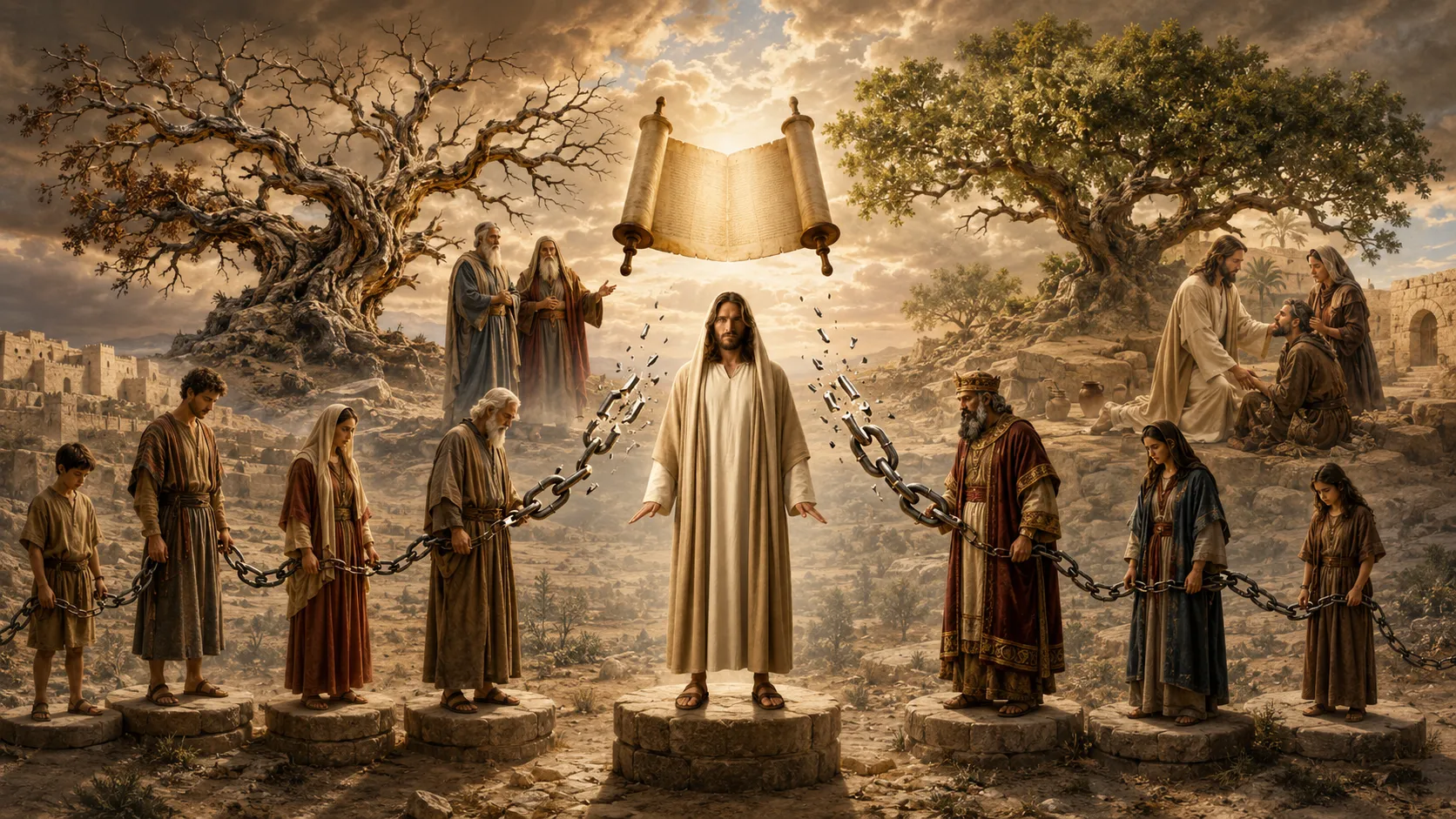
I. What the Church Came to Believe
From the Church Fathers onward, Christian theology produced a series of overlapping explanations for what the crucifixion accomplished. Irenaeus (2nd century) called it recapitulation — Christ retracing Adam’s failure and succeeding at every point Adam failed, summing up human history correctly where the first man had corrupted it. Alongside this, most Greek and Latin Fathers — Origen, Athanasius, the Cappadocians, Chrysostom, Augustine — held some version of Christus Victor: Christ’s death as a ransom or a victory over the powers holding humanity captive, a rescue rather than a legal transaction.
It was not until Anselm of Canterbury in the 11th century that atonement was reframed in transactional terms: sin as an offense against God’s honor, requiring satisfaction — a debt paid by the one figure capable of paying it. Abelard’s 12th-century moral influence theory and Grotius’s 17th-century governmental theory followed, each relocating the mechanism further from a literal cosmic transaction and closer to a demonstration or an example.
What all these theories share, whatever their internal disagreements, is the founding claim: something objective changed at the cross. The relationship between God and humanity was reset. Sin, in some sense, was dealt with.
The argument below is that this founding claim does not survive contact with the two bodies of evidence it depends on — the internal logic of Jewish law, which the sacrificial claim requires, and the textual record of what Jesus himself is reported to have said, which the inherited-guilt claim requires.
II. What Paul Argues, and Why It Runs Against Judaism on Its Own Terms
1. The curse of the tree
Paul’s argument in Galatians rests on a single verse:
Deuteronomy 21:23 (LXX):
ὅτι κεκατηραμένος ὑπὸ Θεοῦ πᾶς κρεμάμενος ἐπὶ ξύλου “for anyone hung on a tree is cursed by God.”
Paul quotes this directly:
Galatians 3:13:
Χριστὸς ἡμᾶς ἐξηγόρασεν ἐκ τῆς κατάρας τοῦ νόμου γενόμενος ὑπὲρ ἡμῶν κατάρα “Christ redeemed us from the curse of the law by becoming a curse for us.”
The critical word is κατάρα (katara, “curse”) and its cognate ἐπικατάρατος (epikataratos, “accursed”) used in the Deuteronomy citation. Deuteronomy does not say the curse is transferable, absorbable, or reversible by a second curse. It states a fact about the hanged man’s status before God: he is cursed. There is no verb of exchange, no mechanism of cancellation, anywhere in the source text. Paul supplies the citation but not its logic.
That logic — a curse functioning as a countermeasure to another curse — has no Hebrew Bible precedent. It does have a precedent: the Greco-Roman practice of defixiones (binding curse tablets) and their counter-defixiones, in which a cursed person commissioned a second, opposing curse engineered specifically to neutralize the first. Scholarship on this point (Popa, Biblische Zeitschrift 68, 2024) describes Paul’s Christ, in this reading, as a “living curse with an anti-curse effect” — the grammar of Greco-Roman apotropaic magic, not of Torah. The 1st-century Amisos amulet, from the same general region and era as Galatia, is a physical example of exactly this logic in lived practice among Paul’s own audience.
The problem, stated plainly: Paul cites a Hebrew text for authority and then explains what it means using a non-Hebrew, non-Jewish conceptual apparatus. Deuteronomy supplies the disqualification. It supplies no solution. The solution is imported from outside Judaism entirely.
2. The sacrifice that could not qualify as one
Paul’s second load-bearing image is Christ as sacrifice:
1 Corinthians 5:7:
τὸ πάσχα ἡμῶν ἐτύθη Χριστός “Christ our Passover [πάσχα, pascha] has been sacrificed [ἐτύθη, from θύω, ‘to slaughter/offer’].”
This metaphor depends on the sacrificial law it invokes, and that law is specific. Leviticus 22:17–25 and Deuteronomy 15:21 require the offering to be תָּמִים (tamim, “unblemished,” “without defect”), physically inspected, and presented at the altar by a priest. A human execution outside the city walls, carried out by Roman soldiers with no interest in or knowledge of Levitical procedure, satisfies none of these conditions on its own terms — but the deeper problem is internal to the Gospel record itself.
The Gospels report Jesus repeatedly working on the Sabbath (Mark 3:1–6), acts the Pharisees identify explicitly as violations. The standard reply — that this was the Father’s will, not a transgression — does not resolve the sacrificial problem; it creates it. Leviticus’s blemish requirement makes no distinction between physical defect and behavioral disqualification of the offering’s own consecration; the requirement exists so the offering is complete and unmarked. A sacrifice cannot simultaneously fulfill the law and be reported as breaking it across multiple narrated episodes.
Then there is the flogging itself:
Matthew 27:26 / John 19:1:
φραγελλώσας (“having scourged”)
Leviticus 22:21–22 explicitly excludes animals with מוּם (mum, “blemish”) — bruising, running sores, damage — from the altar, subject to priestly inspection before acceptance. A flogged, bleeding body fails this inspection before the crucifixion begins. The disqualification occurs at Roman hands, under a legal framework the Romans neither knew nor cared about, and it occurs before the act the sacrifice is supposed to consist of. Malachi 1:8 states God’s view of a substandard offering without ambiguity: it is not a technical defect but an insult — “bring it to your governor; see if he is pleased with you.”
The conclusion Judaism’s own textual law forces: either the Gospel accounts of Sabbath-breaking and flogging are false, or the sacrifice was void before it occurred. Both cannot be true at once, and the Christian defense requires both.
3. The inherited guilt Judaism itself rejected
The virgin birth exists to solve a specific problem: if Adam’s corruption transmits through the father, an ordinary human birth transmits it to Jesus, disqualifying him as mediator. Genesis is not where this logic is stated most sharply — Exodus is:
Exodus 20:5 (paralleled at 34:7, Numbers 14:18, Deuteronomy 5:9):
פֹּקֵד עֲוֹן אָבֹת עַל־בָּנִים “visiting the iniquity of the fathers upon the children [to the third and fourth generation].”
This is the framework that makes inherited guilt a real problem requiring a workaround. But it is not where the Hebrew tradition ends. Ezekiel confronts it directly:
Ezekiel 18:20:
הַנֶּפֶשׁ הַחֹטֵאת הִיא תָמוּת … אִישׁ בְּצִדְקָתוֹ תִּהְיֶה עָלָיו “The soul that sins, it shall die … each will bear his own righteousness.”
Ezekiel opens the chapter explicitly rejecting the proverb “the fathers have eaten sour grapes, and the children’s teeth are set on edge” (Ezekiel 18:2–3). Jeremiah 31:29–30 makes the identical move, naming and discarding the same proverb. The Hebrew canon does not present a single unbroken doctrine of inherited guilt; it presents an argument, and the later prophetic voice wins it decisively in favor of individual moral standing.
This is the tradition Jesus is recorded as standing in, not the one he is recorded as rejecting:
John 9:2–3:
τίς ἥμαρτεν, οὗτος ἢ οἱ γονεῖς αὐτοῦ … Οὔτε οὗτος ἥμαρτεν οὔτε οἱ γονεῖς αὐτοῦ “Who sinned, this man or his parents? … Neither this man sinned, nor his parents.”
The word to note is the flat negation, οὔτε … οὔτε — “neither … nor” — a direct rejection of transferred consequence between generations. Jesus’s answer follows Ezekiel and Jeremiah, not Exodus. But Paul, writing before any Gospel was composed, is working from an Adamic-inheritance framework in which the virgin birth becomes theologically necessary. The two are not the same theology. One requires inherited guilt to make its logic work; the other, on its own textual record, denies that inherited guilt is real.
The genealogies compound rather than repair this. Matthew and Luke disagree on Joseph’s father (Jacob vs. Heli), on the line of descent from David (through Solomon vs. through Nathan), and on the generation count between David and Joseph (twenty-seven vs. forty-two names, almost no overlap). Matthew additionally routes the Davidic line through Jeconiah (Matthew 1:11–12), a king Jeremiah names as cursed with explicit terms: עֲרִירִי (ariri, “childless/stripped bare”) — “write this man down childless … no descendant of his shall prosper, sitting on the throne of David” (Jeremiah 22:30). The standard reply — that Joseph’s acknowledgment legally transferred Davidic standing despite no biological link — invokes a Roman legal category (adoption) that does not exist as a lineage-transferring mechanism in Jewish law, where tribal, priestly, and inheritance status pass through biological paternity only.
III. Conclusion
Set the four points side by side:
- The framework that makes inherited Adamic guilt a problem requiring a solution is the framework the later Hebrew prophets — Ezekiel, Jeremiah — explicitly repudiate, and it is the framework Jesus himself is recorded rejecting in John 9.
- The sacrificial claim requires an unblemished offering; the Gospel record itself narrates Sabbath violations and a flogging that disqualify the offering under the same law the metaphor invokes, before the crucifixion is complete.
- The mechanism by which one curse is said to cancel another has no source in the Hebrew Bible; it is Greco-Roman defixio logic, imported into a Deuteronomic citation that supports disqualification, not remedy.
- Deuteronomy 21:23 states, without qualification, that the hanged man is cursed by God. Paul’s citation confirms the curse. It does not, on the terms of the text he cites, undo it.
None of Judaism’s own internal categories — sacrificial law, the doctrine of individual moral standing, or the meaning of the tree-curse — produce the outcome Paul asserts. What remains, on the textual record alone, is a man executed by Roman authority for conduct his own religious establishment identified as violations of Torah. The claim that this event reset humanity’s standing before God is not demonstrated by the law it claims to fulfill; it is asserted over it, using categories — ransom, honor-debt, counter-curse — that arrive from outside the tradition being invoked as its foundation.
A note on scope: this reconstruction deliberately excludes Christian apologetic and dogmatic responses by the request that generated it. Those responses exist and are substantial — centuries of exegesis on typology, fulfillment-versus-abrogation readings of the Sabbath conflicts, and rabbinic-adoption counter-arguments have all been made in reply to exactly these points. Leaving them out was a condition of this piece, not a claim that they don’t exist or haven’t been argued in detail elsewhere.