Outside the Veil: Paul's Church, Jesus's Prayer, and the Question of Whose Name Was in the Holy of Holies
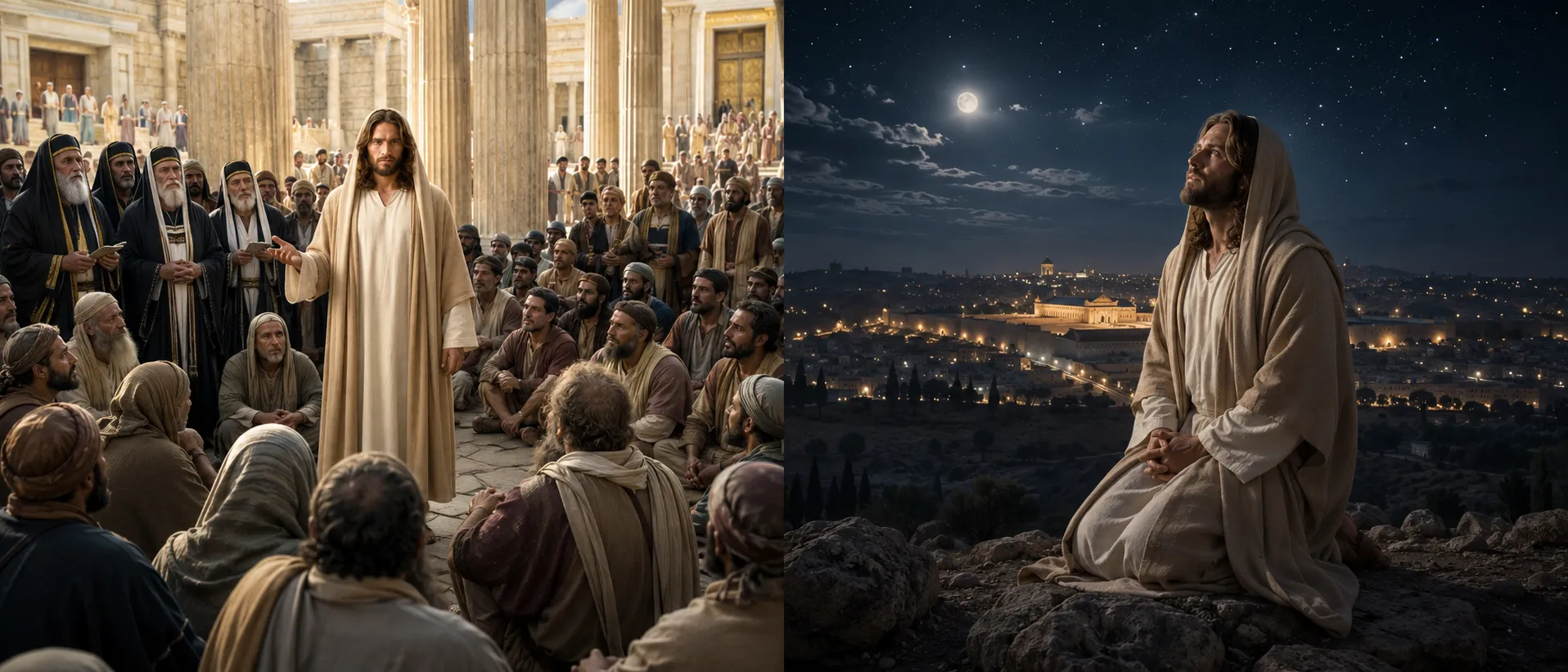
Part I — How “You Must Attend” Became Doctrine
1. Paul, not Jesus, builds the institution
Jesus never wrote an ekklesia charter. He gathered disciples, taught in the open air, in homes, on boats, on hillsides. The word ekklesia (“church,” “assembly”) appears on his lips only twice in all four Gospels (Matthew 16:18, 18:17), and both instances are contested by scholars as later editorial insertions into Matthew, since Mark, Luke, and John never use the word for Jesus at all.
It is Paul — writing before any Gospel was composed — who gives the word ekklesia its theological weight. In Paul’s letters the assembly is not a building or a rite you visit; it is the body of Christ, a corporate organism believers are grafted into (1 Corinthians 12:27, Romans 12:5). Paul is the first to describe communal gathering as structurally necessary to the faith, not merely useful.
2. From “gathering” to “obligation”
The shift from voluntary assembly to required attendance happens gradually, in three stages:
- Paul (mid-1st century): exhorts communities not to “forsake the assembling of yourselves together” — a line actually found in Hebrews 10:25, a Pauline-school text, not an authentic Pauline epistle, but folded into the same corpus and read as Pauline authority for centuries.
- The Pastoral Epistles (late 1st century, pseudonymous): 1 Timothy and Titus introduce church offices — bishop (episkopos), elder (presbyteros), deacon (diakonos) — with qualifications and hierarchy. This is the moment the assembly becomes an institution with gatekeepers.
- The Apostolic and Church Fathers (2nd–4th century): Ignatius of Antioch (d. c. 110) is the first to write explicitly that nothing should be done “without the bishop” — no baptism, no eucharist, no valid gathering apart from institutional sanction. Cyprian of Carthage (d. 258) sharpens this into the famous axiom extra ecclesiam nulla salus — “outside the church, no salvation.” By the time of Augustine (d. 430), non-attendance is treated as a mark of heresy or schism, not personal piety.
So the line runs: Jesus gathers informally → Paul theorizes the “body” → the Pastorals institutionalize offices → the Fathers make attendance a soteriological requirement. Doctrine about needing the building and the officeholder is a second- and third-generation development, several steps removed from Jesus himself.
3. Whose God is being worshipped in that building?
Paul’s theology centers overwhelmingly on the crucified and risen Christ as the object of proclamation, and God the Father as the one who raised him (Romans 10:9, Galatians 1:1). Paul rarely lingers on Jesus’s own private religious practice — his letters are almost silent on Jesus’s habits of prayer, fasting, or worship location. The Jesus of Paul’s letters is a theological figure, the risen Lord; the Jesus of the Gospels is a man with an observable daily rhythm, including where he does and doesn’t pray. This is the seam this article works: Paul built the institution people are told to attend; the Gospels show us what Jesus himself actually did with his own body, inside and outside that same institutional system.
Part II — What Jesus Actually Did in the Institutions (and What He Didn’t)
4. Synagogue and Temple: teaching, reading, healing — never prayer
Across Matthew, Mark, Luke, and John (MMLJ), Jesus enters synagogues repeatedly. Every recorded activity inside one falls into three categories:
- Teaching — Mark 1:21, Luke 4:15, Matthew 4:23, John 6:59
- Reading Scripture aloud — Luke 4:16–20 (Nazareth, reading Isaiah)
- Healing — Mark 3:1–5, Luke 13:10–13, Matthew 12:9–13
The Temple pattern is identical in kind, only larger in scale: teaching daily (Luke 19:47, 21:37), debating the authorities (Mark 11:27–33), and the dramatic act of overturning the money-changers’ tables (Mark 11:15–17, Matthew 21:12–13, Luke 19:45–46). Not one narrated verse shows Jesus kneeling, bowing, or in silent address to God while inside either structure.
5. Where he does pray — and the pattern is relentless
| Reference | Location of prayer |
|---|---|
| Mark 1:35 | a “desolate place,” before dawn |
| Luke 5:16 | “the wilderness” — habitual |
| Luke 6:12 | a mountain, all night |
| Matthew 14:23 / Mark 6:46 | a mountain, alone, after dismissing the crowd |
| Luke 9:18, 9:28–29 | apart from the crowd, on a mountain |
| Luke 22:39 / Mark 14:32 / Matthew 26:36 | Gethsemane, a garden, having withdrawn from even his own disciples |
| Luke 21:37 | Mount of Olives, nightly, after leaving the Temple precinct |
Luke 21:37 is the hinge verse for your argument: it explicitly places teaching inside the Temple by day and withdrawal outside it, to the Mount of Olives, by night — in the same 24-hour cycle, described back to back. The Gospel writer is, whether deliberately or not, drawing the line for us: Temple by day for public instruction, hillside by night for private address to the Father.
6. The one apparent counter-example, and why it doesn’t hold
The strongest text against this pattern is the Temple-cleansing citation of Isaiah 56:7 — “My house shall be called a house of prayer” (Matthew 21:13, Mark 11:17, Luke 19:46). But as established earlier in this exchange, this Isaiah citation is absent from John’s independent account of the same event (John 2:14–16), which only has Jesus reference “my Father’s house,” with no Isaiah quotation at all. Since Matthew, Mark, and Luke share a literary relationship (the Synoptic Problem), this is arguably one written tradition, not three independent testimonies — and even on its own terms, the line is Jesus citing what the building is supposed to be for others, in a rebuke, not Jesus engaging in prayer there himself. No Gospel narrates him praying in that moment; he speaks, then acts, then leaves.
Part III — Whose Name Sits Behind the Veil
7. The structural logic of the Temple
The Jerusalem Temple was built around one architectural fact: the Holy of Holies (Hebrew: קֹדֶשׁ הַקֳּדָשִׁים, qodesh ha-qodashim), the innermost chamber, separated by a veil (Greek: καταπέτασμα, katapetasma), which housed — in the First Temple — the Ark bearing the name יהוה (YHWH, “Yahweh”), and which no one but the high priest entered, once a year, on Yom Kippur (Leviticus 16). The synagogue, architecturally and liturgically, is a satellite of this same system — its prayers (the Amidah, the Shema) are addressed to the same divine Name.
To pray inside either structure, in first-century Jewish practice, is definitionally to address Yahweh, the covenant name bound to that specific architecture and that specific curtained chamber.
8. Jesus’s own vocabulary for God, and where he uses it
This is where the Greek matters and should be handled carefully rather than overstated.
- πατήρ (patēr, “father”) — Jesus’s overwhelmingly preferred address, especially in John (over 100 uses) and in the Synoptic prayer texts. In Gethsemane, Mark preserves the Aramaic underneath the Greek directly: Ἀββᾶ ὁ πατήρ (Abba ho patēr, Mark 14:36) — “Abba, Father.” Abba is an intimate, familial Aramaic form, closer to “Papa” than a liturgical title. This address is used in every recorded instance of Jesus praying outside the institutions.
- θεός (theos, “God”) — the generic term Jesus uses when he is citing Scripture to others, inside or in front of institutional authorities — e.g., quoting Deuteronomy 6:16 to Satan (“You shall not put the Lord your God, Kyrion ton Theon, to the test,” Matthew 4:7), or in the Great Commandment exchange in the Temple courts (“the Lord our God, Kyrios ho Theos hēmōn, is one,” Mark 12:29, quoting the Shema directly). Notably, this is Jesus quoting Torah’s own language back — Kyrios (Lord) here stands in for the Tetragrammaton in the Septuagint tradition, so this is explicitly Yahweh-language, and it is used precisely in the institutional, public, citational context — not in his personal address of prayer.
- κύριος (kyrios, “Lord”) — used when speaking of God in the third person to a public or adversarial audience, again almost always inside or facing the institutional structure (Temple debates, wilderness temptation, quoting the Law).
The pattern that emerges from the Greek itself: when Jesus is inside the institutional frame — Temple, synagogue, debate with scribes — his God-language is citational and third-person (Theos, Kyrios, quoting Torah). When he withdraws to pray alone, his address becomes direct, first-person, and familial (Pater, Abba). The vocabulary itself shifts at the threshold of the building.
9. Jesus names the distinction himself
The pattern of behavior — third-person, citational, institutional language inside the Temple and synagogue; first-person, intimate, familial address outside them — is not left for readers to infer alone. Jesus states the distinction directly, in the Temple itself, in John’s Gospel:
John 8:54 — Greek: ἐὰν ἐγὼ δοξάσω ἐμαυτόν, ἡ δόξα μου οὐδέν ἐστιν· ἔστιν ὁ πατήρ μου ὁ δοξάζων με, ὃν ὑμεῖς λέγετε ὅτι θεὸς ἡμῶν ἐστιν English: “If I glorify myself, my glory is nothing. It is my Father who glorifies me, of whom you say, ‘He is our God’ (ho theos hēmōn, ‘our God’).”
Read plainly, in its own setting — spoken to the Temple authorities, inside the Temple precinct, in a dispute over identity and origin — Jesus draws a line between two referents in the very same sentence: ὁ πατήρ μου (ho patēr mou, “my Father”) and θεὸς ἡμῶν (theos hēmōn, “our God,” i.e. Yahweh, the God the authorities claim, tied to the Temple, the covenant, the Name behind the veil). He does not say “my Father, whom you also call your God.” He says: my Father — the one you call your God. The distinction is spoken by his own mouth, in Greek, on the record, standing inside the very institution built around that other Name.
Word-by-word:
| Greek | Transliteration | English | Function |
|---|---|---|---|
| ἔστιν | estin | “is” | verb, “it is” |
| ὁ πατήρ μου | ho patēr mou | “my Father” | Jesus’s own designation, first person possessive |
| ὁ δοξάζων με | ho doxazōn me | “the one glorifying me” | describes what the Father does |
| ὃν | hon | “whom” | relative pronoun, points back to “my Father” |
| ὑμεῖς λέγετε | hymeis legete | “you [plural] say” | shifts voice — this is now their words, not his |
| ὅτι | hoti | “that” | introduces the quoted claim |
| θεὸς ἡμῶν | theos hēmōn | “our God” | their designation, first person plural possessive |
| ἐστιν | estin | “is” | closes the claim |
Why the possessives matter:
The whole sentence turns on two small Greek pronouns doing a lot of work: μου (“my,” attached to patēr) and ἡμῶν (“our,” attached to theos). In this sentence, Jesus does not say theos mou — “my God.” He says patēr mou — “my Father.” The phrase “our God” belongs grammatically to a different speaker inside his own sentence: ὑμεῖς (“you,” the Pharisees), not to Jesus. He is reporting their language, not adopting it.
The relative clause (ὃν… ὅτι…):
Hon (“whom”) loops back to “my Father” and introduces a reported claim about him: “…whom you say is our God.” The construction ὑμεῖς λέγετε ὅτι (“you say that”) is indirect/reported speech, not a direct quotation. Grammatically this is Jesus reporting a claim, not making one. He states what he calls his Father in his own voice (patēr mou), then states, in reported speech, what his opponents call that same figure (theos hēmōn). The sentence structure keeps those two labels in two separate mouths.
What this does and doesn’t lock down:
The Greek doesn’t contain a flat assertion like “my Father is not your God” — no verse does that work in isolation, and given who transmitted these texts, none would survive if it had. What the Greek does lock down is the distinction in voice and possession: Jesus’s word for the one he addresses is Father, first person, intimate, his own; the Temple authorities’ word is God, first person plural, institutional, theirs. That grammatical seam is exactly where this article’s larger case sits — not on this verse standing alone, but on this verse as one more thread in the same rope: what Jesus calls him, and where Jesus goes to speak to him, are consistently different from what the Temple calls him, and where the Temple keeps him.
This is why the behavioral pattern traced through this whole piece is not incidental. The Temple and the synagogue are Yahweh’s architecture — his Name in the box behind the curtain, his covenant read aloud from the scroll, his Law debated in the courts. Jesus goes there because his mission touches that people and that Law; he teaches there, reads there, heals there, confronts the authorities of that house there. But when he prays — when he actually addresses the one he is in relationship with — he leaves. Every single time. Mountain, wilderness, garden, hillside, before dawn, after dark. He does not kneel behind the veil. He does not address Yahweh in the Holy of Holies. He walks out from under that roof and speaks to his Father in the open air, using a word — Abba — that belongs to no liturgy, no priesthood, no institution at all.
That is the conclusion the text itself draws, in its own Greek, without needing anything imported from outside it: Jesus left the house of Yahweh in order to commune with his Father. The two were not, for him, the same address — and he says so, standing in the Temple, to the men who insisted they were.
Sources for the passages above are drawn directly from the Matthew/Mark/Luke/John texts discussed in this conversation, cross-checked against the Greek New Testament (NA28/UBS5 critical text) for the terms cited.