Was Jesus's Sacrifice Real? Examining the "Bad Weekend" Objection
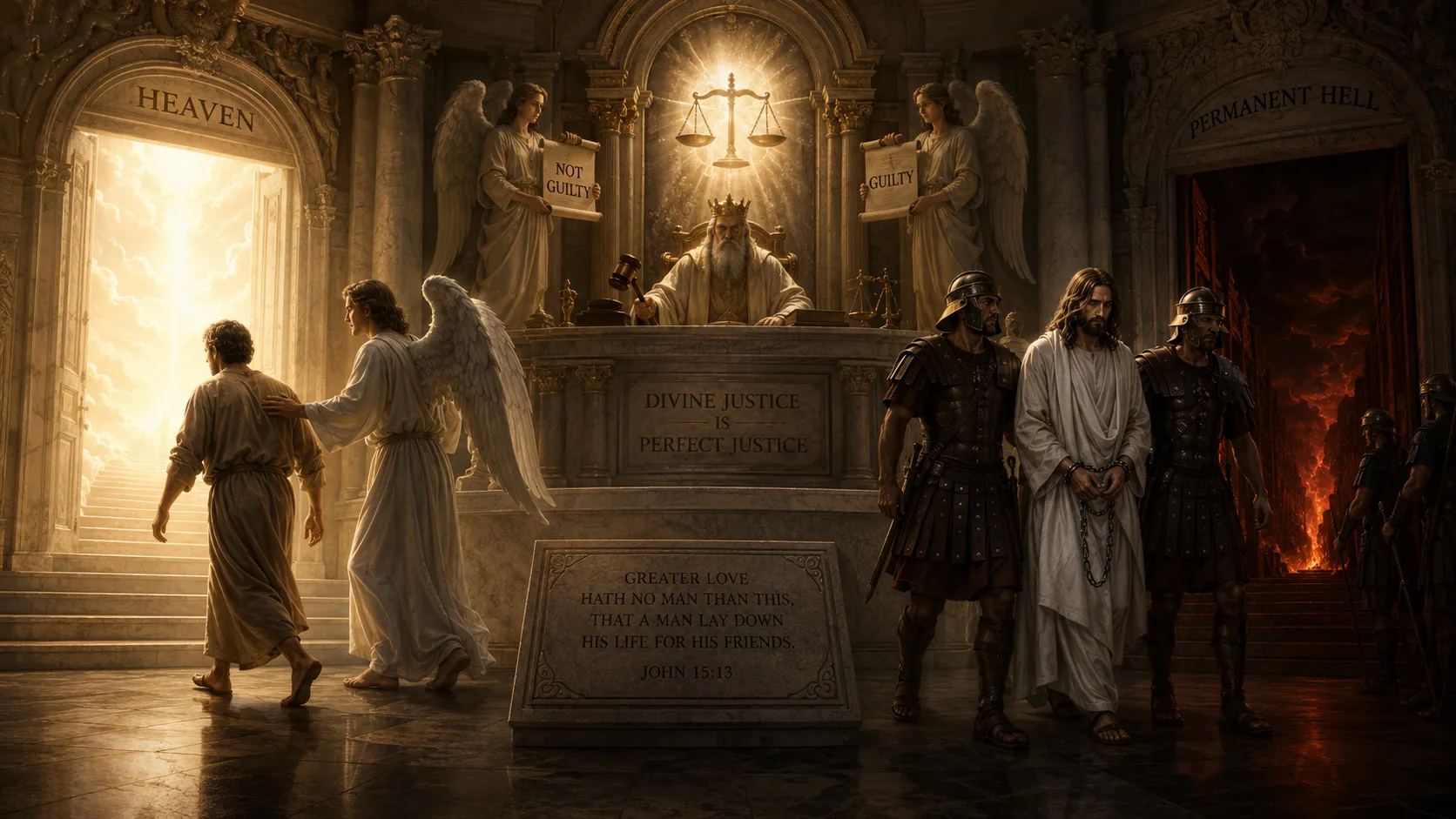
I. The Premise
Christian theology claims Jesus died on the cross to pay for the sins of humanity — taking on himself the punishment that would otherwise be due to every believer. The sequence given is: he suffered, died, spent three days in the realm of the dead, and then resurrected, returning to his prior glory (and more).
The challenge posed against this: if Jesus knew the outcome in advance, retained his divine identity throughout, and got everything back (plus exaltation) after three days, in what sense did he actually lose anything? A temporary loss with a guaranteed, better-than-even return looks less like sacrifice and more like a costume change — a “bad weekend,” as the objection puts it.
This document lays out the Christian position, the objection, and then the logical resolution required by the premise itself: if something is sacrificed, it does not return.
II. The Christian Position and Its Historical Precedent
The classical formulation rests on a few doctrinal pillars:
- The Incarnation as the start of the sacrifice. Philippians 2:6–8 describes Christ as not counting equality with God “a thing to be grasped,” but emptying himself, taking the form of a servant, and becoming obedient to death. On this reading, the sacrifice didn’t begin at Calvary — it began when the eternal Son took on human limitation at all.
- Penal substitution. Rooted in passages like Isaiah 53 (“he was pierced for our transgressions”) and 2 Corinthians 5:21 (“he made him to be sin who knew no sin”), the mainstream Protestant and much of the broader Christian tradition holds that Jesus bore the legal penalty for sin in the place of humanity — a transaction, not merely an example of suffering.
- Historical development. This is not a single, static doctrine. The early church emphasized Christus Victor (Christ’s death and resurrection as a victory over death and the powers of evil) more than a strict legal transaction. Anselm of Canterbury (11th century) formalized “satisfaction” theory — sin incurs a debt of honor to God that only a God-man can pay. The Reformers (Calvin especially) sharpened this into penal substitution: Christ bearing the punishment, not just the debt. So “what Jesus paid” has meant different things across church history — a ransom, a debt of honor, a legal penalty, a defeat of death itself.
- The suffering was still real, whatever its duration. Apologists argue duration is the wrong metric — a person tortured for one hour still suffered something real; measuring sacrifice purely in elapsed time misses the qualitative horror of the event (betrayal, scourging, crucifixion, the cry of dereliction “My God, my God, why have you forsaken me?”).
III. The Opponent Position: Nothing Was Actually Lost
The counter-argument, sharpened by the casino/janitor/CEO analogies, runs like this:
- Certainty defeats the concept of loss. Genuine sacrifice requires risk — the real possibility of failure or permanent forfeiture. If Jesus, as fully God, knew with certainty he would rise in three days and return to glory, there was no risk. A gambler who is guaranteed to win his money back hasn’t gambled.
- He kept what mattered. Nothing essential was forfeited: not his divine nature, not his identity, not his eventual position. He didn’t even lose control — the entire event unfolded, on Christian premises, according to his own sovereign plan.
- He got more, not less. He returned not merely intact but exalted — worshipped by billions, seated at the right hand of the Father, given “the name above every name.” A transaction where the “cost” comes back with interest is hard to call a cost at all.
- The comparison class is damning. Humans who sacrifice — a mother trading her life for her child’s, a soldier who dies and stays dead — do not know the outcome, cannot undo the cost, and may lose everything permanently. By that standard, Jesus’s ordeal, however brutal in the moment, differs in kind, not just degree, from what we normally mean by “sacrifice.”
- The “incarnation as sacrifice” defense doesn’t rescue it either. Even granting 33 years instead of three days, an eternal being giving up 0% of infinity, with full knowledge of the return, still isn’t the same category of loss faced by finite creatures who have no guarantee of anything.
The sharpest form of the objection: for the sacrifice to mean what Christians claim it means, something has to be genuinely, permanently gone. Otherwise the word “sacrifice” is being used equivocally — borrowing its emotional weight from ordinary human sacrifice while not meeting its actual conditions.
IV. A Proposed Resolution: The Permanent Loss Model
The objection above is strongest against a model where Jesus’s cost is temporary — three days, or 33 years, followed by full restoration. But there’s a different way to state the mechanism of substitution, one that locates the loss not in the crucifixion weekend, but in what substitution actually requires if taken to its logical end.
The claim: if Jesus is to actually pay for a person’s sin — not symbolically, but as a real substitution — then he must occupy the place that person would have occupied. And the place a condemned, unforgiven sinner would have occupied is not “three days in the realm of the dead.” It’s eternal separation from God — what Christian theology calls hell — forever.
Worked through an example: Bob is a believer, but suppose the demand of justice is that someone must bear Bob’s specific penalty in full for the trade to be real. If Bob goes to heaven, and the substitution is genuine rather than symbolic, then the eternal, unending portion of the penalty Bob would have faced has to land somewhere. On this model, it lands on Christ — not for a weekend, but permanently. A “portion” of what is paid on Bob’s behalf is not recovered in three days; it is carried without end, in the same way Bob’s alternative fate would have been without end.
Under this framing, the resurrection is not a refund of the sacrifice — it’s the vindication of Jesus’s own person and mission (the divine Son is raised, death is defeated, the tomb is empty) without that vindication canceling the substitutionary debt actually paid on behalf of each individual sinner. The two things — Christ’s own resurrection glory, and the eternal weight transferred away from the believer — are treated as separable: one is restored, the other is not, because it was never Christ’s own to begin with; it was a debt he took on in another’s place, and a debt paid in another’s place is not owed back to the one who paid it.
This reframing directly answers the “bad weekend” objection on its own terms:
- It removes the certainty-of-return problem, because the thing lost (the borne penalty) is not the thing that returns. Jesus’s own resurrection and glorification is real and total — but it is categorically distinct from the penalty transferred to him on behalf of the believer, which is not undone by his rising.
- It removes the “nothing permanent was lost” problem, because on this model something is permanent: the eternal component of the penalty, carried without end, for every individual sinner it was accepted on behalf of.
- It reframes what the resurrection actually proves. It isn’t evidence the sacrifice was undone; it’s evidence that the one making the payment had the standing and power to make it, and that his own identity survives the transaction — while the transaction’s cost still stands, transferred.
The strength of this model is that it takes the opponent’s central demand seriously — something permanent must be lost for this to be a real sacrifice — rather than disputing the premise. Whether it succeeds depends on whether one accepts that a “loss” can be real and eternal even while the one who bears it is otherwise unharmed and glorified — a question that ultimately returns to what one considers the essential nature of substitutionary atonement to require.