Christianity: Judaism’s Poor Imitation
An argument, not a verdict: the case as its proponents would frame it, examined through the Greek text rather than through inherited doctrine.
The Basic Claim
One way of reading the relationship between Judaism and Christianity is as an original and a copy: Judaism supplies concrete institutions, including a Temple, a priesthood, a sacrifice, and a calendar, while Christianity supplies a spiritualized, often metaphorical echo of them. On this reading, Christianity doesn’t invent new content so much as it relocates Jewish content into the person of Jesus, or into a new institution built to stand in for the old one. Whether that relocation is a fulfillment or a dilution is precisely what’s contested. This article lays out the parallels and lets the Greek and Hebrew vocabulary itself show what work each term is actually doing, rather than assuming the theological gloss that later doctrine placed on it.
Below are the major parallels, each followed by the original-language text usually cited for it, a plain English rendering, and a short note on what the word choice actually claims, as opposed to what preaching has claimed on its behalf.
1. Belief: An Uncreated God vs. a Person Called God
Judaism: God is worshipped directly, without mediation, as the sole uncreated being who identifies himself by a proper name.
Deuteronomy 6:4 (Hebrew): שְׁמַע יִשְׂרָאֵל יְהוָה אֱלֹהֵינוּ יְהוָה אֶחָד English: “Hear, O Israel: the LORD our God, the LORD is one.”
Christianity: belief is directed at a specific human being, identified with God.
John 20:28 (Greek): ὁ Θωμᾶς εἶπεν αὐτῷ, Ὁ κύριός μου καὶ ὁ θεός μου. English: “Thomas said to him, My Lord and my God!”
The Hebrew אֶחָד (echad, “one”) asserts a numerical, undivided singularity attached to a name, YHWH, never applied to a human figure elsewhere in the Hebrew Bible. The Greek in John is a confession spoken to a man standing in a room, grammatically a vocative address to a visible, touchable body. The object of belief has moved from an unseen, unified, named deity to a specific, physically located human individual.
2. Ritual Cleansing in Worship: Blood vs. Water
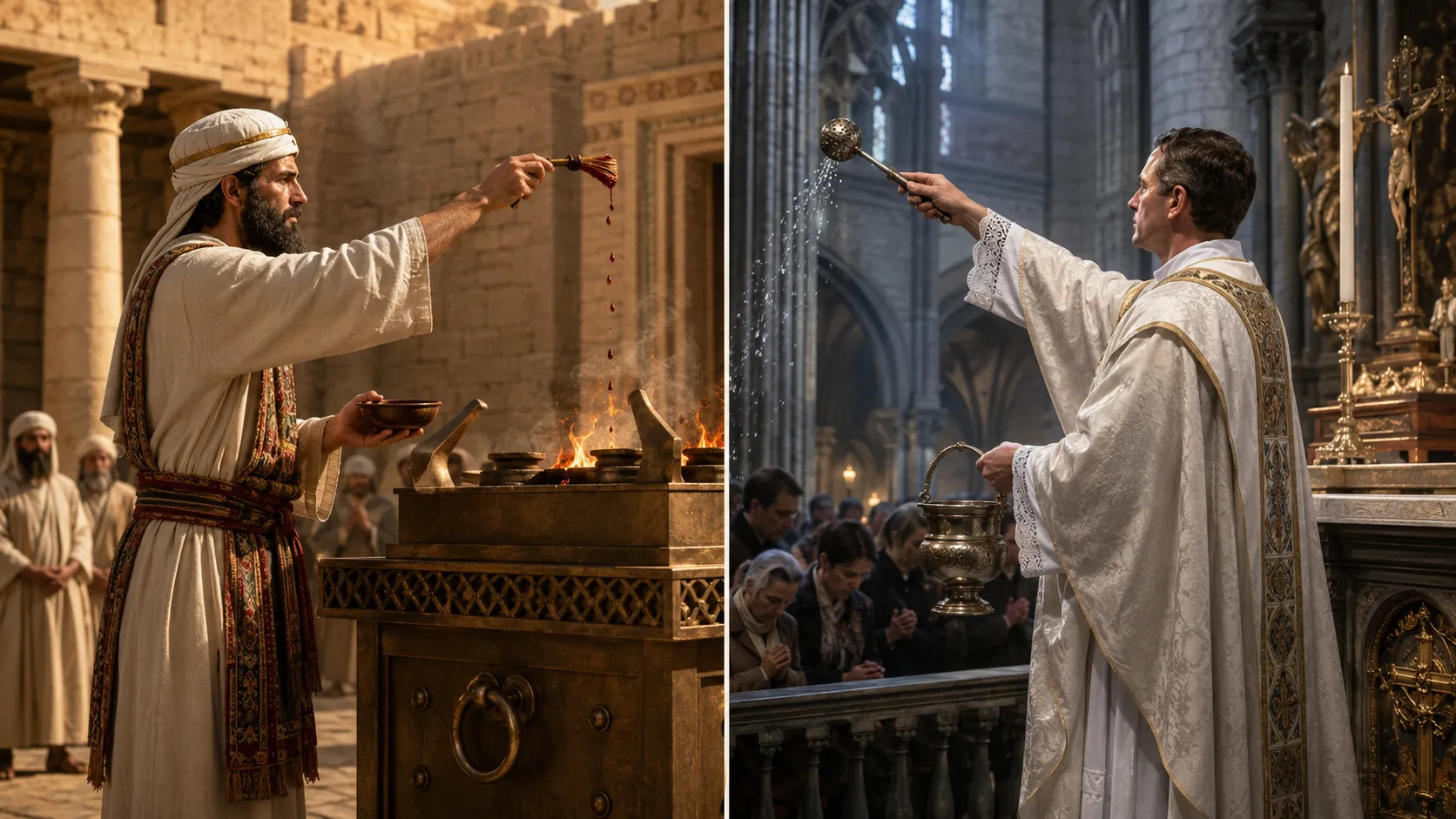
Judaism: Temple worship uses the blood of sacrificial animals in prescribed rites of atonement, purification, and consecration. The blood is physically applied to the altar, sacred objects, priests, or the people according to a written procedure (Leviticus 16; Exodus 24:6-8).
Christianity: liturgical churches retain the same visible act of sprinkling a congregation or sacred space, but replace sacrificial blood with holy water.
The parallel here is not baptism. It is the public cleansing rite performed during worship: a priestly figure applies a liquid to people, objects, or a sacred space as a sign of purification and blessing. Judaism’s rite uses the blood of an actual sacrifice commanded in the Torah. Christianity preserves the outward form, including a consecrated liquid, a priestly officiant, and ritual sprinkling, while substituting water for blood. The institution remains recognisably similar even though the substance and claimed mechanism have changed.
3. Forgiveness of Sins: A Direct Claim vs. a Delegated Claim
Judaism: forgiveness is God’s alone to grant, directly, without any human intermediary’s authority being in question (Isaiah 43:25: “I, even I, am he who blots out your transgressions”).
Christianity: a human figure is recorded pronouncing forgiveness, provoking immediate controversy among witnesses.
Mark 2:7 (Greek): τίς δύναται ἀφιέναι ἁμαρτίας εἰ μὴ εἷς ὁ θεός; English: “Who can forgive sins but God alone?”
The text preserves the objection as a live question rather than resolving it narratively. The scribes’ challenge, “who can forgive sins but God alone,” is left standing in the text as the terms of the dispute. Ἀφιέναι (“to forgive/release”) is the same verb used of God throughout the Septuagint; its application to a human speaker is exactly what generates the recorded controversy. Judaism’s claim requires no argument to establish who holds the authority; Christianity’s claim is introduced as a disputed assertion that the text itself flags as needing defense.
4. Covenant: Abraham’s Descendants vs. Twelve Representatives of Humanity
Judaism: the covenant is cut with Abraham and extended to his physical descendants as an everlasting covenant (Genesis 17:7: “an everlasting covenant… to be God to you and your descendants after you”). Its sign is circumcision, and its human parties are explicitly identified.
Christianity: Jesus announces a new covenant to the twelve at the Last Supper.
Luke 22:20 (Greek): Τοῦτο τὸ ποτήριον ἡ καινὴ διαθήκη ἐν τῷ αἵματί μου. English: “This cup is the new covenant in my blood.”
Διαθήκη (diathēkē) is the same word the Septuagint uses for covenant. The declaration is made in one room to twelve followers, who then function in Christianity as representatives of the new community. Paul expands that community beyond Abraham’s physical descendants and makes participation depend on belonging to Christ rather than descent, circumcision, and the covenantal structure given to Abraham.
Galatians 3:28-29 (Greek): πάντες γὰρ ὑμεῖς εἷς ἐστε ἐν Χριστῷ Ἰησοῦ. εἰ δὲ ὑμεῖς Χριστοῦ, ἄρα τοῦ Ἀβραὰμ σπέρμα ἐστέ, κατ’ ἐπαγγελίαν κληρονόμοι. English: “For you are all one in Christ Jesus. And if you belong to Christ, then you are Abraham’s seed, heirs according to promise.”
The replacement is therefore structural. Judaism locates covenant membership in Abraham’s descendants under an everlasting covenant marked in the body. Christianity announces a covenant through Jesus to twelve men and then universalises Abrahamic inheritance through attachment to Christ. From the Jewish perspective, a declaration at a meal cannot transfer, cancel, or supersede the covenant YHWH established with Abraham and his descendants.
5. Circumcision: A Commanded Physical Sign vs. Its Removal
Judaism: circumcision is a literal physical procedure commanded by YHWH as the sign of the everlasting covenant with Abraham and his male descendants.
Genesis 17:11 (Hebrew): וּנְמַלְתֶּם אֵת בְּשַׂר עָרְלַתְכֶם וְהָיָה לְאוֹת בְּרִית בֵּינִי וּבֵינֵיכֶם English: “You shall circumcise the flesh of your foreskin, and it shall be a sign of the covenant between me and you.”
Christianity: Paul explicitly removes physical circumcision as a requirement and relocates covenant identity into Christ.
Galatians 5:2 (Greek): ἐὰν περιτέμνησθε, Χριστὸς ὑμᾶς οὐδὲν ὠφελήσει. English: “If you are circumcised, Christ will be of no benefit to you.”
Colossians then retains the word while detaching it from the body:
Colossians 2:11 (Greek): περιετμήθητε περιτομῇ ἀχειροποιήτῳ. English: “You were circumcised with a circumcision made without hands.”
Genesis requires an observable mark in the flesh. Paul says that accepting that physical sign as a covenantal requirement is incompatible with his gospel, while Christian language preserves “circumcision” as an inward, non-physical condition. The original sign is not merely reinterpreted; it is declared unnecessary and replaced by an unverifiable metaphor.
6. A New Heart vs. a New Creation
Judaism: YHWH promises to renew his people by giving them a new heart and a new spirit.
Ezekiel 36:26 (Hebrew): וְנָתַתִּי לָכֶם לֵב חָדָשׁ וְרוּחַ חֲדָשָׁה אֶתֵּן בְּקִרְבְּכֶם English: “And I will give you a new heart, and a new spirit I will put within you.”
Christianity: Paul duplicates the same pattern of inward renewal but relocates it into belonging to Christ.
2 Corinthians 5:17 (Greek): ὥστε εἴ τις ἐν Χριστῷ, καινὴ κτίσις· τὰ ἀρχαῖα παρῆλθεν, ἰδοὺ γέγονεν καινά. English: “So then if anyone is in Christ, there is a new creation; the old things have passed away. Behold, new things have come.”
The parallel does not depend on whether either transformation is physical, legal, mystical, or psychological. The structure is the same: an old human condition is replaced by a new inward condition. Ezekiel attributes that renewal directly to YHWH within Israel’s restoration. Paul reproduces the transformation as a “new creation” whose defining condition is being “in Christ.” The Jewish promise is retained, but its centre is moved from YHWH’s direct action toward identification with Jesus.
7. Priesthood: A Living High Priest vs. a Living Supreme Pontiff
Judaism: the High Priest is a living, earthly officeholder. He occupies a defined institutional position, performs public rites, exercises real authority, and can be approached as an actual person. The office continues from one human holder to the next within a prescribed succession (Leviticus 16; Numbers 20:25-28).
Catholic Christianity’s earthly equivalent: the Pope.
The comparison here is institutional rather than theological. Christianity may call Jesus its heavenly High Priest, but Jesus is not an earthly officeholder who can be approached for an audible ruling, questioned in real time, or observed administering the institution. The Pope is.
The Pope occupies a fixed seat, succeeds earlier officeholders, governs doctrine and ritual, appoints subordinate clergy, and exercises continuing jurisdiction over the faithful. That makes the Papacy the closest earthly Christian duplication of the Jewish High Priesthood: a living man at the summit of a religious hierarchy, occupying an enduring office that outlives each individual holder.
The parallel applies specifically to Catholic Christianity. Other Christian traditions reject papal jurisdiction, but Catholicism preserves the clearest earthly equivalent of a continuing supreme priestly office.
8. Atonement: A Recurring Sacrifice vs. a Single Sacrifice
Judaism: Temple sacrifices for atonement are offered repeatedly, daily, at festivals, and above all on Yom Kippur, as an ongoing system maintained continuously by a functioning priesthood (Leviticus 16:34: “this shall be an everlasting statute”).
Christianity: atonement is claimed as a single, unrepeated event.
Hebrews 10:10 (Greek): ἡγιασμένοι ἐσμὲν διὰ τῆς προσφορᾶς τοῦ σώματος Ἰησοῦ Χριστοῦ ἐφάπαξ. English: “We have been sanctified through the offering of the body of Jesus Christ once for all.”
Ἐφάπαξ (ephapax, “once for all”) is used specifically to contrast with the Levitical system’s repetition. The same passage explicitly says the old sacrifices had to be repeated “year after year” (Hebrews 10:1) precisely because they couldn’t finish the job permanently. The claim in Hebrews is not a minor variant of the old system; it is a claim that the entire logic of repeated, ongoing sacrifice has been replaced by a single non-repeatable event, which is a structurally different kind of institution: one occurrence rather than a maintained system.
9. Repentance and Restitution vs. Salvation by Grace
Judaism: repentance (teshuvah) requires concrete correction: returning what was stolen, repairing harm, changing conduct, and doing what is right.
Ezekiel 33:14-15 (Hebrew): חָבוֹל יָשִׁיב רָשָׁע גְּזֵלָה יְשַׁלֵּם בְּחֻקּוֹת הַחַיִּים הָלַךְ לְבִלְתִּי עֲשׂוֹת עָוֶל חָיוֹ יִחְיֶה לֹא יָמוּת English: “If the wicked restores the pledge, repays what he stole, and walks in the statutes of life without committing injustice, he shall surely live; he shall not die.”
Pauline Christianity: salvation is presented as a free gift received through faith, explicitly not as the result of works.
Ephesians 2:8-9 (Greek): τῇ γὰρ χάριτί ἐστε σεσῳσμένοι διὰ πίστεως· καὶ τοῦτο οὐκ ἐξ ὑμῶν, θεοῦ τὸ δῶρον· οὐκ ἐξ ἔργων, ἵνα μή τις καυχήσηται. English: “For by grace you have been saved through faith, and this is not from yourselves; it is God’s gift, not from works, so that no one may boast.”
The contrast is direct. Ezekiel’s standard is visible and reparative: the wrongdoer must restore, repay, and change behaviour. Paul’s formula makes salvation a gift mediated through faith and expressly denies that it comes “from works.” Christian teaching may still encourage good conduct afterward, but the order has changed. In Judaism, repentance is demonstrated through corrective action; in Pauline Christianity, salvation is first granted freely through faith in Christ, and works are treated as its consequence rather than its basis.
10. The Day of Atonement vs. Good Friday and Easter
Judaism: Yom Kippur is an annual, recurring, fixed-calendar observance (Leviticus 23:27: “on the tenth day of this seventh month”), repeated every year without exception, tied to a specific date every believer can independently track.
Christianity: the atonement event is located at a single point in historical time, commemorated afterward rather than repeated as the mechanism itself.
Romans 6:10 (Greek): ὃ γὰρ ἀπέθανεν, τῇ ἁμαρτίᾳ ἀπέθανεν ἐφάπαξ. English: “For the death he died, he died to sin once for all.”
Again ἐφάπαξ (“once for all”) marks the event as historically singular rather than calendrically recurring. Good Friday and Easter, as later observed, are memorials of a past event, not independent occasions on which atonement itself recurs. They are structurally closer to a monument than to Yom Kippur’s yearly, self-contained ritual mechanism.
11. Passover’s Lamb vs. the Lamb of God
Judaism: a specific, physical lamb is slaughtered by each household, its blood applied to doorposts, consumed as food, on a fixed date, as a repeatable national commemoration (Exodus 12:3-13).
Christianity: the label is transferred to a person.
John 1:29 (Greek): Ἴδε ὁ ἀμνὸς τοῦ θεοῦ ὁ αἴρων τὴν ἁμαρτίαν τοῦ κόσμου. English: “Behold, the Lamb of God, who takes away the sin of the world!”
Ἀμνός (“lamb”) applied to a person is a title, not a description of an animal being slaughtered, its blood collected, and applied to a specific physical location as Exodus 12 describes in procedural detail. The Passover lamb is a repeatable domestic ritual performed by every household annually; “Lamb of God” is a one-time title assigned to one person, with no household-level ritual of blood-application attached to it at all.
12. Sacred Bread: The Temple Table vs. the Eucharistic Table
Judaism: the Lechem HaPanim (“Bread of the Presence,” Leviticus 24:5-9) consists of twelve physical loaves baked, arranged before YHWH, renewed every week, and eaten by priests in the Temple as a perpetual institution.
Christianity: the Eucharist establishes a recurring sacred bread rite centred on Jesus and maintained by the Church.
1 Corinthians 11:23-24 (Greek): Ἐγὼ γὰρ παρέλαβον ἀπὸ τοῦ κυρίου, ὃ καὶ παρέδωκα ὑμῖν, ὅτι ὁ κύριος Ἰησοῦς ἐν τῇ νυκτὶ ᾗ παρεδίδετο ἔλαβεν ἄρτον καὶ εὐχαριστήσας ἔκλασεν καὶ εἶπεν, Τοῦτό μού ἐστιν τὸ σῶμα τὸ ὑπὲρ ὑμῶν· τοῦτο ποιεῖτε εἰς τὴν ἐμὴν ἀνάμνησιν. English: “For I received from the Lord what I also delivered to you: that the Lord Jesus on the night he was betrayed took bread, and when he had given thanks, he broke it and said, This is my body, which is for you; do this in remembrance of me.”
This is not a claim that the Eucharist is equivalent to Passover. Passover commemorates Israel’s liberation from slavery in Egypt. The Eucharist commemorates Jesus and identifies the bread with his body.
The structural duplication lies elsewhere. Both religions maintain a recurring sacred bread institution under priestly or clerical supervision. Judaism places the bread before YHWH in the Temple and reserves it for the priests. Christianity places consecrated bread at the centre of church worship and redirects its meaning toward Jesus. The physical object and repeated institution remain; the referent and claimed function are replaced.
13. Manna vs. “Bread of Life”
Judaism: manna is a literal, physical food that fell from the sky daily for forty years, gathered, measured, and eaten by an entire nation as sustenance (Exodus 16:14-15, 35).
Christianity: the same category of provision is claimed metaphorically.
John 6:35 (Greek): Ἐγώ εἰμι ὁ ἄρτος τῆς ζωῆς· ὁ ἐρχόμενος πρός με οὐ μὴ πεινάσῃ. English: “I am the bread of life; whoever comes to me shall not hunger.”
The construction ἐγώ εἰμι + predicate noun (“I am ___”) is the same grammatical pattern used for “I am the door” and “I am the vine” elsewhere in John. It is a metaphor, not a food description. Manna is a physical substance with a measurable daily quantity (an omer per person, Exodus 16:16) that an entire camp of people gathered and ate; “bread of life” describes no substance, has no quantity, and is eaten by no one in any literal sense. Hunger here is used figuratively, paired two verses later with “never thirst,” about someone who believes, not someone who eats.
14. Torah vs. the Word Made Flesh
Judaism: the Torah is a fixed, written text, five books forming a specific and stable body of law and narrative that can be read, copied, and checked against itself (Deuteronomy 4:2: “you shall not add to the word… nor take from it”).
Christianity: the “word” is relocated from a text to a person.
John 1:14 (Greek): Καὶ ὁ λόγος σὰρξ ἐγένετο καὶ ἐσκήνωσεν ἐν ἡμῖν. English: “And the Word became flesh and dwelt among us.”
Λόγος (logos, “word”) here takes a verb of becoming, ἐγένετο (“became”), describing a transformation into a body, not a text being written, copied, or transmitted. Torah is a stable document precisely because it does not change or “become” anything; its authority rests on being a fixed, checkable text. A “word” that becomes flesh is, by definition, no longer a text at all. It is a claim about a person’s origin and nature, unverifiable and uncopyable in the way a scroll is.
15. The Temple vs. the Church
Judaism: the Temple in Jerusalem is the authorised national centre of sacrifice, pilgrimage, priesthood, sacred service, and the public worship of YHWH. It is a physical institution with a fixed location, prescribed offices, and rites established in the Torah.
Christianity: the Church becomes the authorised communal body through which worship, teaching, sacraments, discipline, and membership are administered.
1 Corinthians 3:16 (Greek): οὐκ οἴδατε ὅτι ναὸς θεοῦ ἐστε καὶ τὸ πνεῦμα τοῦ θεοῦ οἰκεῖ ἐν ὑμῖν; English: “Do you not know that you are God’s temple and that God’s Spirit dwells in you?”
The Greek ἐστε is plural: Paul addresses the community collectively as God’s temple. Elsewhere Christian texts apply Temple language to Jesus and to individual bodies, but the institutional result is the same. The geographically fixed Temple is replaced by a distributed religious body whose congregations, clergy, sacraments, and buildings carry the functions of organised worship.
Luke 17:21 is disputed between “within you” and “in your midst,” so it is unnecessary to base the argument on whether God’s kingdom is inward or external. In ordinary Christian practice, believers are directed into the Church as the recognised community of salvation, worship, teaching, and sacramental life. The Temple’s role as the central institution of religious belonging is therefore reproduced in the Church, even though Christianity no longer binds that institution to Jerusalem.
16. Sabbath: A Commanded Day vs. a Spiritualised Rest
Judaism: Shabbat is a specific seventh day, defined by cessation from melakhah, observed weekly, and commanded as a covenantal sign tied to creation and the Exodus (Genesis 2:2-3; Exodus 31:16-17; Deuteronomy 5:15).
Christianity: Hebrews retains Sabbath language but relocates it into a theological state entered by God’s people.
Hebrews 4:9-10 (Greek): ἄρα ἀπολείπεται σαββατισμὸς τῷ λαῷ τοῦ θεοῦ· ὁ γὰρ εἰσελθὼν εἰς τὴν κατάπαυσιν αὐτοῦ καὶ αὐτὸς κατέπαυσεν ἀπὸ τῶν ἔργων αὐτοῦ ὥσπερ ἀπὸ τῶν ἰδίων ὁ θεός. English: “So then, a sabbath-rest remains for the people of God; for whoever has entered his rest has also rested from his works, as God did from his own.”
Σαββατισμός preserves the language of Sabbath, but Hebrews no longer defines it as the recurring seventh day governed by Torah. It becomes an enduring divine rest into which a person or community enters. Judaism retains a public, calendrical command that can be observed each week. Christianity retains the concept of Sabbath while shifting it from a fixed day into a spiritual condition associated with faith, perseverance, and entry into God’s rest.
17. Giving: A Legal Tax vs. a Feeling
Judaism: Israelites were obligated to at least three distinct tithes under the Torah, including a Levitical tithe (Leviticus 27:30; Numbers 18:21-24), a festival tithe (Deuteronomy 14:22-27), and a triennial poor-tithe (Deuteronomy 14:28-29), totaling roughly 20-30% of annual produce, legally mandated and enforceable.
Christianity: giving is voluntary and quantified only by internal disposition.
2 Corinthians 9:7 (Greek): ἕκαστος καθὼς προῄρηται τῇ καρδίᾳ, μὴ ἐκ λύπης ἢ ἐξ ἀνάγκης· ἱλαρὸν γὰρ δότην ἀγαπᾷ ὁ θεός. English: “Each one as he has purposed in his heart, not from grief or of necessity, for God loves a cheerful giver.”
Note what has vanished grammatically: there is no percentage, no ἀνάγκη (“necessity,” and the text explicitly rules necessity out), and no enforcement mechanism. Προῄρηται (“has purposed/decided beforehand”) locates the entire obligation inside the individual’s private will. Judaism’s system is auditable. A priest could in principle check whether the tithe was rendered. Christianity’s system, by its own wording, cannot be checked at all; it depends entirely on self-report of an inward state.
18. Worship’s Object
The starkest of the parallels, and the one underneath all the others:
Judaism. Worship God. Christianity. Worship God’s Son.
Every parallel above follows the same shape: Judaism’s referent is God, or a fixed, verifiable institution God directly established (a building, a day, a text, a tax, a rite); Christianity’s referent is either a person believed to represent or embody that referent, or a newer institution (the Papacy, the Eucharist) built to perform the function the original institution performed. Whether that substitution constitutes fulfillment (as Christian theology claims) or substitution-as-diminishment (as the argument in this article holds) depends on whether you think a person, or a newly built office, can be what a Temple, a day, a text, and a law were.