Mary: How Catholic Veneration Developed, and What Jesus Himself Said
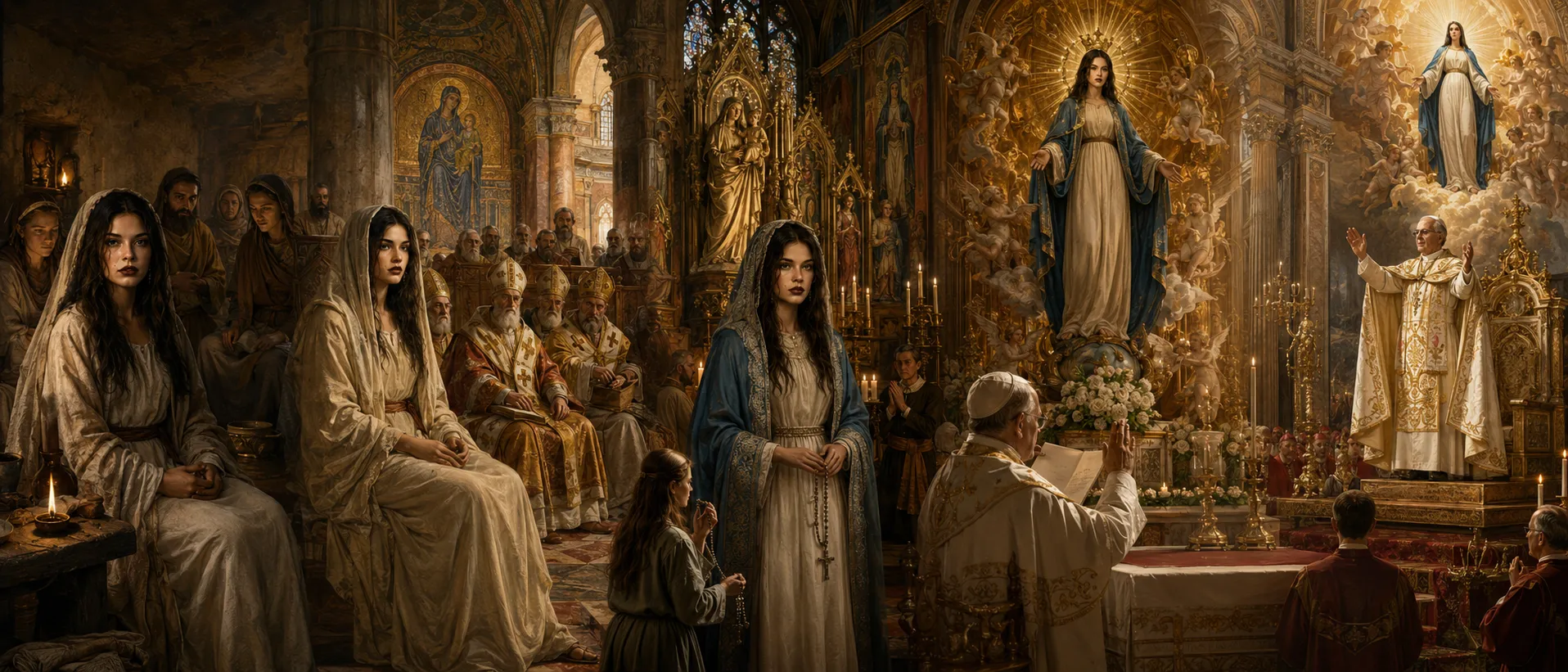
A layman’s guide, with the original Greek included wherever the New Testament is quoted.
1. How the History Formed: From Ordinary Mother to Venerated Figure
Mary is barely described in the earliest Christian writings. The devotion Catholics practice today didn’t arrive all at once. It built up in layers, over centuries, mostly after the New Testament was written.
Stage 1: The New Testament itself (1st century). Mary appears at the Annunciation, the birth of Jesus, briefly at Cana, and at the cross. She is not given a title beyond “mother of Jesus.” No New Testament writer calls her sinless, ever-virgin, co-redeemer, or queen of heaven.
Stage 2: The “Theotokos” controversy (431 AD). The real turning point wasn’t really about Mary. It was a fight about Jesus. A bishop named Nestorius argued Mary should be called “Christ-bearer,” not “God-bearer,” because he wanted to stress that Jesus’s human and divine natures were distinct. The Council of Ephesus rejected this and declared Mary Theotokos, meaning “God-bearer.” The logic: since Jesus is fully God, the woman who bore him can rightly be called Mother of God. This title is the foundation everything later is built on, but notice it’s a conclusion about Christ, applied to Mary, not a claim about Mary’s own exceptional nature.
Stage 3: Medieval expansion (5th–15th centuries). This is where most of the visible tradition comes from: cathedrals dedicated to “Our Lady,” the rosary, feast days, hymns, and art. Popular devotion grew far ahead of any formal doctrine. Ordinary religious practice, not councils, drove most of it.
Stage 4: Formal dogma, very late (1854 and 1950). The two biggest remaining claims, that Mary was conceived without sin (Immaculate Conception) and that her body was taken into heaven at death (Assumption), were only declared official Catholic dogma in 1854 and 1950 respectively. That’s roughly 1,800 and 1,900 years after Mary lived.
The plain takeaway: the veneration of Mary is a cumulative tradition, built mostly through later theological reasoning and popular devotion, not something laid out in the New Testament itself.
2. Why Catholics Pray to Her
This is the part most often misunderstood, so it’s worth being precise about the actual claim:
- Catholics insist they do not worship Mary. Worship (latria) is reserved for God alone.
- Mary receives hyperdulia, a higher honor than other saints get, but officially a different category from worship.
- The reasoning: saints who have died are believed to be alive with God and able to intercede, the same way you might ask a friend to pray for you. Mary, considered the “first and greatest” of the saints, is treated as the most powerful intercessor.
- Prayers like the Hail Mary explicitly ask her to intercede (“pray for us sinners”), not to grant anything herself.
Important for a fair reading: this entire framework, including sainthood, intercession, and degrees of veneration, is a theological structure that developed over time. It is nowhere set out by Jesus in the Gospels. Protestants historically rejected it precisely because they don’t see it demonstrated in the biblical text.
3. “Immaculate”: What the Word Actually Means
This is one of the most commonly confused Catholic terms.
It has nothing to do with Jesus’s conception. It refers to Mary’s own conception, in her mother’s womb. The doctrine claims Mary alone, uniquely among human beings, was conceived without inheriting original sin, a special exemption made in advance so she could carry Jesus.
- The idea existed informally for centuries but was genuinely disputed among theologians. Even Thomas Aquinas had reservations about how to state it.
- It was only made official Catholic dogma by Pope Pius IX in 1854.
- Catholics point to the Lourdes apparitions of 1858, where a young, uneducated visionary named Bernadette reported Mary identifying herself with the phrase “the Immaculate Conception,” a theological term Bernadette would not have known. Catholics treat this as confirmation; it is not, by its nature, something that can be independently verified.
There is no verse in the New Testament that states Mary was sinless or conceived without sin. This doctrine rests entirely on later theological argument, not direct scriptural statement.
4. What Happened After Her Death: The Assumption
Catholic teaching holds that at the end of her earthly life, Mary’s body did not decay in the grave like everyone else awaiting resurrection. Instead, she was taken up, body and soul, directly into heaven.
- This is called the Assumption.
- It was declared official dogma even later than the Immaculate Conception: by Pope Pius XII in 1950.
- There is no New Testament account of Mary’s death at all. The Gospels and Acts simply stop mentioning her after Acts 1:14, where she is present praying with the disciples after the resurrection. What happened to her afterward is not recorded in scripture in any form.
So both of the two biggest formal claims about Mary, her sinless conception and her bodily assumption, are 19th- and 20th-century declarations about events (or a life-stage) the Bible itself never describes.
5. How Jesus Himself Actually Treated Her: The Gospel Evidence
This is where things get more interesting, because Jesus’s own recorded words and actions toward his mother don’t obviously point toward later veneration. In some places they seem to push the other way. Here is the evidence, plainly, in Greek and English.
A. Jesus redefines “family” away from blood ties
Matthew 12:46-50: full passage. Jesus is in the middle of teaching a crowd when word comes that his mother and brothers are outside, waiting to speak with him.
Ἔτι δὲ αὐτοῦ λαλοῦντος τοῖς ὄχλοις ἰδοὺ ἡ μήτηρ καὶ οἱ ἀδελφοὶ αὐτοῦ εἱστήκεισαν ἔξω ζητοῦντες αὐτῷ λαλῆσαι. “While he was still speaking to the crowds, behold, his mother and brothers were standing outside, seeking to speak with him.”
Someone in the crowd, whom the text doesn’t name and calls only “one,” points this out to Jesus:
εἶπεν δέ τις αὐτῷ, Ἰδοὺ ἡ μήτηρ σου καὶ οἱ ἀδελφοί σου ἔξω ἑστήκασιν ζητοῦντές σοι λαλῆσαι. “And someone said to him, ‘Behold, your mother and your brothers are standing outside, seeking to speak with you.’”
This is Jesus’s reply, and it’s important that this is a direct response to being told, plainly, “your mother is right outside, asking for you”:
ὁ δὲ ἀποκριθεὶς εἶπεν τῷ λέγοντι αὐτῷ, Τίς ἐστιν ἡ μήτηρ μου, καὶ τίνες εἰσὶν οἱ ἀδελφοί μου; “But he answered the one telling him, ‘Who is my mother, and who are my brothers?’”
καὶ ἐκτείνας τὴν χεῖρα αὐτοῦ ἐπὶ τοὺς μαθητὰς αὐτοῦ εἶπεν, Ἰδοὺ ἡ μήτηρ μου καὶ οἱ ἀδελφοί μου. “And stretching out his hand toward his disciples, he said, ‘Behold my mother and my brothers.’”
ὅστις γὰρ ἂν ποιήσῃ τὸ θέλημα τοῦ πατρός μου τοῦ ἐν οὐρανοῖς, αὐτός μου ἀδελφὸς καὶ ἀδελφὴ καὶ μήτηρ ἐστίν. “For whoever does the will of my Father in heaven, that one is my brother and sister and mother.”
So the sequence is: his actual mother is standing outside, someone tells him so directly, and Jesus responds not by going out to her, but by asking a rhetorical question that dismisses the premise, gesturing instead at his disciples, and redefining “mother” as a category anyone can enter through obedience. Mary is not brought in front of him in this scene at all.
Luke 11:27-28: a woman in the crowd calls out a blessing on Mary specifically:
Μακαρία ἡ κοιλία ἡ βαστάσασά σε καὶ μαστοὶ οὓς ἐθήλασας. “Blessed is the womb that bore you and the breasts that nursed you.”
Jesus’s reply:
Μενοῦν μακάριοι οἱ ἀκούοντες τὸν λόγον τοῦ θεοῦ καὶ φυλάσσοντες. “Rather (menoun), blessed are those who hear the word of God and keep it.”
The Greek word μενοῦν (“rather,” “on the contrary”) is a correcting word. Jesus doesn’t simply add to the woman’s blessing. He redirects it away from biological motherhood and toward obedience, available to anyone.
B. Jesus never calls her “mother” to her face in John’s Gospel
John 2:4: Wedding at Cana:
Τί ἐμοὶ καὶ σοί, γύναι; οὔπω ἥκει ἡ ὥρα μου. “What to me and to you, woman? My hour has not yet come.”
Τί ἐμοὶ καὶ σοί (“what to me and to you”) is a distancing idiom borrowed from Hebrew/Aramaic speech, used elsewhere in the Gospels by hostile demons addressing Jesus. It signals two parties are not on the same page.
John 19:26-27: at the cross, his final words to her:
Ἰησοῦς οὖν ἰδὼν τὴν μητέρα καὶ τὸν μαθητὴν παρεστῶτα ὃν ἠγάπα, λέγει τῇ μητρί, Γύναι, ἴδε ὁ υἱός σου. “Jesus, then, seeing his mother and the disciple whom he loved standing there, says to his mother, ‘Woman, behold your son.’”
εἶτα λέγει τῷ μαθητῇ, Ἴδε ἡ μήτηρ σου. καὶ ἀπ’ ἐκείνης τῆς ὥρας ἔλαβεν ὁ μαθητὴς αὐτὴν εἰς τὰ ἴδια. “Then he says to the disciple, ‘Behold your mother.’ And from that hour the disciple took her into his own home.”
Notice that John’s narration, in the very same sentence, calls her “his mother” (τὴν μητέρα), so the word mētēr (“mother”) is sitting right there, available, and John himself just used it two words earlier. Jesus then opens his mouth and, instead of that word, says gynai, meaning “woman.” The word was not missing from the scene; it was deliberately not chosen for his own address to her.
In both this passage and John 2:4 at Cana, the word Jesus uses to address his mother directly is γύναι (“woman”), never μήτηρ (“mother”). This is a consistent pattern across both scenes in John’s Gospel where Jesus speaks to her personally.
Why this matters more than it might first appear. Gynai is the same word Jesus uses elsewhere for women he does not know at all or barely knows. Two examples, in the same Greek and English format:
John 4:21: a Samaritan woman Jesus has just met, minutes earlier, at a well:
λέγει αὐτῇ ὁ Ἰησοῦς, Πίστευέ μοι, γύναι, ὅτι ἔρχεται ὥρα ὅτε οὔτε ἐν τῷ ὄρει τούτῳ οὔτε ἐν Ἱεροσολύμοις προσκυνήσετε τῷ πατρί. “Jesus says to her, ‘Believe me, woman, an hour is coming when neither on this mountain nor in Jerusalem will you worship the Father.’”
John 20:15: Mary Magdalene, at the empty tomb, whom Jesus has known for some time as a follower but who is not his mother:
λέγει αὐτῇ Ἰησοῦς, Γύναι, τί κλαίεις; τίνα ζητεῖς; “Jesus says to her, ‘Woman, why are you weeping? Whom are you seeking?’”
Same word, gynai, both times: a stranger at a well and a female disciple who is not family. Put simply, this is the word for “ma’am” or “woman” that you would use for a stranger. If you don’t know a woman, you call her “woman.” If she is your mother, the ordinary and expected thing is to call her “mother.” The word existed, John himself uses it one clause earlier, and Jesus does not. Rather than being a neutral detail, this is arguably a stronger observation than simple silence: Jesus uses, to his own mother’s face, at his own death, the identical form of address he uses for women he has never met before.
C. His own family thought he had lost his mind
Mark 3:21
οἱ παρ’ αὐτοῦ ἐξῆλθον κρατῆσαι αὐτόν· ἔλεγον γὰρ ὅτι ἐξέστη. “His own people went out to restrain him, for they said, ‘He is out of his mind.’”
This is immediately followed (Mark 3:31-35) by his mother and brothers arriving and standing outside asking for him, the same scene as Matthew 12 above.
John 7:5
οὐδὲ γὰρ οἱ ἀδελφοὶ αὐτοῦ ἐπίστευον εἰς αὐτόν. “For not even his brothers were believing in him.”
The verb tense here (imperfect) describes an ongoing state. This was their standing position, not a one-time doubt.
D. At the cross, custody of Mary bypasses her own family
This is the most striking piece of evidence, and it’s easy to miss on a casual reading.
John 19:25, one verse before Jesus speaks to Mary from the cross:
Εἱστήκεισαν δὲ παρὰ τῷ σταυρῷ τοῦ Ἰησοῦ ἡ μήτηρ αὐτοῦ καὶ ἡ ἀδελφὴ τῆς μητρὸς αὐτοῦ… “Standing by the cross of Jesus were his mother, and his mother’s sister…”
Mary’s own sister is named as physically present at the same scene. In both first-century Jewish and Greco-Roman custom, care of a widowed mother would normally fall first to sons, and failing that, to other close kin. A sister was a completely normal candidate. And yet:
ἀπ’ ἐκείνης τῆς ὥρας ἔλαβεν ὁ μαθητὴς αὐτὴν εἰς τὰ ἴδια. “From that hour the disciple took her into his own home.”
Custody goes to an unrelated disciple instead of the sister standing right there. No Gospel explains why. Combined with the brothers’ documented unbelief (John 7:5) and the family’s earlier attempt to restrain Jesus (Mark 3:21), the scene reads less like ordinary family logistics and more like John deliberately constructing a specific relationship between Jesus, Mary, and “the disciple whom he loved” for a purpose internal to his Gospel, not simply reporting who happened to be available.
6. What This Means for the Church’s Later Mandate
Putting the two halves side by side:
| What later Catholic tradition claims | What the Gospel text itself shows | |
|---|---|---|
| Mary’s status | Sinless from conception, taken bodily into heaven, worthy of special veneration and prayer | Never called sinless; her death/afterlife is simply not recorded; Jesus redirects blessing away from her specifically |
| Jesus’s address to her | Reverent, honoring | “Woman,” never “Mother,” at both major recorded encounters |
| Family arrangements | Not typically discussed | Custody at the cross bypasses her own sister with no explanation given |
| Basis for doctrine | Councils, papal declarations, apparitions (431, 1854, 1950) | Nothing in the text states these things; they are absent, not merely undeveloped |
The honest conclusion: the elevated devotional role Mary holds in Catholic practice today is a tradition built over roughly two millennia, resting on theological reasoning, popular piety, and later doctrinal declarations, not on explicit claims made by Jesus or the Gospel writers about Mary’s own exceptional nature. Read on its own, without importing later tradition, the Gospel evidence is neutral at best and, in places like Cana, the cross, and the “who is my mother” scenes, arguably points the opposite direction from where later veneration would go.
This is the actual fault line between Catholic and Protestant views of Mary, not a dispute over what the Greek says (both sides can read the same text), but a dispute over whether doctrine is only valid when scripture states it outright, or whether centuries of Church tradition and reasoning can legitimately add conclusions the text itself never makes. That is a question of religious authority and method, not a question the Greek grammar alone can settle.
Sources for further reading: Council of Ephesus (431 AD) records; the papal bull Ineffabilis Deus (1854); the apostolic constitution Munificentissimus Deus (1950); the Greek New Testament (Nestle-Aland text) for all cited passages above.