Nobody Actually Rebelled: The Myth of the War in Heaven
Preface
Ask most Christians how Satan came to be Satan, and you’ll get a strikingly confident answer: once he was the most beautiful angel in Heaven, pride corrupted him, he led a rebellion, God cast him and a third of the angelic host down to Hell or Earth, and the two of them have been at war ever since. It sounds like scripture. It sounds ancient. It sounds settled.
It isn’t any of those things, at least not in the form people believe it. The “one-third of the angels” detail comes from a single, wildly symbolic verse in the most disputed book of the New Testament. The theological scaffolding around why and how it happened — Lucifer’s psychology, the mechanics of angelic knowledge, the instant of temptation — comes almost entirely from medieval scholastic speculation and, further back, from a book the councils of the Church explicitly threw out of the Bible. And the character of Satan himself, the cosmic rival worthy of a war, didn’t exist in the oldest layers of the Hebrew tradition at all. He was built, gradually, over centuries, because a monotheistic religion needed an answer for suffering and eventually borrowed one.
This isn’t an attack on faith. It’s an argument that the “war in Heaven” is not a fact reported by scripture so much as a myth assembled in stages — apocryphal literature, mistranslated poetry, and a hallucinatory prophetic text — and then retroactively treated as doctrine. Follow the actual paper trail, and the story falls apart at every joint.
1. The Christian Origin Story — and Where It Actually Comes From
The popular version goes roughly like this: at creation, the angels were given instantaneous, total knowledge — of themselves, of each other, of their assigned roles, and of the beatific vision awaiting them if faithful. Confronted with this knowledge, they made an irreversible choice. Lucifer, the most glorious of them, desired a perfection beyond his given nature; a third of the angelic host chose to follow him rather than submit; in an instant, “like lightning,” they fell, and their wills became eternally fixed in rebellion.
This account — down to the “instances” of angelic cognition and the doctrine that angelic choices are made once and irrevocably, unlike human choices — is not biblical. It is Thomistic. It’s Thomas Aquinas’s 13th-century philosophical reconstruction of angelic psychology, built from Aristotelian categories of intellect and will, applied retroactively to a handful of scattered verses. It is elegant scholastic theology. It is not history, and it is not scripture. Even its modern defenders concede as much, pointing to “theological reasoning” and the “collective experience of exorcists” — tradition and inference, not textual evidence — as the basis for details nowhere stated in the Bible.
Where does the actual imagery come from — the fall, the third of the angels, angels lusting after mortal perfection, cosmic armies? Overwhelmingly, from 1 Enoch, a text composed in stages from roughly the 3rd century BC onward. And 1 Enoch is not scripture for the vast majority of Christians and Jews. It was excluded from the Hebrew canon and from the canons adopted by the Catholic and Protestant traditions alike; only the Ethiopian and Eritrean Orthodox churches treat it as fully canonical. For everyone else, it is apocrypha — literature the Church itself judged, after centuries of use, to be unreliable enough to exclude.
And what 1 Enoch actually describes isn’t a war of ideological rebellion at all. It’s a sex-and-violence morality tale about two hundred “Watchers” who conspire on a mountaintop to take human wives, teach forbidden technology and cosmetics to their brides, and produce a race of monstrous, cannibalistic giants who have to be exterminated in a flood. This is the real origin story behind the “fallen angels” — not a battle for the throne of Heaven, but a story about illicit sex and stolen knowledge, closer to Greek myths of Titans and demigods than to any coherent doctrine of cosmic rebellion. The idea that this narrative and the “Lucifer’s pride” narrative are the same event is a later harmonization — one that the texts themselves don’t actually support, since 1 Enoch never mentions Lucifer’s fall at all, and Genesis never mentions a war.
So the “origin story,” taken at face value, is not one story. It’s several unrelated legends — a Babylonian court poem, a lurid apocryphal sex-and-giants narrative, and a feverish apocalyptic vision — stitched together centuries later into something that sounds unified because tradition kept repeating it as if it were.
2. Isaiah, the Old Testament, and the Case of the Misread King
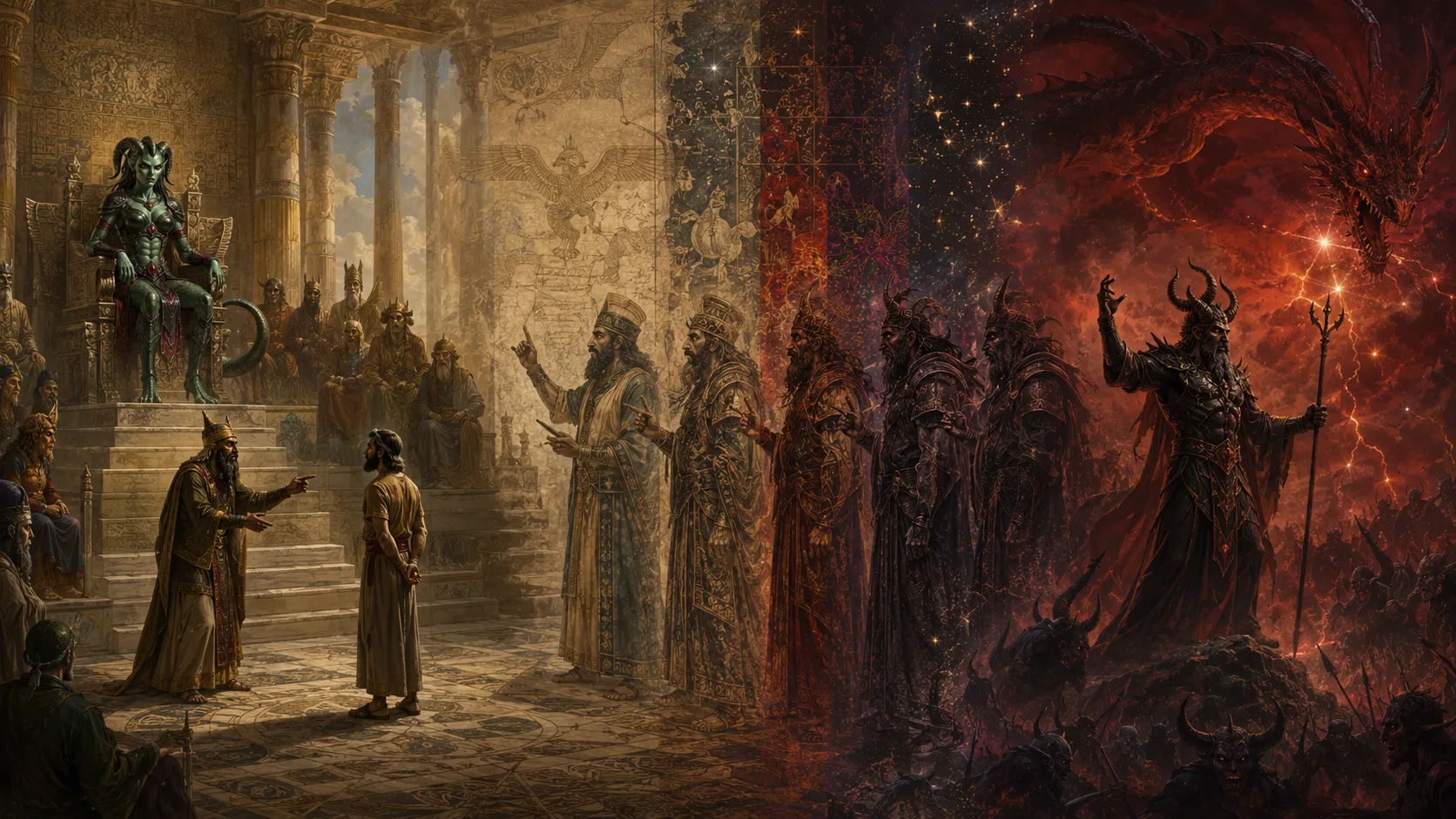
The single verse most people would point to as “proof” that Lucifer fell from Heaven is Isaiah 14:12 — “How you have fallen from heaven, morning star, son of the dawn.” Even mainstream commentary admits what the text is actually doing: the surrounding chapter is a taunt-poem aimed at a Babylonian king, part of a genre of ancient Near Eastern royal mockery. The “fall from heaven” language is stock hyperbole for a tyrant’s humiliation, the same rhetorical move used elsewhere in the Hebrew Bible against arrogant rulers. Nothing in the passage names an angel. Nothing describes Heaven as a place with armies. The word later translated “Lucifer” is simply the Hebrew term for the morning star, Venus — a poetic insult, not a proper name.
It took the Latin Vulgate’s translation choice, centuries of allegorical reading, and later Christian theology to turn a piece of political satire about a Mesopotamian despot into the biography of a supernatural being. That’s not “the Bible tells us Satan fell from Heaven.” That’s later interpreters deciding a verse about a human king was secretly about someone else, then treating that decision as settled fact.
This matters more broadly. The entire architecture of “the war in Heaven” leans on Old Testament fragments read through a Christian theological lens applied centuries after the fact — Ezekiel’s poem about the king of Tyre (again, addressed explicitly to a human ruler, “prince of Tyre,” using the imagery of a jeweled being in Eden as royal flattery-then-condemnation), Job’s “sons of God,” and this Isaiah passage. None of them, read in their own historical and literary context, describe a cosmic rebellion. They become that story only when Christian doctrine, developed generations later, is projected backward onto them. That is not what a religiously neutral reading of ancient Hebrew poetry supports — it’s theology doing archaeology on its own terms and finding exactly what it went looking for.
3. Revelation: The Prophecy That Built the Myth
Strip away Isaiah and 1 Enoch, and the entire “one-third of the angels” detail rests on one text: Revelation 12, a single sentence about a red dragon whose tail sweeps a third of the stars from the sky. That’s it. That is the totality of the scriptural basis for one of Christianity’s most confidently repeated cosmic facts — one verse, in the most bizarre, hallucinatory, symbol-drenched book in the entire canon, a text that also features locusts with human faces, a beast with seven heads, and a woman clothed with the sun.
Revelation was almost certainly not written by the author of the Gospel of John. This isn’t a fringe claim — it’s the dominant position in modern biblical scholarship. The Greek of Revelation is grammatically rough and idiosyncratic in ways that stand out sharply against the polished, theologically distinct Greek of the Fourth Gospel; the theological emphases, vocabulary, and portrait of Jesus differ substantially between the two. Revelation’s Jesus is a warrior-lamb presiding over apocalyptic vengeance; the Gospel’s Jesus is a philosopher of love and abstract divine “light” and “logos.” Treating them as products of one consistent theological mind, let alone one author, is a tradition of convenience, not a finding of textual analysis.
So the load-bearing evidence for the entire “war in Heaven, third of the angels” doctrine is a single verse of highly symbolic imagery, in a book whose own authorship and coherence with the rest of the New Testament are seriously disputed, describing an event most scholars read as a future, end-times prophecy rather than a report of something that already happened at the dawn of creation. Even sympathetic commentators concede that Revelation, “by and large a vision of events to come,” makes it genuinely unclear whether this is describing a past fall or one still to happen — which means the tradition has been reading a forward-looking apocalyptic hallucination as a historical creation-account footnote.
4. Why Christianity Needed Satan to Exist
None of this is really mysterious once you ask a different question: not “did this happen,” but “what job does this story do?”
The oldest layers of the Hebrew Bible don’t have a cosmic adversary of God at all. In the Book of Job — the text most people point to as “Satan’s” debut — “the satan” isn’t a proper name or a fallen rebel; it’s a title, “the accuser” or “the adversary,” a functionary within God’s own divine council who shows up alongside the other “sons of God” to do a job, not to wage war. There’s no rebellion, no fall, no army. He works for the boss.
The shift from God’s prosecutor to God’s cosmic enemy tracks a real historical process, not a theological revelation. During and after the Babylonian exile, Israelite religion came into sustained contact with Persian Zoroastrianism, a genuinely dualistic religion with a good creator god locked in real combat against an independent evil power. Over the next several centuries of Second Temple Judaism, apocalyptic writers — the authors of 1 Enoch chief among them — increasingly needed a way to explain the persistence of evil and suffering in a world ruled by a single, all-good God. A tempting, elegant solution: evil doesn’t originate with God at all, it originates with a rebellious subordinate. The “fallen angel” mythology isn’t an eyewitness report; it’s a theological patch, developed gradually, to relieve monotheism of a problem it otherwise couldn’t easily solve.
By the time of the New Testament, that patch had hardened into assumed background reality — a worthy opponent, an explanation for temptation, sin, and suffering that doesn’t implicate God directly, and, not incidentally, a very useful rhetorical tool for a persecuted early Christian movement that needed to frame Rome, its enemies, and evil in general as instruments of a single, defeatable cosmic villain. A God locked in a real war has a much more satisfying story than a God who simply allows suffering to exist for reasons of his own. The “war in Heaven” is doing narrative work — it’s not a report, it’s a solution.
Summary
Pull the thread and the whole tapestry unravels. The vivid psychological drama of Lucifer’s temptation is scholastic philosophy from the 1200s, not scripture. The imagery of angels falling and giants roaming the earth comes from 1 Enoch, a text the Church itself excluded from the Bible as unreliable. The “proof texts” in Isaiah and Ezekiel are, on their own terms and in their own historical context, taunt-poems about human kings, retrofitted centuries later into angelology. And the one number everyone remembers — a third of the angels — rests on a single sentence of surreal, disputed-authorship apocalyptic poetry that many scholars read as describing the future, not the past.
What’s left, once you strip away the apocrypha, the mistranslation, and the fever-dream prophecy, is not a historical event. It’s a myth built the way most enduring myths are built: in layers, by different hands, for different reasons, over hundreds of years — assembled backward into a “war” because a war makes for a better story than the slow, human, entirely explicable evolution of an idea.