Pascal's Wager vs The Monarc Wager
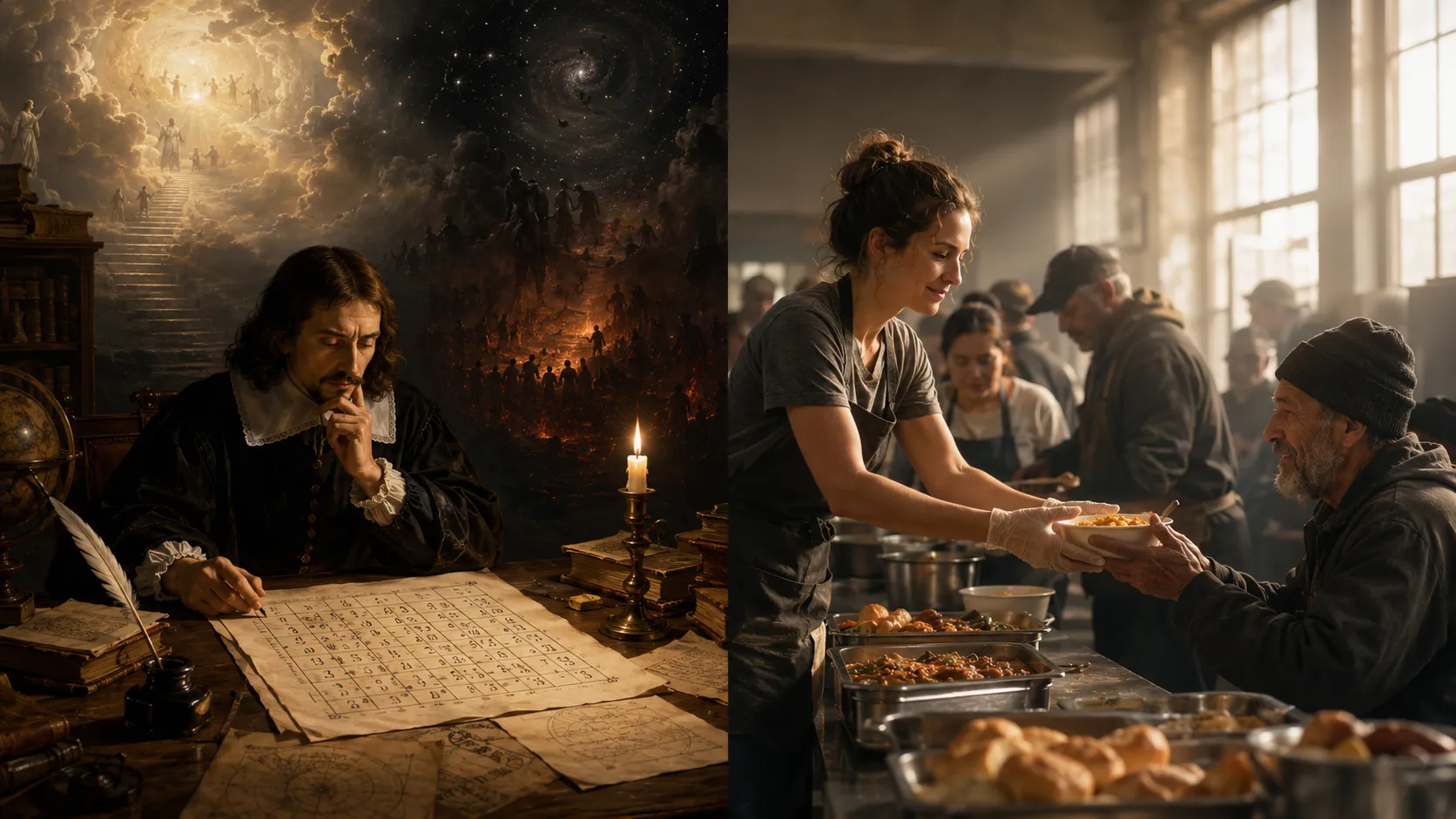
Part I: Pascal’s Wager
What It Is
Blaise Pascal (1623–1662) was a French mathematician, physicist, and philosopher. In his posthumously published Pensées, he offered an argument for belief in God that didn’t rely on proving God’s existence; it relied on decision theory instead. Pascal’s insight was that even if you can’t know whether God exists, you can still reason about what to do given the uncertainty, by looking at the payoffs of each possible choice.
The argument runs as a simple matrix:
| God does not exist | God exists | |
|---|---|---|
| Believe | Small loss (some worldly pleasures forgone) | Infinite gain (eternal life) |
| Don't believe | Small gain (worldly pleasures kept) | Infinite loss (eternal damnation) |
Since the potential downside of disbelief is infinite, and the cost of belief is merely finite, Pascal argued that believing is the only rational choice, even under total uncertainty about whether God is real. This is technically an early example of expected value reasoning under uncertainty, applied to theology rather than economics or gambling.
Why It Matters
Pascal’s Wager matters for a few reasons, historically and philosophically:
- It was one of the first attempts to use formal decision theory to argue for religious belief, rather than relying on scripture, revelation, or classical proofs (like the cosmological or ontological arguments). It reframed faith as a rational bet rather than a matter of evidence.
- It shifted the terms of the debate. Instead of asking “is God real?” it asked “given that you don’t know, what should you do?” That’s a different, and in some ways more modest, question.
- It’s been hugely influential outside theology. Versions of “wager” reasoning show up in modern arguments about existential risk, climate change, and even AI safety (the basic structure, “the downside of being wrong is so catastrophic that even low-probability risk justifies costly precaution,” is a direct descendant of Pascal’s logic).
- It’s also one of the most heavily criticized arguments in the philosophy of religion, which is part of why it still gets taught and argued about centuries later.
The Key Problem With It
Pascal’s Wager runs into two well-known objections worth knowing before looking at an alternative version:
- You can’t just choose to believe something. Belief isn’t usually a switch you can flip on command the way you can choose an action. Pascal’s Wager asks for belief as if it were a decision, but most people can’t sincerely convince themselves of something just because the payoff matrix favors it.
- The “Many Gods” problem. The wager works equally well for any religion promising infinite reward or punishment, and these options often contradict each other. It tells you to “believe in something with infinite stakes,” without telling you what.
(For readers who want to go deeper: this territory connects to the philosophical ideas of expected value, doxastic voluntarism, fideism, and a modern descendant of Pascal’s logic called “Pascal’s Mugging.” Worth a search if you want the full academic picture; it’s a bit much for this page.)
Part II: The Monarc Wager
The Structure
Unlike Pascal’s Wager, this version doesn’t ask you to believe anything. It asks you to act, specifically, to do “the works”: kindness, generosity, honesty, care for people in need, the kind of conduct described in Matthew 25:31-40, regardless of whether any metaphysical claim behind it turns out to be true.
| It's not true | It's true | |
|---|---|---|
| Do the works | The world is better, at some real but finite cost to you | The world is better, and you're rewarded |
| Don't do the works | You keep what the works would have cost you | The world isn't better, and you face the second death: cast out, the light carrying on as someone else |
This is worth being honest about: doing the works isn’t actually free. Generosity, honesty, and care can cost real money, time, comfort, and sometimes safety. Take a concrete case: showing up to volunteer at a soup kitchen at 5am. The person who does it loses sleep, gives up their morning, and puts in real effort. The person who stays in bed loses nothing; they get a few extra hours of comfortable sleep. That’s the actual trade.
So the honest version of the wager isn’t “you lose nothing either way.” It’s this: the finite cost of doing the works is justified because it produces meaningful good even if the metaphysical claim turns out to be false, and if the claim is true, failing to do the works means the second death: being cast out, with the light continuing on as someone else, not as you. The soup kitchen guest gets fed regardless of what’s ultimately true about judgment or an afterlife. That good is real and banked immediately. The person who stayed in bed gained a little comfort, and nothing else, no matter which branch of the matrix turns out to be real.
How It Differs From Pascal’s Wager
1. It wagers on action, not belief. Pascal’s Wager asks you to adopt a belief, something psychologists and philosophers generally agree isn’t a simple, direct choice (this is the doxastic voluntarism problem above). You can’t just decide to be convinced of something the way you decide to act on it. The Monarc Wager sidesteps this entirely: doing good deeds is a behavior, fully within anyone’s control, whether or not they believe the underlying metaphysics.
2. It has a real payoff even in the “false” branch — and a real cost even there too. In Pascal’s Wager, if God doesn’t exist, belief just costs you: forgone pleasures, a life organized around something false. Critics have pushed on this for centuries. In the Monarc Wager, if the metaphysics is false, the action still produces a real, secular good: a better world, better relationships, a life that was well-lived regardless of the cosmic scorecard. The “false” branch isn’t neutral by assumption; it’s positive by observation.
But the reverse is also true, and this is where the Monarc Wager stops being a purely comfortable bet: failing to produce the works isn’t neutral either. Judgment, per Luke 12:4-5, isn’t fear of what people can do to the body, it’s fear of the one “which after he hath killed hath power to cast into hell.” Someone who bears no fruit from the works fails that judgment, and the consequence isn’t a pause or a soft landing; it’s the second death, being cast into the darkness by Jesus himself. What continues after that isn’t the person who failed; the light carries on, but as someone else, in another life, given another attempt at the same test. The self that did not act is the self that ends.
That’s the asymmetry that gives the wager its teeth: doing the works costs something finite now, and either builds a better world with no further downside, or is rewarded. Not doing the works costs nothing now, but risks something total: not torment as yourself forever, but the end of yourself, full stop, with the light continuing on without you.
3. It’s grounded in a specific standard, not a vague “moral order.” This wager isn’t built on the general idea that “some moral order exists and is enforced.” It’s built on a specific standard Jesus himself defines, in his own words, in Matthew 25:35-36:
“For I was hungry and you gave me food to eat, I was thirsty and you gave me water to drink, I was a stranger and you invited me in, I was naked and you clothed me, I was sick and you cared for me, I was in prison and you came and visited me.”
Six concrete acts: feeding the hungry, giving drink to the thirsty, welcoming the stranger, clothing the naked, caring for the sick, and visiting the imprisoned. Notice what that judgment scene does not ask about: it doesn’t ask about church attendance, communion, or how much scripture someone could recite. It only asks: when did you act?
That standard is reinforced by Matthew 7:21-23, where people who preached in Jesus’s name, prophesied, and performed miracles in his name are still told “I never knew you.” Put the two passages together and the pattern is consistent: performance of belief is shown as insufficient, while unclaimed action, from someone who may not have even known who they were acting for, is shown as sufficient. The non-believer who fed, clothed, and visited people isn’t turned away in favor of the preacher who only talked about Jesus. That’s also where this wager differs most from Pascal’s: Pascal’s is a bet on believing the right thing, mine is a bet on doing the right thing, per the standard Jesus himself uses when he judges.
4. The asymmetry is different. Pascal’s Wager treats the stakes as infinite in one direction (eternal damnation vs. eternal life), an all-or-nothing structure. The Monarc Wager treats the stakes as conditional and earned: the reward, or the second death and the light carrying on as someone else, hinges specifically on whether the works were done, not on whether a proposition was affirmed. That ties the consequence directly to the behavior in question, rather than to intellectual assent, which is also why Matthew 7:21-23 (“not everyone who says Lord, Lord…”) and Matthew 25:31-40 (judgment based on deeds, not confession) are the anchor texts for this version rather than a creed or statement of belief.
5. It doesn’t need the theology to be true to be worth doing. Pascal’s argument only makes sense if you take the specific stakes (heaven/hell) seriously as live possibilities. The Monarc Wager holds up as a secular decision-theoretic argument on its own; even someone with zero interest in any afterlife claim can look at the matrix and conclude that doing good, as a policy, dominates not doing it. The theology is the motivation; it isn’t the load-bearing structure.
Why It Matters
The core move is converting a bet about doctrine into a bet about conduct. Pascal needed you to believe something you might not be able to sincerely believe on command. The Monarc Wager only needs you to act, and action is something anyone, regardless of their metaphysical convictions, can actually choose to do.