The Greek Path: A Traceable Chain in John's Gospel

Summary: What This Chain Is
This is an attempt to trace, using only the Greek text and grammar of John’s Gospel, a sequence that Jesus’ own words present: from the initial sending of a message, through hearing and trust, to a completed following, and outward into visible action, ending in “life” (ζωή).
The purpose is not to prove doctrine, but to give anyone reading the Greek a traceable, checkable path: each stage is anchored to specific verses, specific verb forms, and specific grammatical features, not paraphrase or later theological gloss.
The core claim the chain is testing: πιστεύω (“believe/trust”) is not presented as an isolated, one-time mental assertion. It sits inside a chain of verbs: hearing, following, keeping, doing, and abiding. The text’s own grammar (particularly its consistent use of present-tense participles) supports reading it as an ongoing disposition that leads into action, not a single completed event that stands alone.
A second, independent claim now appended in Section 2 below: the criterion of authenticity is not spectacular/supernatural action, but doing what is asked, traced through Matthew 7 and 25. It is kept deliberately separate from this John-based chain since it draws on a different Gospel’s vocabulary.
The chain in order
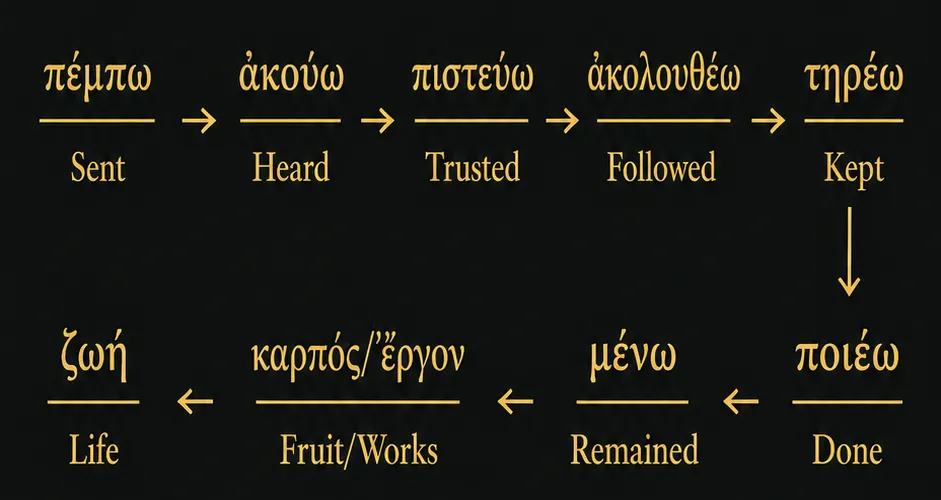
How to read this map
- Solid, tight links = the words appear in the same sentence or same syntactic unit, with a direct grammatical relationship (a participle chain, a conditional clause and its result, etc.).
- Thematic links = the connection is conceptual, built by comparing separate passages that use related vocabulary, not by one continuous sentence. These are marked clearly below so the chain doesn’t overstate its own tightness.
- Every stage below gives: the Greek text, the grammatical form, what that form is doing, and the specific verse(s) it’s drawn from.
Section 1: The John Chain
Stage 1: πέμπω, The Father Sends
Function in the chain: thematic frame, not a lexical link into the next stage.
Jesus repeatedly identifies his authority as derivative: he did not originate the message himself, but was sent:
ὁ πέμψας με πατήρ “the Father who sent me”
This phrase (aorist active participle of πέμπω, in the nominative, functioning substantivally as “the one who sent me”) recurs across John as Jesus’ standing description of the Father’s role. It establishes source and authorization before anything else in the chain happens.
John 12:49 makes the content of the sending explicit:
ὁ πέμψας με πατὴρ αὐτός μοι ἐντολὴν δέδωκεν “The Father who sent me; he himself has given me a command (ἐντολή).”
δέδωκεν is a perfect active indicative of δίδωμι (“to give”). The perfect tense signals a completed act with continuing effect: the command has been given and stands given. Jesus does not originate content; he transmits what was given.
Why this is marked thematic, not lexical: πέμπω and ἐντολή (John 12:49) are not grammatically linked to ἀκούω (John 5:24); they occur in separate passages and separate contexts. The connection between “the Father sends” and “the person hears” is thematic synthesis across the Gospel, not one continuous sentence. This is a legitimate way to build a map, but it should be visually distinct (a dotted line, not a solid arrow) from the tighter links that follow.
Stage 2: ἀκούω, The Person Hears
John 5:24:
ὁ τὸν λόγον μου ἀκούων καὶ πιστεύων τῷ πέμψαντί με ἔχει ζωὴν αἰώνιον “The one hearing my word and trusting the one who sent me has eternal life.”
Grammar: ὁ … ἀκούων is a present active participle, articular (with the definite article ὁ), functioning as a substantive: “the one who hears” or “the hearing one.” The present tense here is not merely “hears once” but describes a characteristic, ongoing action. This is who the person is, not just something that happened to them one time.
τὸν λόγον μου (“my word”) is the direct object, in the accusative case, representing the thing heard. λόγος here means the spoken message or teaching, not yet “keeping” it (that’s τηρέω, stage 5); hearing is reception, not yet retention or obedience.
This is a tight, solid link: ἀκούων and πιστεύων (next stage) are joined in the same sentence, under the same article (ὁ), describing the same subject, with the same result (ἔχει ζωὴν αἰώνιον). This is as textually secure as the chain gets.
Stage 3: πιστεύω, Trusts the Sender
Same sentence, John 5:24, continued:
καὶ πιστεύων τῷ πέμψαντί με “and trusting the one who sent me”
Grammar: πιστεύων is again a present active participle, coordinated with ἀκούων by καί. The two participles are grammatically parallel, with the same subject and the same tense.
Two things this participle does NOT do, and one thing it does:
-
It does not take a direct object like “Jesus” or “that Jesus is divine.” The object is τῷ πέμψαντί με, in the dative case, meaning “to/toward the one who sent me.” πιστεύω with the dative means entrusting reliance to someone, placing confidence in their reliability. This is directed at the Father, mediated through the sender-relationship, not a standalone claim about Jesus’ nature.
-
It does not, by grammar alone, prove “continual trust as a lifestyle” in some absolute sense. A substantival present participle can simply mean “the one who believes,” describing a class of person without heavy theological weight on the tense.
-
What it does do: the present tense (imperfective aspect) consistently chosen here and throughout John’s related sayings presents the action as characteristic of the person, as opposed to an aorist participle (ὁ πιστεύσας, “the one who believed,” viewing the act as a completed point), which John had available and doesn’t use here. On its own, this grammatical fact is modest: a substantival present participle can simply mean “the one who believes,” describing a class of person, without settling how durative that belief must be.
The stronger case for reading πιστεύω as a continuing posture, rather than a single assertion, doesn’t rest on this participle alone; it is confirmed independently at stage 7. John 15:4–6 makes continuation in Jesus a stated requirement (ἐὰν μὴ μένητε ἐν ἐμοί, “unless you abide in me”) with real consequences for failing to continue (the branch that does not abide is removed and withers, 15:6). That passage doesn’t use πιστεύω, but it establishes that Johannine theology already treats the disciple’s relationship to Jesus as something that must be maintained, not just entered once. Read alongside that requirement, πιστεύω describes a continuing posture of trust. The case is made by two independent verses working together, not by over-reading one participle’s tense.
Result of stages 2–3 combined:
ἔχει ζωὴν αἰώνιον … μεταβέβηκεν ἐκ τοῦ θανάτου εἰς τὴν ζωήν “has eternal life … has passed from death into life”
ἔχει is present active indicative (“has,” ongoing possession, not “will get”). μεταβέβηκεν is perfect active indicative of μεταβαίνω (“to cross over/pass over”). It indicates completed action with a continuing state: the crossing has happened and the person now stands on the other side of it.
What πιστεύω is not lexically carrying: the sense of “adopting someone as a pattern to imitate.” The dative/εἰς-plus-accusative construction of πιστεύω consistently means reliance or entrustment, not imitation. That distinct sense belongs to the next verb.
Stage 4: ἀκολουθέω, Follows
Lexical meaning, stated plainly: ἀκολουθέω means “to follow,” referring to physical or behavioral movement after a person. That is the complete semantic content of the word. It does not itself mean “imitate,” “adopt as a pattern,” or “standard-bearer.” Those are not part of the word’s definition, and an earlier draft of this document overstated what the verb lexically carries.
Interpretive extension (marked here as interpretation, not definition): if one wants to draw an implication out of the act of following a person, rather than following a rule or a path, it’s reasonable to note that following someone’s physical or behavioral direction tends to mean ending up where they go, by the route they took. That is an inference beyond the word itself, not something ἀκολουθέω asserts. It belongs in a separate category from the lexical claims above it.
ἀκολουθέω appears across the Gospels describing a decisive, often costly reorientation of one’s path: leaving nets, leaving the dead to bury the dead, and following behind a leader physically and behaviorally. These narrative contexts show the verb used for real, costly action, but the cost and decisiveness come from the narrative context, not from the word’s dictionary meaning.
The key confirming text, John 10:26–28:
ἀλλὰ ὑμεῖς οὐ πιστεύετε, ὅτι οὐκ ἐστὲ ἐκ τῶν προβάτων τῶν ἐμῶν. τὰ πρόβατα τὰ ἐμὰ τῆς φωνῆς μου ἀκούουσιν, κἀγὼ γινώσκω αὐτά, καὶ ἀκολουθοῦσίν μοι, κἀγὼ δίδωμι αὐτοῖς ζωὴν αἰώνιον “But you do not believe (πιστεύετε), because you are not of my sheep. My sheep hear (ἀκούουσιν) my voice, and I know them, and they follow (ἀκολουθοῦσίν) me, and I give them eternal life.”
Grammar and structure, checked directly against the Greek text:
- ὅτι οὐκ ἐστὲ ἐκ τῶν προβάτων τῶν ἐμῶν (“because you are not of my sheep”) gives the reason for οὐ πιστεύετε, not the reverse. The causality runs: not-belonging → unbelief, not unbelief → not-belonging. Not being one of the sheep is presented as what explains the failure to believe; belief is not shown here as the thing that produces or determines sheep-status. This is a correction to an earlier draft of this document, which had the causal arrow backwards.
- The sheep are then positively described by three coordinated present-tense verbs: ἀκούουσιν (hear), καὶ ἀκολουθοῦσίν μοι (and follow me), and receiving ζωὴν αἰώνιον. Note that πιστεύω is not repeated in v.27. It is implied by “being of his sheep,” but the verb actually predicated of the sheep’s behavior is ἀκολουθέω.
On whether πιστεύω and ἀκολουθέω overlap or divide labor: they divide labor, but not as a diagnostic-vs-descriptive pair as previously framed. πιστεύω’s absence is explained by not belonging to the sheep; it functions as a symptom of not belonging, not a gate that determines it. ἀκολουθέω is the separate, active verb that describes what belonging concretely looks like, paired with ἀκούω. They are not redundant or synonymous. This is a real distinction the text itself draws, in the same pericope, about the same subject, but the direction of causation between belonging and believing should not be overstated in either direction.
A second confirming text, John 10:4–5:
τὰ πρόβατα αὐτῷ ἀκολουθεῖ, ὅτι οἴδασιν τὴν φωνὴν αὐτοῦ· ἀλλοτρίῳ δὲ οὐ μὴ ἀκολουθήσουσιν “the sheep follow (ἀκολουθεῖ) him, because they know (οἴδασιν) his voice; but they will not follow a stranger”
Here ἀκολουθέω is grounded in οἶδα (“to know,” here in the sense of recognizing or being familiar with) rather than πιστεύω at all. This is a third related verb, worth noting but not central to this chain. The pattern across all three texts is that ἀκούω and ἀκολουθέω consistently pair as “hearing the voice” and “following the one whose voice it is.” πιστεύω sits adjacent to this pairing as the trust that makes the following possible, but is not the verb that describes the following itself.
Stage 5: τηρέω, Keeps the Word
John 14:23, a direct conditional, not a synthesis across passages:
ἐάν τις ἀγαπᾷ με, τὸν λόγον μου τηρήσει, καὶ ὁ πατήρ μου ἀγαπήσει αὐτόν, καὶ πρὸς αὐτὸν ἐλευσόμεθα καὶ μονὴν παρ᾽ αὐτῷ ποιησόμεθα “If anyone loves me, he will keep my word, and my Father will love him, and we will come to him and make a dwelling with him.”
Grammar:
- ἐάν … ἀγαπᾷ is a third-class conditional (ἐάν + present subjunctive), a general, open condition: “if/whenever anyone loves…” It describes a real possibility, not a hypothetical unlikely to occur.
- τηρήσει is future active indicative of τηρέω (“to keep, guard, watch over, observe”). The keeping is presented as the natural consequence that follows from love, not a separate, additional requirement bolted on.
- τὸν λόγον μου (“my word”) is the same object as in stage 2 (ἀκούω, τὸν λόγον μου). This is deliberate: the word that was heard is now the word that is kept. Hearing is reception; keeping is retention or fidelity to what was received.
- ἐλευσόμεθα (future middle, “we will come”) and ποιησόμεθα (future middle, “we will make”) are both first-person plural, referring to the Father and Jesus together. The result of keeping the word is not abstract approval but a stated indwelling: μονή, “a dwelling place,” from the same root as μένω (stage 7 below). The noun form of “abiding” appears here, planting that word early.
This is a tight, direct textual link: love → keep the word → indwelling, all in one conditional sentence with a clear apodosis (the “then” clause).
Stage 6: ποιέω, Does the Will and the Works
The single strongest recurring lexical bridge in the whole chain: the same verb, ποιέω (“to do, make”), appears across multiple distinct Johannine contexts describing action:
John 7:17 directly pairs θέλημα and ποιέω within John itself. This is needed since Matthew’s Matt 7:21, the usual anchor for θέλημα, is excluded here:
ἐάν τις θέλῃ τὸ θέλημα αὐτοῦ ποιεῖν “If anyone wants to do his will”
Grammar: θέλῃ is present subjunctive of θέλω (“to want, wish, be willing”), inside an ἐάν clause (general condition, the same construction seen in John 14:23). τὸ θέλημα αὐτοῦ ποιεῖν (“to do his will”) is an infinitive phrase serving as the object of θέλῃ. The willing and the doing are grammatically bound together in a single clause, not two separate acts. Worth noting: the verse continues with a result, γνώσεται περὶ τῆς διδαχῆς (“he will know concerning the teaching”). Obedience produces understanding, a minor but interesting epistemological hook not otherwise central to this chain.
John 14:12:
ὁ πιστεύων εἰς ἐμὲ τὰ ἔργα ἃ ἐγὼ ποιῶ κἀκεῖνος ποιήσει “The one trusting in me: the works that I do (ποιῶ), that person also will do (ποιήσει).”
Grammar: ποιῶ is present active indicative, first person (“I do/am doing”); ποιήσει is future active indicative, third person (“he will do”). The same verb, same root, shifts from Jesus’ present action to the believer’s future action, grammatically encoding a transfer or continuation of the same kind of doing from Jesus to the one who trusts.
Note also: πιστεύων εἰς ἐμέ here uses εἰς + accusative (“trusting into me”) rather than the dative construction seen in John 5:24 (τῷ πέμψαντί με). Both are legitimate ways John expresses trust, sometimes directed at Jesus and sometimes explicitly at the Father who sent him. This is worth flagging as a variation within the same lexical field rather than treating “trust in Jesus” and “trust in the Father who sent him” as if they were expressed identically everywhere.
Result: ἔργον (“work, deed”) is the noun object of ποιέω throughout, referring to the concrete, nameable acts that result from trust.
Stage 7: μένω, Abides
John 15, and this stage’s position in the chain was corrected during this discussion: μένω precedes fruit-bearing; it does not follow it.
μείνατε ἐν ἐμοί, κἀγὼ ἐν ὑμῖν. καθὼς τὸ κλῆμα οὐ δύναται καρπὸν φέρειν ἀφ᾽ ἑαυτοῦ ἐὰν μὴ μένῃ ἐν τῇ ἀμπέλῳ, οὕτως οὐδὲ ὑμεῖς ἐὰν μὴ ἐν ἐμοὶ μένητε “Abide (μείνατε) in me, and I in you. Just as the branch cannot bear fruit (καρπὸν φέρειν) from itself unless it abides (μένῃ) in the vine, neither can you unless you abide (μένητε) in me.”
Grammar:
- μείνατε is aorist active imperative, a direct command, “abide!” The aorist imperative used for entry into a state one is then to remain in is a recognized pattern, but the form alone doesn’t prove this reading with certainty; the present tense of the subordinate clauses that follow (μένῃ, μένητε) is what actually indicates continuation, not the initial aorist imperative by itself.
- μένῃ and μένητε (twice) are present subjunctive, inside ἐὰν μή (“unless”) clauses. Again, the present tense signals a continuous, maintained condition, not a momentary one.
- καρπὸν φέρειν (“to bear fruit”) is dependent grammatically on the abiding. The infinitive φέρειν is what the branch cannot do ἀφ᾽ ἑαυτοῦ (“from itself”) unless (ἐὰν μή) it is already abiding. The condition (abiding) precedes and enables the result (fruit); the sentence structure itself makes fruit downstream of abiding, not the reverse.
John 15:5 confirms the direction explicitly:
ὁ μένων ἐν ἐμοὶ κἀγὼ ἐν αὐτῷ, οὗτος φέρει καρπὸν πολύν “The one abiding (μένων, present participle) in me, and I in him, this one bears (φέρει, present indicative) much fruit.”
Again present participle → present indicative result: abiding is the standing condition; fruit-bearing is its consistent, ongoing output.
Stage 8: καρπός / ἔργον, Fruit and Works (Related, Not Identical)
Two distinct words describe the outward result, and they should not be collapsed into one term in the map, even though they function similarly:
- ἔργον (“work, deed”) is used in John 14:12, describing nameable, doable acts tied to ποιέω.
- καρπός (“fruit”) is used only in John 15, tied to μένω and φέρω (“to bear/carry”), describing organic output rather than deliberate manufacture.
The honest textual position: John 14’s works-language and John 15’s fruit-language are conceptually parallel but never merged into a single vocabulary anywhere in the text. The vine passage never calls fruit ἔργα, and John 14 never calls the works καρπός. This seam should stay visible in any diagram of the chain; it is a conceptual synthesis across two passages, not one continuous lexical formula.
Stage 9: ζωή, Has Life
John 5:24 (closing the loop back to stage 2–3):
ἔχει ζωὴν αἰώνιον, καὶ εἰς κρίσιν οὐκ ἔρχεται, ἀλλὰ μεταβέβηκεν ἐκ τοῦ θανάτου εἰς τὴν ζωήν “has eternal life, and does not come into judgment, but has passed from death into life”
Grammar recap: ἔχει is a present active indicative representing a current, ongoing possession, not a future promise only. μεταβέβηκεν is a perfect active indicative representing a completed crossing with a continuing resultant state. The tense choices at both ends of the chain, the present participles opening it at stages 2–3 and the perfect indicative closing it here, frame the whole sequence as something that is both already accomplished and presently, continuously lived out, not purely future and not a single isolated past event.
John 10:28 (parallel, from the sheep passage):
κἀγὼ δίδωμι αὐτοῖς ζωὴν αἰώνιον “and I give them eternal life”
δίδωμι here is present active indicative. The present tense presents the action from within its unfolding or characteristic frame, consistent with, but not proof of, continuous ongoing giving. The wider context, including the sheep’s continual hearing and following in the same verse, is what supports reading it that way, not the tense form alone.
Built-In Textual Controls
These are cross-checks the chain should keep visible, to guard against oversimplifying:
- πέμπω → ἀκούω is thematic, not lexical. Mark this arrow differently from the tight, same-sentence links.
- πιστεύω and ἀκολουθέω divide labor, they don’t overlap. Confirmed directly in John 10:26–27, with the causality running as the Greek states it: unbelief is presented as a symptom of not belonging to the sheep, not the reverse; following (ἀκολουθέω) describes what the sheep actively do. Keep them as separate, sequential stages.
- ἔργον and καρπός are conceptually parallel, lexically distinct. Don’t merge them into one word in any diagram; the seam between John 14’s works-language and John 15’s fruit-language is real and should stay visible.
- μένω precedes καρπός, not the reverse, confirmed directly against John 15:4–5’s grammar (the ἐὰν μή clause makes abiding the condition for the possibility of fruit-bearing, not its result).
- Present tense throughout the chain (ἀκούων, πιστεύων, μένῃ, μένων, φέρει) is doing real grammatical work, favoring an ongoing or characteristic reading over a single completed act, without over-claiming that grammar alone settles every theological question about the nature of that ongoingness.
Section 2: The Matthean Control, Supernatural Display vs. ποιέω τὸ θέλημα
This section is deliberately kept separate from the John chain above, not merged into it. The John chain (Section 1) is built entirely from same-Gospel cross-references and its own internal vocabulary network, including ἀκολουθέω, μένω, καρπός, and so on, none of which appear in Matthew 7 or 25. Forcing these Matthean texts into the same numbered stages as John would repeat the exact error already caught and corrected earlier in this document: treating a thematic connection as if it were a lexical one. Matthew is better read as an independent witness that arrives at the same underlying distinction: doing (ποιέω) is not the same as displaying power. It does so from a different textual angle entirely. Two unrelated vocabulary systems converging on the same point is stronger evidence than one continuous chain, provided the seam between them stays visible.
Matthew 7:21–23: the false positive
ὁ ποιῶν τὸ θέλημα τοῦ πατρός μου “The one doing the will of my Father”
This is stated as the actual criterion, first, before the false claimants speak. Then the rejected group’s résumé:
προεφητεύσαμεν… καὶ τῷ σῷ ὀνόματι δαιμόνια ἐξεβάλομεν… καὶ τῷ σῷ ὀνόματι δυνάμεις πολλὰς ἐποιήσαμεν “We prophesied… and in your name cast out demons… and in your name did many mighty works”
The key lexical hook: ἐποιήσαμεν (“we did/performed,” aorist active indicative of ποιέω) is the same verb used in the stated criterion, ὁ ποιῶν. Matthew is not making a loose thematic contrast; he is deliberately reusing the identical verb for both the true criterion (doing the will) and the false claim (doing miracles), forcing the reader to notice that ποιέω alone doesn’t settle the question. The object of the verb is what matters, τὸ θέλημα versus δυνάμεις πολλάς, not the act of “doing” itself. This is a tighter, same-word contrast than most of the thematic links in the John chain above.
The rejection itself:
οὐδέποτε ἔγνων ὑμᾶς “I never knew you”
ἔγνων is aorist active indicative of γινώσκω, representing relational knowledge, not cognitive awareness of their existence. This echoes, thematically (not lexically, since the vocabulary doesn’t overlap), John 10’s sheep who know and are known by their shepherd (κἀγὼ γινώσκω αὐτά, John 10:27). It is a thematic parallel worth noting, but it should not be treated as a textual link between the two Gospels.
Matthew 25:31–40: the content of “the will”
ἐπείνασα καὶ ἐδώκατέ μοι φαγεῖν, ἐδίψησα καὶ ἐποτίσατέ με, ξένος ἤμην καὶ συνηγάγετέ με, γυμνὸς καὶ περιεβάλετέ με, ἠσθένησα καὶ ἐπεσκέψασθέ με, ἐν φυλακῇ ἤμην καὶ ἤλθατε πρός με “I was hungry and you gave me food, I was thirsty and you gave me drink, I was a stranger and you welcomed me, naked and you clothed me, sick and you visited me, in prison and you came to me”
This is the concrete content that Matthew 7:21’s ὁ ποιῶν τὸ θέλημα was pointing toward but did not itself specify. Three chapters later, the same verb closes the loop:
ἐφ᾽ ὅσον ἐποιήσατε ἑνὶ τούτων τῶν ἀδελφῶν μου τῶν ἐλαχίστων, ἐμοὶ ἐποιήσατε “Insofar as you did it to one of the least of these my brothers, you did it to me”
ἐποιήσατε (again, aorist active indicative of ποιέω) appears twice in this single sentence. The same verb that marked both the true criterion and the false claim in chapter 7 now supplies its own content: not prophecy, not exorcism, not δυνάμεις, but hunger fed, thirst given drink, the stranger welcomed, the naked clothed, and the sick and imprisoned visited.
Why this is a tighter case than parts of the John chain
The contrast here is lexically airtight in a way several of the John chain’s individual joints are not: the same verb, ποιέω, marks the false criterion (7:22, δυνάμεις πολλὰς ἐποιήσαμεν), the true criterion (7:21, ὁ ποιῶν τὸ θέλημα), and the concrete content of that true criterion (25:40, ἐμοὶ ἐποιήσατε), all across a single Gospel’s connected discourse. This is worth stating plainly as a stronger internal case than the thematic links flagged elsewhere in this document (Section 1, Stage 1’s πέμπω→ἀκούω joint, for instance).
Required caveat: keep the seam visible
ποιέω in Matthew (this section) and ποιέω in John (Section 1, Stage 6) are the same Greek word but are not part of the same textual chain. They occur in different Gospels, with no direct literary link between the two passages. Noting this keeps the document’s own standard consistent: the same care taken to keep ἔργον and καρπός distinct within John (Section 1, Stage 8) applies here to keep Matthew’s ποιέω and John’s ποιέω from being treated as one continuous argument rather than two independent Gospels making a convergent point.