Three Arguments About Biblical Authority: A Summary
I. Preface
Discussions about the nature and authority of the Bible often circle back to three recurring questions: what the text itself claims about its own origin and authority, whether it is internally consistent, and whether it can be read as speaking with a single, unified voice. This document lays out three related but distinct arguments that push back on the common assumption that the Bible is straightforwardly the literal, inspired, inerrant, and univocal word of God. Each argument builds on the last, moving from a claim about biblical vocabulary, to a claim about doctrine and internal consistency, to a claim about how the text is actually used and interpreted by different readers and traditions. Below is a summary of each.
II. “Word of God” Doesn’t Mean “The Bible as Text”
The first argument is a claim about biblical vocabulary. According to this analysis, the phrase “word of God” or “God’s word” is never used within the Bible itself to refer to the physical, textual form of scripture. Instead, the phrase is used in one of two ways:
- To refer to Jesus (as in John 1)
- To refer to a message God communicates, independent of any particular medium — most often understood as spoken, oral communication
The claim is that later passages sometimes describe a message that was eventually transmitted in writing, but the phrase is never applied to the act of textual transmission itself. From this, the argument concludes that equating “the word of God” with “the Bible in our hands” is a theological leap not directly supported by how the phrase is actually used in the text.
This leads into a broader claim: because the Bible is a text, and texts do not interpret themselves, something or someone outside the text — a reader, a community, a tradition — must always supply the interpretation. On this view, the Bible can never function as a true “final authority” in practice, because it cannot speak or adjudicate meaning on its own; only people can do that.
III. Claims of Inspiration, Inerrancy, and Univocality Are Presuppositions, Not Conclusions
The second argument addresses three common doctrinal claims about the Bible: that it is inspired (divinely breathed), inerrant (without error), and univocal (speaking with one consistent voice). The argument here is that none of these three positions can be reached through a neutral, critical examination of the biblical text and its history. Instead, they are described as dogmas — starting assumptions a person adopts first, and only afterward tries to justify with supporting arguments.
The specific example given involves the Greek word theopneustos in 2 Timothy 3:16, usually translated “God-breathed” or “inspired.” The argument claims that based on how the word was used at the time the text was written, it more likely meant something like “life-giving” rather than “inspired” in the modern doctrinal sense — and that the “inspired” reading only became standard later, attributed to the third-century theologian Origen.
Not inerrant. Beyond the specific vocabulary question, the claim of inerrancy runs into the problem that the Bible contains numerous internal contradictions, whether within the same testament or across both:
Old Testament vs. Old Testament
- How many of each animal did Noah take on the ark? Genesis 6:19–20 says two of every kind. Genesis 7:2–3 says seven pairs of every “clean” animal and two of every “unclean” animal.
- Who incited David to take a census of Israel? 2 Samuel 24:1 says the Lord did it. 1 Chronicles 21:1 says Satan did it.
- How did God create humans? Genesis 1:27 has man and woman created together, after the animals. Genesis 2:7, 18–22 has man created first, alone, before the animals, with woman formed afterward from his rib.
New Testament vs. New Testament
- What were Jesus’s last words on the cross? Matthew 27:46 and Mark 15:34 have him cry out “My God, my God, why have you forsaken me?” Luke 23:46 instead has “Father, into your hands I commit my spirit.” John 19:30 has simply “It is finished.”
- Who was at Jesus’s tomb, and how many? Matthew 28:1 mentions two women. Mark 16:1 mentions three. Luke 24:10 mentions at least five. John 20:1 mentions only one, Mary Magdalene.
- How did Judas die? Matthew 27:5 says he hanged himself. Acts 1:18 says he fell headlong and his body burst open — a different manner of death, in a different location, for a different stated reason.
Old Testament vs. New Testament
- Genealogy of Jesus through Joseph. Matthew 1:1–16 and Luke 3:23–38 both trace Jesus back through David, but list substantially different ancestors between David and Joseph, and differ on David’s son in that line (Solomon vs. Nathan).
- Is the Law of Moses still binding? Passages like Leviticus 3:17 and Exodus 20 present the Mosaic law as permanently binding. Passages like Mark 7:19 and Galatians 3:23–25 present it as fulfilled or no longer binding.
- Is salvation individual or corporate? The Old Testament’s Deuteronomistic framework ties the nation’s fate to collective obedience (Deuteronomy 28), while texts like Ephesians 2:8–9 frame salvation as an individual gift through grace and faith.
These are presented as the same kind of problem as the inspiration claim: internal disunity that inerrancy, as a doctrine, has to explain away rather than derive from the text.
Not inspired. This is where the inerrancy and inspiration arguments converge. If the Bible were truly transmitted by a single divine mind through the Holy Spirit, it would be expected to speak with one consistent voice — the same God saying the same things, without contradiction, throughout. The contradictions above are treated as evidence against this: they are not superficial slips but disagreements over core facts and even core theology (the nature of salvation, of the law, of Jesus’s final words). Because this degree of internal disagreement exists and has never been resolved on the text’s own terms, the argument concludes there is no single unifying thread running through the Bible — and therefore no factual basis for treating it as the product of one unified divine authorship. The broader methodological point stands alongside this: any argument built to defend inspiration, inerrancy, or univocality will, at some stage, require accepting an unproven assumption rather than following where the evidence leads.
IV. The Bible Is “Multivocal,” So Every Reading Involves Negotiation
The third argument builds on the second: because the Bible is multivocal — a collection of different, sometimes conflicting voices and perspectives rather than one unified viewpoint — anyone who wants to use it to support a single, consistent teaching has to actively “negotiate” with the text. This means:
- Selecting passages that agree with a position already held, and treating those as authoritative
- Reinterpreting or subordinating passages that disagree
- In some cases, importing an entirely external framework (developed outside the Bible) to override passages that don’t fit
The primary illustration used is the historical shift on slavery. The argument holds that no biblical passage plausibly condemns the practice of buying, selling, and owning people outright — yet most contemporary readers now assume the Bible opposes slavery. That shift, on this view, didn’t come from the text itself changing, but from a hermeneutical framework built up gradually (largely through 19th-century debates) and then imposed on the text.
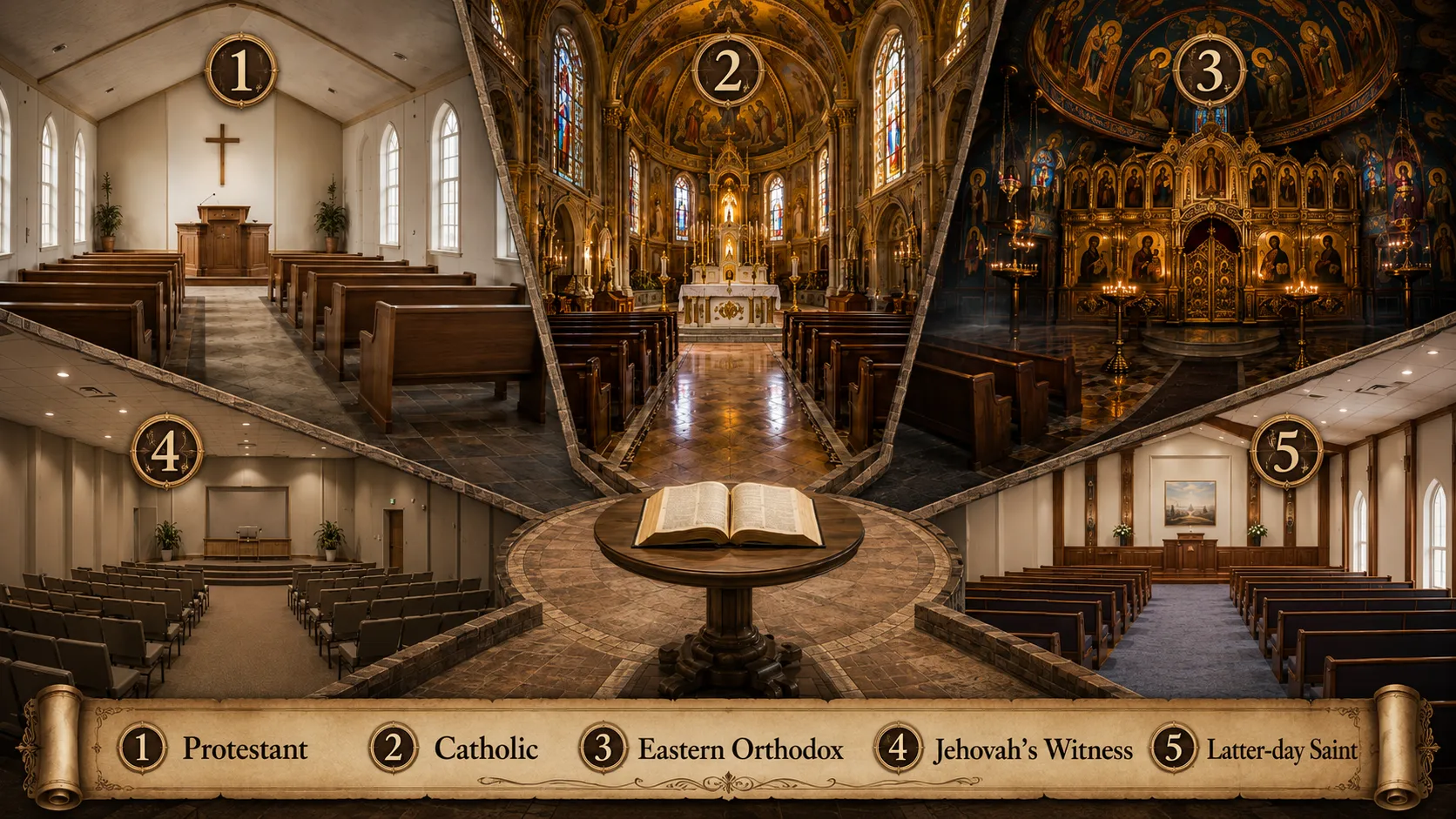
Denominational disagreement as evidence of multivocality. A further illustration of this same dynamic is the sheer range of theological systems that different Christian traditions — all reading the same Bible — have negotiated their way to. If the text spoke with one voice, these traditions would be expected to converge; instead they diverge sharply on how salvation itself works:
- Jehovah’s Witnesses: Faith in Jehovah and Jesus, combined with works and organizational loyalty. Jesus is understood as a created being rather than God himself. In their end-times theology, God intervenes to proclaim judgment, 144,000 chosen ones ascend to rule in heaven, the remaining righteous live eternally on a paradise Earth, and the unrighteous are annihilated rather than tormented eternally.
- Protestants: Salvation by grace through faith alone (sola fide), following especially the theology of Paul’s epistles. Good works are treated as evidence of genuine faith, not as a means of earning salvation.
- Catholics: Salvation through both grace and works, where faith must be “formed by charity.” Works of love and obedience, along with participation in the sacraments, are considered necessary alongside faith.
- Eastern Orthodox: Salvation as theosis — a gradual union with God achieved through synergy between human effort and divine grace, mediated through the Church, sacraments, and ascetic spiritual practice, rather than a single legal transaction.
- Latter-day Saints (LDS/Mormons): A framework often described as “fringe” by mainstream Christians, involving continuing revelation beyond the Bible, a distinct view of God’s nature (including an embodied, exalted Father), and a plan of salvation with multiple degrees of post-mortem glory rather than a simple heaven/hell binary.
| Tradition | How Salvation Works | God’s Nature | Final Judgment/Afterlife | Role of Works | Key Scriptures/Authority |
|---|---|---|---|---|---|
| Jehovah’s Witnesses | Faith in Jehovah and Jesus + works + organizational loyalty | Jehovah is God; Jesus is a created being, not God | 144,000 go to heaven to rule with Christ; remaining righteous live eternally on a paradise Earth; unrighteous are annihilated | Essential — must demonstrate faith through works and obedience to the organization | Bible (New World Translation); Watchtower publications |
| Protestant (Mainstream) | Grace through faith alone (sola fide) | Trinitarian; Jesus fully God and fully human | Believers go to heaven; unbelievers go to hell | Evidence of genuine faith, not a means of earning salvation | Bible alone (sola scriptura); Pauline epistles emphasized |
| Catholic | Grace through faith AND works | Trinitarian; emphasis on mercy and justice | Heaven (possibly via purgatory), or hell, judged on faith and deeds | Necessary; faith must be “formed by charity” | Bible + Sacred Tradition + Magisterium; sacraments essential |
| Eastern Orthodox | Theosis — union with God through synergy of grace and human effort | Trinitarian, with emphasis on divine mystery | Judgment experienced as joy or torment depending on one’s spiritual state | Central — ascetic practice, prayer, sacraments as participation in Christ | Bible + Holy Tradition + Church Fathers |
| LDS (Mormon) | Grace plus ordinances/works, including temple ordinances | Embodied, exalted Father; distinct view of the Godhead | Multiple degrees of post-mortem glory, not a single heaven/hell | Necessary alongside grace; ordinances required | Bible + Book of Mormon + additional continuing revelation |
The existence of these divergent, internally coherent theological systems — each claiming biblical grounding — is treated the same way as the slavery example: as evidence that the text itself does not settle these questions, and that readers and traditions, not the Bible alone, are doing the settling. The conclusion drawn is that most widely-held beliefs about what the Bible teaches are the product of ongoing renegotiation with the text, rather than a straightforward reading of it.
V. The Common Thread
All three arguments converge on a single underlying claim: texts don’t speak for themselves. Whether it’s the meaning of “word of God,” the doctrines of inspiration and inerrancy, or the practical process of deriving ethical teaching from scripture, the recurring conclusion is that interpretation always requires a human interpreter, community, or tradition standing between the text and its meaning — and that acknowledging this is a matter of historical and linguistic analysis, not merely a rhetorical strategy to undermine biblical authority.