Take Up Your Cross: Sacrifice, Curse, and the Meaning of Following Jesus in First-Century Judea
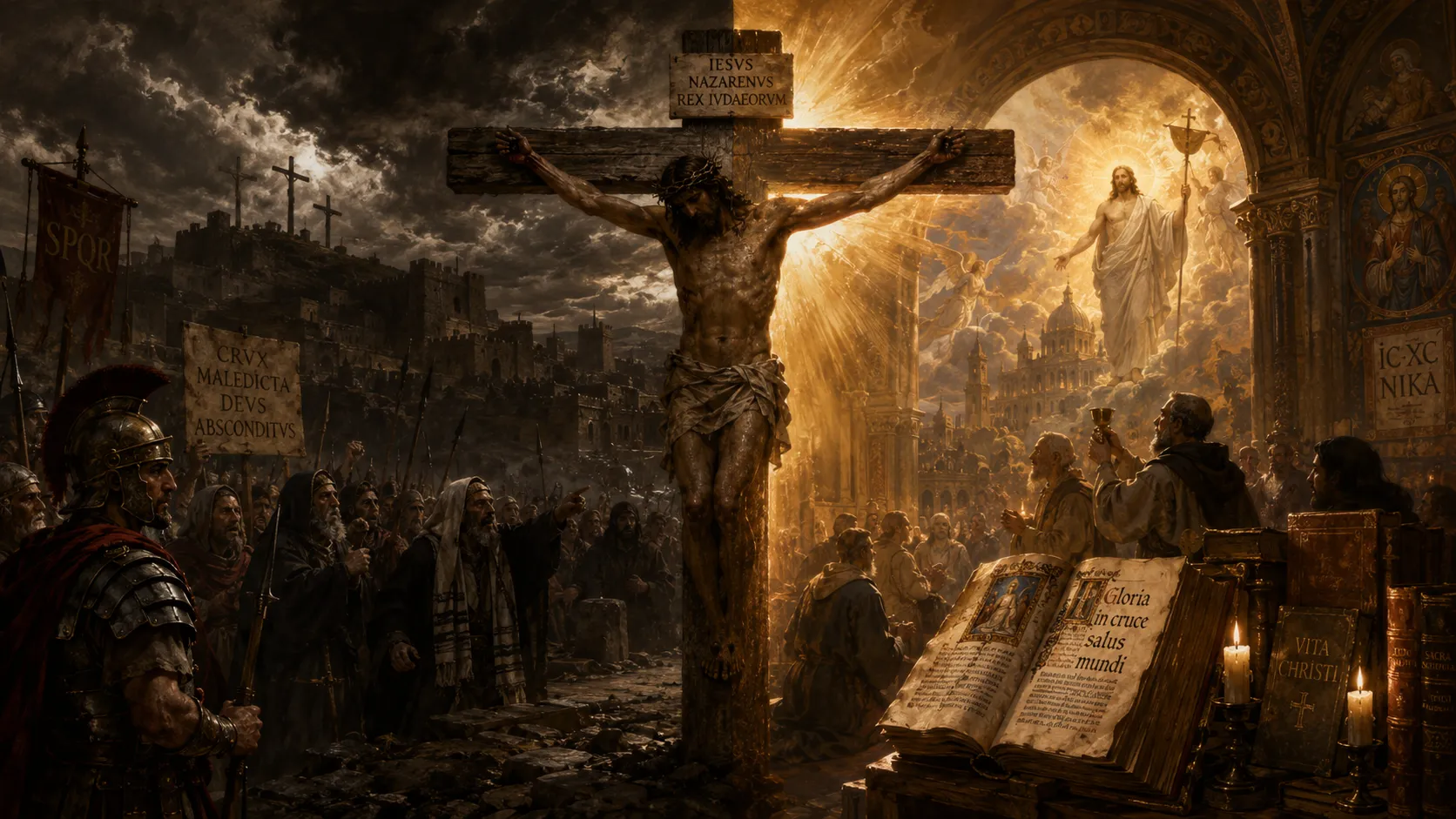
I. The Christian Position: Sacrifice, and How It Became Doctrine
How the reading started
The New Testament itself lays the groundwork for the “cross as sacrifice” reading almost immediately. Paul, writing within a couple of decades of the crucifixion, is the pivotal figure. In Galatians 3:13, he directly confronts the Deuteronomic curse language — “Christ redeemed us from the curse of the law by becoming a curse for us, for it is written, ‘Cursed is everyone who is hanged on a tree’” — and inverts it. The curse is not erased; it is absorbed and transformed into an act of vicarious atonement. In Philippians 2:8, Paul frames Christ’s death as voluntary self-emptying obedience — “he humbled himself by becoming obedient to the point of death, even death on a cross.” This is the seed of everything that follows: shame becomes glory, curse becomes gift, execution becomes offering.
The Church Fathers formalize it
- Ignatius of Antioch (early 2nd century), writing on his way to his own martyrdom, treats suffering and death as imitation of Christ’s sacrifice — a privilege, not a curse.
- Justin Martyr (2nd century) develops typology connecting the cross to Old Testament sacrificial imagery (the bronze serpent, the Passover lamb), reading the crucifixion backward through a sacrificial lens.
- Origen and later Athanasius (On the Incarnation, 4th century) build substitutionary and cosmic-victory theologies around the cross as necessary, redemptive self-giving.
- Augustine cements the cross within a broader doctrine of sin and satisfaction, feeding into what Anselm of Canterbury would later systematize in Cur Deus Homo (1098) as satisfaction atonement theory — Christ’s death pays a debt owed to God’s honor.
- The Reformers (Luther, Calvin) sharpen this into penal substitutionary atonement: Christ bears the punishment humans deserved. Suffering-as-payment becomes the dominant Protestant frame.
- Devotional and mystical traditions — the Imitation of Christ (Thomas à Kempis, 15th century), Ignatian spirituality, and later evangelical piety — popularize “carrying your cross” as a call to personal, willing self-denial: enduring hardship nobly, in union with Christ’s own sacrifice.
How it became dominant
By the time this reaches modern popular Christian discourse (Jordan Peterson’s framing among them), “carrying your cross” has been thoroughly detached from its original legal and political context. Two thousand years of Pauline theology, patristic typology, medieval atonement doctrine, and devotional literature have smoothed a brutal Roman execution method and a specific Torah-curse into a universal moral metaphor: shoulder your burden voluntarily, suffer nobly, and this is virtuous sacrifice. It becomes portable, detachable from Judea, detachable even from Christianity itself — which is exactly how Peterson can apply it to anyone, Christian or not, who “voluntarily shoulders a burden.”
II. The Jewish Position: Curse, Not Sacrifice
Matthew’s texts
Matthew 10:38 (Greek, NA28):
καὶ ὃς οὐ λαμβάνει τὸν σταυρὸν αὐτοῦ καὶ ἀκολουθεῖ ὀπίσω μου, οὐκ ἔστιν μου ἄξιος.
English (ESV):
“And whoever does not take his cross and follow me is not worthy of me.”
Matthew 16:24 (Greek, NA28):
εἴ τις θέλει ὀπίσω μου ἐλθεῖν, ἀπαρνησάσθω ἑαυτὸν καὶ ἀράτω τὸν σταυρὸν αὐτοῦ καὶ ἀκολουθείτω μοι.
English (ESV):
“If anyone would come after me, let him deny himself and take up his cross and follow me.”
Key word: σταυρός (stauros) — not a metaphorical burden. To a first-century audience under Roman occupation, this word denoted one specific thing: the stake or crossbeam of state execution, reserved for slaves, rebels, and insurrectionists. It carried no connotation of noble endurance. It signaled public, state-sanctioned, maximally shaming death, and — critically for a Judean audience — it triggered Torah’s own legal category for the executed and displayed body.
Deuteronomy’s text
Deuteronomy 21:22-23 (Hebrew, WLC):
וְכִי־יִהְיֶה בְאִישׁ חֵטְא מִשְׁפַּט־מָוֶת וְהוּמָת וְתָלִיתָ אֹתוֹ עַל־עֵץ׃ לֹא־תָלִין נִבְלָתוֹ עַל־הָעֵץ כִּי־קָבוֹר תִּקְבְּרֶנּוּ בַּיּוֹם הַהוּא כִּי־קִלְלַת אֱלֹהִים תָּלוּי וְלֹא תְטַמֵּא אֶת־אַדְמָתְךָ אֲשֶׁר יְהוָה אֱלֹהֶיךָ נֹתֵן לְךָ נַחֲלָה׃
English (ESV):
“And if a man has committed a crime punishable by death and he is put to death, and you hang him on a tree, his body shall not remain all night on the tree, but you shall bury him the same day, for a hanged man is cursed by God. You shall not defile your land that the LORD your God is giving you for an inheritance.”
Key words:
- תָּלוּי (talui) — “hanged/impaled one.” The same root that later becomes rabbinic shorthand for the crucified — talui is used in later Jewish sources to refer to Jesus himself (“that hanged one”).
- קִלְלַת אֱלֹהִים (qilelat Elohim) — “curse of God.” Not a general disgrace; a specific declaration that the displayed corpse marks divine rejection. This is the operative legal-theological category for anyone hung up publicly after execution.
Immediately preceding this passage, Deuteronomy 21:18-21 deals with the ben sorer u’moreh — the stubborn and rebellious son who will not obey the voice of his father or mother, who is brought before the elders at the gate and stoned to death by the men of the town. The juxtaposition is not accidental in the Torah’s own structure: rebellion against parental/communal authority leads to execution and public display, and public display of an executed body equals divine curse.
Putting Matthew and Deuteronomy together
A first-century Judean audience hearing “take up your stauros and follow me” would not hear a call to noble endurance. They would hear, in immediate legal and cultural shorthand: become the rebellious son; be cast out by the elders; be executed and displayed as one cursed by God. The word stauros and the concept talui / qilelat Elohim point to the same social and theological reality from two directions — Roman political execution and Torah legal curse converging on the same act.
III. What It Meant in First-Century Judea
Putting the two threads together — the Roman mechanics of crucifixion and the Deuteronomic curse on the hanged body — the historical picture that emerges is this:
Jesus was in open conflict with the Temple authorities and elders over adherence to and interpretation of Torah; he was, in their eyes, functionally the “stubborn and rebellious son” who would not submit to the received authority. Stoning was the traditional Torah penalty for such defiance, but the religious charge alone wouldn’t move Rome. The Temple leadership needed Rome’s method — public, prolonged, maximally shaming crucifixion — both because it carried the political weight to break a large following, and because a private or quieter death (as with John the Baptist’s beheading) would not have delivered the same public message.
When Jesus told his followers “take up your cross and follow me,” he was not issuing a timeless platitude about willingly enduring hardship. He was telling them, in terms his audience could not have missed: the authorities will name you a rebellious, Torah-defying son, and they will try to make an example of you as publicly and shamefully as they intend to make an example of me. The cross, in that moment, was not a symbol of sacrifice. It was a warning — the sign of the curse in Deuteronomy 21:23 and the sign of Rome’s political terror, converging on one word.
The “sacrifice” reading is real, and it is what the Church built — through Paul’s inversion in Galatians, through the Fathers, through a thousand years of atonement theology — but it is a later theological transformation of an original meaning that was, in its first-century Judean context, the opposite: not glory, but curse; not noble suffering, but public rejection.