Jesus at War With Yahweh: The Six-Point Campaign Against the Temple Hierarchy
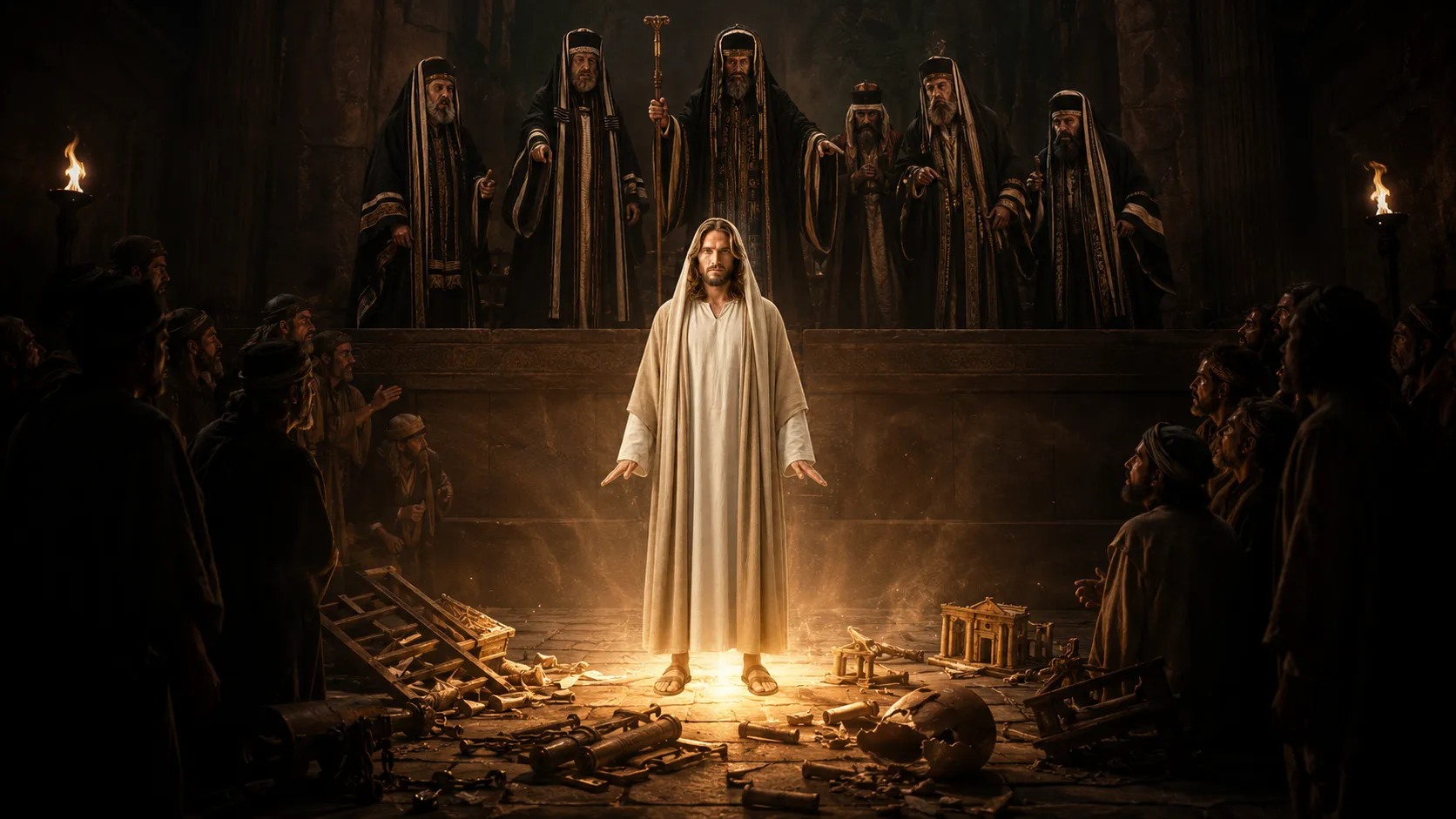
Framing the Issue
This article sets out to demonstrate, using evidence drawn from the Gospels themselves, that Jesus was at war with Yahweh. Not in conflict with corrupt priests who had misused a good system, not campaigning for reform of the Temple’s practices — at war with the god the Temple served and the architecture of distance that god’s system was built to enforce. Six actions, traceable across Mark, Matthew, Luke, John, and Thomas, will be shown to attack six different points of that architecture — the prayer address, the ranked hierarchy of access, the teaching tradition, the human formation demanded of the covenant people, the sacrificial economy, and the physical Temple itself — and each one systematically debases what the Pharisees called God in favor of a different figure entirely, one Jesus calls Abba: not enthroned at a distance atop a graded system, but already at home within.
The Gospels are traditionally read as saying one thing: Yahweh is the Father of Jesus. This article sets out to disprove that. Jesus has his own Father — a different figure entirely from Yahweh — and the six actions below are the evidence for it.
On this reading, the conflict that gets Jesus killed is not a reform movement against corrupt administrators. It is a systematic dismantling, conducted on six fronts, of every mechanism by which the first figure maintained distance between itself and the people below it (katō, “down here” / “below”). Each front does the same thing to a different part of the system: it collapses hierarchy into immediacy.
1 — The Prayer Architecture: Abba
The Architecture of Distance
By the first century, the name of Yahweh had been surrounded by layers of protection so elaborate that the entire Jewish world had organized itself around maintaining the correct distance from it. The Tetragrammaton — יהוה (YHWH), built from the Hebrew root “to be” — was pronounced only once a year, by one person (the High Priest), in one place (the Holy of Holies), on one day (Yom Kippur). To attempt it by its letters otherwise was said to forfeit any portion in the world to come (Mishnah Sanhedrin 10:1).
אֲדֹנָי (Adonai, “My Lord”) replaced YHWH in speech. הַשֵּׁם (HaShem, “The Name”) replaced Adonai in casual conversation, so that even the substitute would not become too familiar. The Talmud (Shevuot 35a) lists seven sacred names of God — YHWH, Adonai, El, Elohim, El Shaddai, Tzeva’ot, Ehyeh-Asher-Ehyeh — each hedged by prohibition. The Talmud also records a third-century debate between the sages Rav and Shmuel over whether the second-person pronoun “you” belonged in a blessing addressed to God at all; Shmuel argued that including “you” placed a mortal in too intimate a relationship with the Creator. A civilization’s worth of legal and liturgical effort went into keeping God at a formally maintained distance — culminating in the standard address, “Lord Our God, King of the Universe”: hierarchical, sovereign-acknowledging, distance-preserving.
Ἀββά (Abba) — an Aramaic word of direct family address, the term a child uses for a parent still living in the house. Not a title. Not one of the seven protected names. No liturgical formula, no priestly certification, no substitute standing between the speaker and the one addressed.
Mark 14:36 — Ἀββᾶ ὁ πατήρ, πάντα δυνατά σοι — “Abba, Father, all things are possible for you” — spoken by Jesus alone, in Gethsemane, in the hour he calls the arrival of “the power of darkness” (Luke 22:53). Not a public polemic. A private prayer, in the worst hour, addressed in the most intimate register Aramaic had available.
The deeper rupture is not that he used the word himself but that he taught it as the address for everyone who follows him. Luke 11:2 — “when you pray, say: Father.” Matthew 6:9 — Πάτερ ἡμῶν ὁ ἐν τοῖς οὐρανοῖς — “Our Father who is in the heavens” — the prayer he gives them opens with the same direct filial address, no substitute name, no priestly relay required to say it. He is not claiming a private access unique to himself; he is instructing others to bypass the same architecture he bypassed — no Temple apparatus, no priestly mediation, no liturgical structure.
This is the John 14:23 argument stated as a prayer practice: the True Father makes his home within those who keep Jesus’s word — not visits, not descends to, but makes his home within. Thomas 3 makes the same claim outside the canonical frame: the kingdom is within every person, already present, not arriving from elsewhere. If the Father is already at home within a person — a state, not a destination reached through ritual — then Abba is simply what you say to someone who is already there.
Why the Temple Establishment Reacted
The reaction was not an overreaction; it was the correct inference from the evidence. On the narrowest technical reading of the blasphemy statute (Leviticus 24:10–23; Mishnah Sanhedrin 7:5), which required pronunciation of the Tetragrammaton itself in a curse, Abba alone did not meet the threshold. But the charge was understood, on the evidence available, to run from word to implication: an address like this, from an Israelite, in that register, was read as a claim to direct divine sonship — not devotion, but standing — bypassing the covenant structure through which the Temple mediated all access to Yahweh, and then teaching others to claim the same standing for themselves.
That is the institutional threat in concrete form. The Temple’s authority rested on being the necessary mediator: it set the terms of approach, the words required, the preparations needed, and who could stand in for whom. All of that is bypassed the moment someone says Abba directly — without priest, without purity code, without liturgy, without the building standing in between. The issue was never informality. It was that the distance architecture itself — built, maintained, and administered as the source of institutional authority — was being treated as unnecessary. Not reformed. Not improved. Unnecessary.
2 — Whoever Is Greatest: No Hierarchy at All
If Abba dissolves the distance in prayer, the next move dissolves the distance in rank — because a hierarchy of address (who may pray which name, using what formula) is inseparable from a hierarchy of persons (who may stand where, in what order of dignity, before God).
Matthew 18:1 — τίς ἄρα μείζων ἐστὶν ἐν τῇ βασιλείᾳ τῶν οὐρανῶν; — “Who then is greatest in the kingdom of heaven?”
The question itself is only possible from within Yahweh’s framework. It presupposes that the kingdom of the True Father is organized the same way as the system the disciples were formed by — graded, ranked, with a “greatest” position to compete for. The leaven is still working in them (see Point 3, below), and it produces exactly this: the competition for position, the ranking of spiritual achievement, the assumption that proximity to God is a ladder with rungs.
To see why the answer is so radical, the ladder has to be laid out in full. It is not a social custom; it is a theological structure, built into the covenant itself and enforced, in the tradition, by death:
The hierarchy of access
from YHWH to the profane
YAHWEH
- utterly above, unapproachable, dwelling in thick darkness
- no human may see his face and live
DIVINE COUNCIL / ANGELS
- the heavenly court, messengers and executors of Yahweh's will
- the sons of God assigned to the nations (Deuteronomy 32:8)
ISRAEL — above all the nations
- Yahweh's chosen people, covenant recipients
- all other nations assigned to lesser divine beings
HIGH PRIEST — above all in Israel
- the one person who enters the Holy of Holies once a year
- mediator between Yahweh and the entire people
PRIESTS — above all laypeople
- hereditary caste, sons of Aaron
- the only ones permitted to offer sacrifice
LEVITES — above ordinary Israelites
- Temple servants, custodians of sacred objects
- set apart from the general population
MEN — above women
- full covenant standing, counted in census, bearers of commandments
- women's obligations significantly fewer and derivative
RITUALLY CLEAN ISRAELITES — above the impure
- those who have observed purity codes
- permitted to enter the Temple courts
THE RITUALLY IMPURE — excluded from worship
- lepers, those with bodily discharge, those who touched the dead
- required to dwell outside the camp
GENTILES / THE PROFANE
- outside the covenant entirely
- no standing before Yahweh
Every level here is theological, not merely social — commanded, not merely customary. The priest who approaches the altar is not simply a functionary; his lineage and purity permit a proximity to Yahweh’s presence that is lethal to anyone else. Leviticus 10:1–2 — Nadab and Abihu offer unauthorized fire before Yahweh, and fire comes out and consumes them. The distance between the levels is not negotiable; the hierarchy is enforced with death.
Against this whole structure, Jesus’s answer places a παιδίον (paidion, “child”) — not a slave, not a servant, not the lowest rung of an existing ladder, but someone the ladder has not yet been built under — in the center of the room. A servant would still be inside the hierarchy, just at its foot; had Jesus meant “take the lowest position,” he would have pointed to a slave. He pointed to a child instead: someone the ranking system has not yet touched, not yet trained in the 613 commandments, not yet formed by the framework that makes the disciples’ question feel natural. This is Luke 10:21’s νήπιοι (nēpioi, “infants”) given a body in the narrative — the True Father hides himself from the wise and intelligent and reveals himself to nēpioi, and here one stands in the middle of the room as the answer.
The answer to “who is greatest,” then, is not “the least among you” as a new bottom rung of the same ladder. It is a refusal of the category. Matthew 18:4 makes the refusal explicit: ὅστις οὖν ταπεινώσει ἑαυτὸν ὡς τὸ παιδίον τοῦτο, οὗτός ἐστιν ὁ μείζων ἐν τῇ βασιλείᾳ τῶν οὐρανῶν — “Whoever humbles himself like this child is the greatest in the kingdom of heaven.” Read against the ladder above, this is not naming a new occupant for the top rung; it is collapsing the question that assumed a ladder existed at all. There is no greatest, because there is no ladder — the child is outside it, not underneath it.
3 — The Teaching: His Own Gospel
Mark 1:22 records that he taught ὡς ἐξουσίαν ἔχων — “as one having authority” — and explicitly not as the scribes, who taught by citation of prior authorities (Hillel, Shammai, Moses). The crowd at Capernaum is described as astonished — not at a novel interpretation of the Law, but at the absence of the citation-chain interpretation normally requires. Six times in Matthew 5 the formula runs Ἐγὼ δὲ λέγω ὑμῖν — “But I say to you” — each time setting his own word against the received tradition rather than interpreting it. At his interrogation (John 18:19) the High Priest questions him about “his teaching” as though its content were foreign to the system supposedly already governing it.
The possessive running through John and Thomas marks the same claim from another angle: his own word, his own commandments, his own Father — not the Law’s word, not Yahweh’s commandments relayed through him, but a source held to be categorically distinct from the one the Temple administered. The teaching does not claim to unpack Yahweh’s Torah more faithfully; it claims a source of its own.
4 — The Formation: Dissolve or Remain Blind
The system does not just teach; it forms people — builds the vessel that holds a particular loyalty. οἶνον νέον εἰς ἀσκοὺς παλαιούς — “new wine into old wineskins” — describes an incompatibility, not a repair job: the old container ruptures under the new content. ζύμη (zymē, “leaven”) of the Pharisees is the image for a formation that, once it has worked all the way through the dough, cannot be partially removed; it fills the vessel and closes off the True Father’s reality.
Being “born again” is not addition to the old vessel but a new vessel entirely. John 12:24 — the grain of wheat falling into the earth and dying before it bears fruit — makes the same point as a life-cycle: the old form does not get improved into the new one, it ends, and something else grows from the place it ended. The demand to “hate your life in this world” (John 12:25) targets the katō-formed identity — the Torah-shaped self, covenant standing included — as the very thing that must be surrendered, not refined. And the broad road that leads to destruction (Matthew 7:13) is named, on this reading, as the road of the existing formation — the well-trodden, well-populated path the system itself lays out — set against the narrow way that requires the old vessel to be abandoned rather than walked further down.
5 — The Economy: Breaking the Money Cycle
Luke 2:24 — καὶ τοῦ δοῦναι θυσίαν κατὰ τὸ εἰρημένον ἐν τῷ νόμῳ κυρίου, ζεῦγος τρυγόνων ἢ δύο νοσσοὺς περιστερῶν — “and to offer a sacrifice according to what is said in the law of the Lord: a pair of turtledoves or two young pigeons.” The law makes provision for the poor, but it still makes purification a Temple transaction: even the household that cannot afford a lamb must purchase and present birds. The system’s financial reach is therefore built into its impurity laws themselves; impurity creates the demand, and the Temple-controlled offering supplies the paid resolution.
Mark 1:44 — καὶ λέγει αὐτῷ· ὅρα μηδενὶ μηδὲν εἴπῃς, ἀλλὰ ὕπαγε σεαυτὸν δεῖξον τῷ ἱερεῖ καὶ προσένεγκε περὶ τοῦ καθαρισμοῦ σου ἃ προσέταξεν Μωϋσῆς, εἰς μαρτύριον αὐτοῖς — “and he says to him: See that you tell no one; but go, show yourself to the priest and offer concerning your cleansing what Moses commanded, as a testimony to them.” Jesus heals the man, but the Temple system still claims the power to certify him clean. The healed person must pass through priestly inspection and bring the required offering before impurity is officially resolved. That is the economic mechanism: the condition may be removed freely, but the institution charges for recognition and restoration.
Mark 11:15–18: the overturning of the tables of the κολλυβιστῶν (“money-changers”) and the seats of those selling περιστεράς (“doves,” the animal prescribed for the poor’s purification offering). No currency exchange means no Temple-shekel offerings; no doves means no purification sacrifice completed. This is staged at the busiest time of the year, and the chief priests’ response is immediate: they begin looking for a way to kill him (Mark 11:18). The act is not moral censure of dishonest vendors. It is a demonstration, at the mechanism’s most vulnerable moment, that the entire sacrificial economy is unnecessary — that what it claims to provide can be had without it.
6 — The Physical Structure: He Is the Replacement
John 2:19 — λύσατε τὸν ναὸν τοῦτον, καὶ ἐν τρισὶν ἡμέραις ἐγερῶ αὐτόν — “Destroy this temple, and in three days I will raise it up.” Mark 14:58 repeats the claim in the accusation brought against him at trial: he will destroy the χειροποίητον (“made-with-hands”) temple and build another ἀχειροποίητον (“not made with hands”). The claim recurs across the trial and mockery scenes — Matthew 26:61, Matthew 27:40, and, outside the canonical frame, Thomas 71: “I will destroy this house, and no one will be able to build it again.” The repetition across independent scenes is itself evidence of how central the charge was taken to be.
The contrast between the two temples is exact: one is a building maintained by human construction and priestly administration; the other is not built by hands at all. Matthew 6:5–6 relocates the practice of prayer itself away from the visible, public architecture — “go into your room and shut the door” — rather than praying, Pharisee-style, where it can be seen; the Temple-within-the-person argument stated as an instruction for a private, no-audience, no-building act. Luke 17:21 locates the kingdom ἐντὸς ὑμῶν — “within you” — and at the moment of death, Mark 15:38 records the Temple veil (the barrier separating the Holy of Holies from everyone but the High Priest, once a year) torn in two. The barrier does not get a new keeper. It is removed. He does not attack the Temple to purify it; he positions himself, and the indwelling reality he named Abba, as what replaces it — not with another building, but with the divine presence already within every person, accessible directly, requiring no architecture of distance.
What Ties the Six Together
Every one of the six moves does the identical thing to a different mechanism of distance: it takes a system that ran on graded access — sacred names instead of the name, cited authority instead of a direct word, an old vessel instead of a new one, mediated sacrifice instead of a repealed need for it, a building instead of an indwelling, a rank instead of no rank — and collapses it into immediacy. None of the six is a call to reform the mechanism. Each removes it.
The War Named
Abba is the word that ties all six levels together. In Gethsemane, in the hour that belongs to the power of darkness (Luke 22:53), surrounded by the evidence that the Temple system is about to execute him under the Deuteronomy 21 statute governing a rebellious son, he says Abba. Not Yahweh’s name. Not the liturgical address the Temple system prescribed. Not the carefully protected formula that maintained the correct distance. The word a child uses for their father. Present. Near. Home.
On this reading, he was not a reformer seeking a better Temple. Not a prophet seeking a more merciful Torah. Not a rabbi seeking a more accessible Yahweh. He was operating on six fronts simultaneously against every mechanism the Temple system used to maintain its grip on the people katō — the prayer architecture, the ranked hierarchy, the teaching tradition, the human formation, the Temple economy, and the physical structure itself. The campaign was total; the intention was replacement; and in every instance the system responded the only way a system built to enforce distance with death could respond. You do not execute a man for wanting to reform an institution. You execute someone who is at war with the institution’s god.